Omnisend AI


 OFFER
OFFER










This Klaviyo vs. GetResponse comparison can help you determine which tool is better for growing, engaging, and retaining your audience in 2026. While both platforms are established players, they’re built with different users in mind.
Klaviyo suits ecommerce brands that need deep store integrations and behavioral automation. Meanwhile, GetResponse offers a broader toolkit for small businesses, creators, and service providers.
In this comparison article, we won’t just cover surface-level features. You’ll also see where each platform excels, where it falls short, and which one actually delivers better results depending on your goals.
If you’re running an online store versus a general business, the best choice won’t be the same. And if you’re an ecommerce brand that’s looking to scale faster, we’ll introduce an even stronger third option.
Choosing the right tool depends on whether you’re a general business or an online retailer. If you’re running an ecommerce brand that’s ready to scale, we’ll introduce a third option. Its advanced features can help you grow even faster.
Quick sign up | No credit card required
Klaviyo vs. GetResponse: Quick comparison
Before diving into detailed features, here’s a side-by-side Klaviyo vs. GetResponse comparison to show how these tools stack up across important criteria.
| Klaviyo | GetResponse | |
|---|---|---|
| G2 rating | 4.6/5 (1,300+ reviews) | 4.3/5 (1,100+ reviews) |
| Free plan | ✅ Yes, up to 250 contacts | ✅ Yes, up to 500 contacts |
| Starting price | $20/month (up to 500 contacts) | $19/month (up to 1,000 contacts) |
| Best for | Ecommerce brands | Small businesses and creators |
| Automation workflows | Advanced, behavior-driven | Visual, funnel-based |
| Analytics | Deep predictive and ROI revenue tracking | Standard campaign and engagement metrics |
| SMS availability | Yes, all plans | Yes, Enterprise |
| Integrations | 350+, including Shopify, WooCommerce, Magento, BigCommerce, Wix, and PrestaShop | 170+, including BigCommerce, Magento, WooCommerce, Shopify, and Shoper |
| Ease of use | Moderate | Easy |
Accurate as of May 2026.
Klaviyo is a specialized ecommerce engine built for data-driven growth. Meanwhile, GetResponse is a broader, all-in-one marketing platform that focuses on flexibility.
In simple terms: Klaviyo wins on depth and revenue-focused features, while GetResponse wins on affordability and versatility.
While both of these tools work great, Omnisend might be the best option if you’re looking for the best value for ecommerce. It offers deeper automation, integrated SMS, and advanced reporting — with better pricing and usability.
Klaviyo vs. GetResponse: Pricing comparison
When comparing Klaviyo vs. GetResponse, pricing is a key factor. Both charge based on the number of contacts. However, they differ in how the costs scale and the value they offer.
Free plans
Klaviyo and GetResponse both offer free plans. With Klaviyo, you get a forever-free plan without requiring a credit card. Here’s what you can expect:
- Up to 250 active contacts
- 500 email sends per month
- 150 SMS/MMS credits per month
- Access to basic automation, segmentation, and templates
- Email support for the first 60 days
GetResponse also offers a free account with no credit card needed. Upon registration, you get a 14-day free trial of the premium features. After this, here’s what remains:
- Up to 500 contacts
- 2,500 sends per month
- One landing page
You lose automations, autoresponders, and most useful tools after the trial period. This makes the GetResponse free plan feel more like a starter demo instead.
Paid plans
Here’s a look at Klaviyo vs. GetResponse monthly costs across list sizes:
| Klaviyo Marketing | GetResponse Starter | GetResponse Marketer | GetResponse Creator | |
|---|---|---|---|---|
| 1,000 contacts | $30/month | $19/month | $59/month | $69/month |
| 5,000 contacts | $100/month | $54/month | $95/month | $109/month |
| 10,000 contacts | $150/month | $79/month | $114/month | $134/month |
| 25,000 contacts | $400/month | $174/month | $215/month | $249/month |
| 50,000 contacts | $720/month | $299/month | $359/month | $414/month |
Accurate as of May 2026.
Both platforms offer enterprise plans for large senders and advanced needs.
GetResponse offers relatively cheaper plans. Klaviyo starts reasonably, then climbs fast, especially as your list grows past 10,000 contacts.
The Klaviyo vs. GetResponse pricing structure differs as well. GetResponse’s paid plans provide unlimited monthly sends, ensuring your costs remain predictable even as your sending frequency scales. Klaviyo caps monthly emails at 10x your contact count, so your sending ceiling scales with your list.
For features, the dynamic flips.
Klaviyo is generous from the start. Its free plan covers core email and SMS automation, but excludes advanced tools. Predictive analytics, generative AI, and branding removal require a paid upgrade. Mobile messages and review add-ons are billed separately.
GetResponse takes the opposite approach. Core features are gated by plan tier, so they’re progressively unlocked as you scale. However, paid plans offer unlimited monthly sends. Here’s what you get with each tier:
- Custom automation workflow is limited to one on the Starter plan
- Advanced segmentation, cart recovery, and sales funnels are offered on Marketer
- Webinar, course, and website builders unlock at Creator
Mini verdict: GetResponse wins on price. You get more flexibility for less money, which is valuable for small businesses or service brands. However, if you’re scaling an ecommerce store, you can benefit from Klaviyo’s smarter automation and better customer insights.
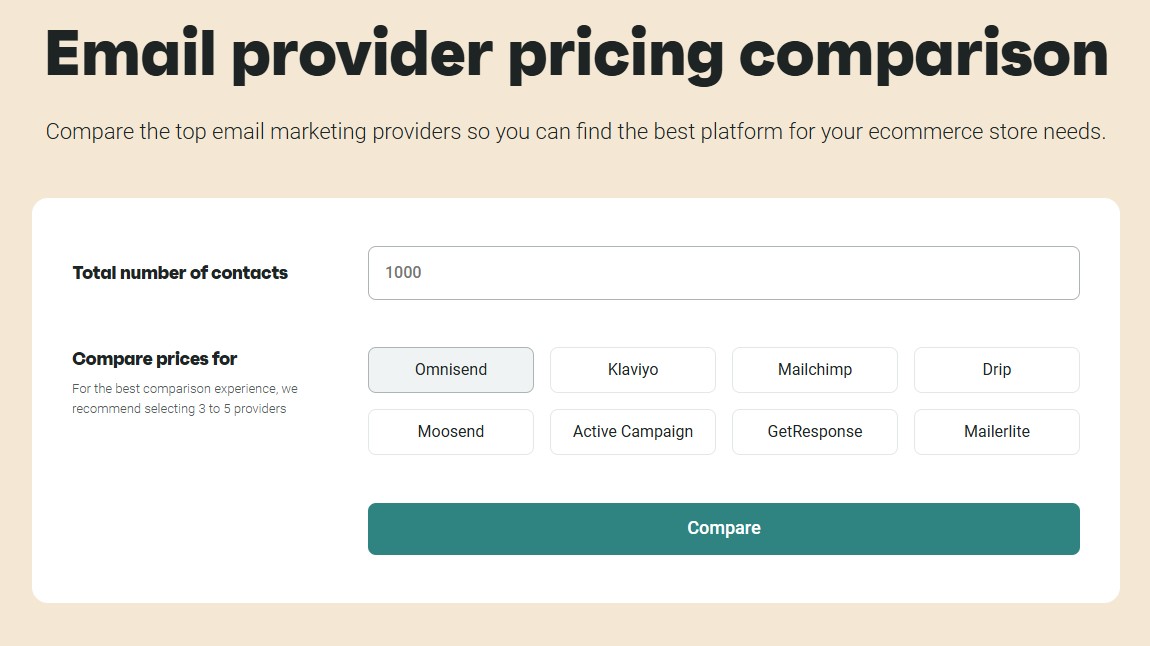
👉 Want to see how both compare to a third option? Check out Omnisend’s pricing comparison tool to find a cost‑effective solution for your store:
Klaviyo vs. GetResponse: Feature comparison
In this section, we look into how GetResponse vs. Klaviyo compare across key growth-focused features. These include automation, segmentation, forms, and reporting.
These capabilities shape how well you convert and retain customers.
Email automation
This is where we start to see GetResponse vs. Klaviyo differences.
Klaviyo’s automation, Flows, is a powerful visual flow builder that can trigger workflows based on customer behavior. This includes viewing products, adding to the cart, or making purchases.
Klaviyo Flows comes with 60+ pre-built templates that you can customize for maximum engagement, including:
- Welcome series
- Abandoned cart reminders
- Post-purchase follow-up
- Browse abandonment
- Price drop reminders
Building an abandoned cart flow begins with a Started Checkout trigger. It then branches into personalized follow‑ups using product data and set delays or predictive Smart Send Time:
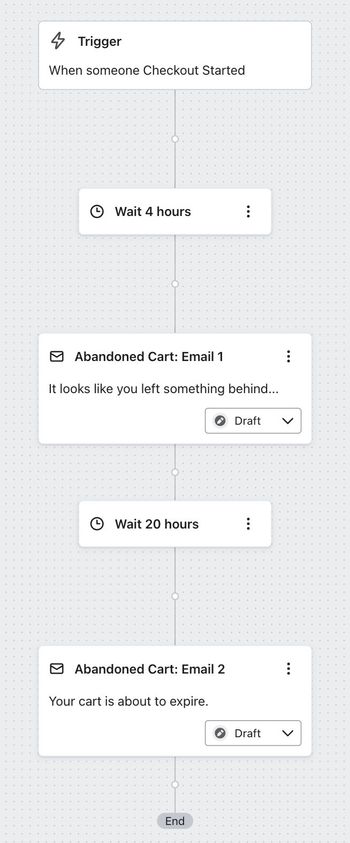
You can layer conditions like “Has purchased before” or total cart value to create more relevant messages.
GetResponse also has a solid visual automation builder that comes with 40+ pre-built templates.
You can build a welcome series, basic abandoned-cart emails, and post-purchase follow-ups. However, its ecommerce-native triggers, such as cart abandonment and purchase-based branching, are more limited than those in Klaviyo.
Additionally, unlimited automation workflows are available only from the Marketer plan. Starter users only have one custom automation workflow.
Mini verdict: For email automation that reacts to customer behavior, Klaviyo is better. GetResponse serves well for general sequences, but it doesn’t match Klaviyo’s behavioral intelligence.
Segmentation
This is the ability to group customers by behavior and data to create personalized campaigns.
Klaviyo’s segmentation is built around real-time store data. You can filter by purchase history, browsing behavior, predicted lifetime value, churn risk, and next expected order date.
Segments update in real time, and you can pull data from 350+ integrations, custom API events, and predictive analytics.
Notably, Klaviyo recently released Segments AI. It lets you describe the audience you want to reach, while Klaviyo handles the logic. This way, you can easily test new segment ideas and update targeting.
Klaviyo also supports full RFM modeling, which groups customers by recency, frequency, and monetary value. This helps you target high-value or at-risk customers with more precision.
Meanwhile, GetResponse offers tag-based segmentation and basic behavioral conditions like opens, clicks, and customer location. However, it doesn’t pull real‑time product or revenue data.
Segments are dynamic and update automatically when contacts meet set conditions. However, it lacks the depth of ecommerce data, such as predicted CLV, churn risk, and next order date.
Mini verdict: Klaviyo leads by a wide margin on email segmentation, especially for ecommerce brands.
SMS marketing
SMS is another area where there’s a big difference in access and scope between Klaviyo vs. GetResponse.
Klaviyo offers SMS across 20+ countries, including the USA, Canada, the UK, and Australia. It’s built into the same platform as email, so you can combine both channels in a single automation flow.
Features include consent management, SMS-specific flows, and age-gating for alcohol and firearm brands in supported regions. It also offers AI-assisted SMS segmentation, allowing you to create targeted messages to improve conversion.
GetResponse also offers SMS, but only in its Enterprise MAX plan. This makes it inaccessible for small-budget entrepreneurs.
While it claims global reach, delivery depends on local carrier rules. In parts of Africa or the Middle East, delivery is “best‑effort” and not guaranteed. That makes it less reliable for global ecommerce brands.
For international ecommerce brands, Omnisend’s SMS marketing capabilities and global reach offer a more accessible alternative without requiring an enterprise plan.
Mini verdict: Both tools offer SMS, but geographic limitations apply. Omnisend’s global SMS reach is well-suited for international sellers.
Landing pages and forms
GetResponse offers a full landing page builder with 200+ templates. You also get an AI page generator, drag-and-drop editing, and built-in A/B testing. It includes conversion funnels, so you can link pages, emails, and offers in one flow.
Its forms are just as strong, with 30+ triggering rules and formats like popups, slide-ins, bars, and mobile banners. Templates are organized by goal, whether it’s to grow an email list, drive sales, stay connected, or get feedback. This makes it easier and faster to launch campaigns.
Klaviyo’s landing page functionality is more limited. You can build a basic page with an embedded form or create a multi-step form. However, you don’t get popup triggers, timing rules, or on-site behavioral targeting.
Visitors reach Klaviyo landing pages directly via URL, as there’s no funnel logic built around them. Klaviyo provides 70+ prebuilt forms that you can A/B test. However, customization feels limited compared to GetResponse’s funnel‑ready toolkit.
Mini verdict: When comparing Klaviyo vs. GetResponse here, GetResponse wins. It’s well-suited for brands focused on top-of-funnel capture and conversion flow.
Reporting and analytics
Reporting isn’t just about opens and clicks. It lets you know what drives revenue and guides your marketing decisions.
Klaviyo’s reporting is built around revenue attribution. It connects your emails and automations directly to purchases. You can see exactly how much money a specific campaign or automation generates.
For example, Klaviyo can tell you how much revenue your abandoned cart flow brought in. Plus, you get predictive lifetime value reports to estimate how much a customer is likely to spend in the future.
You can view per-flow and per-campaign revenue tracking. Comparison views are also possible using pre-built performance cards. These, like in the example below, let you compare flows against campaign revenue.
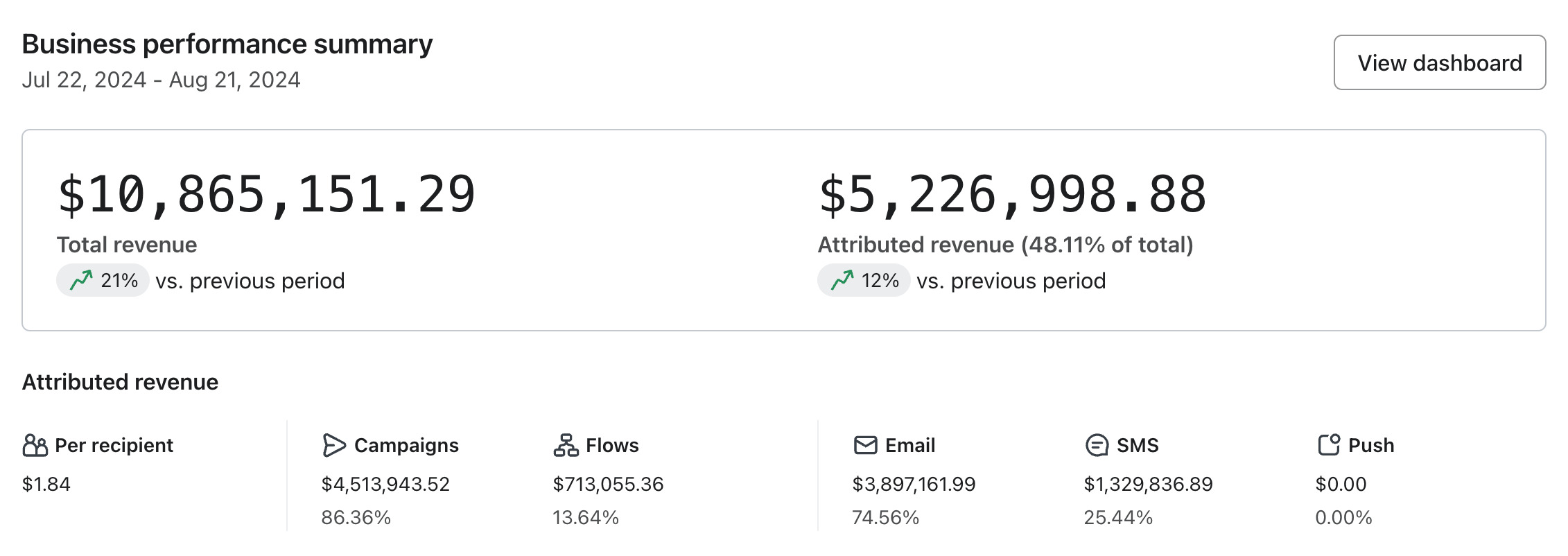
To deal with fragmented reporting, Klaviyo has also introduced omnichannel attribution. This feature tracks customer journeys across Klaviyo and third-party platforms to report which channels drive conversion.
GetResponse covers the basics well. You get data on open rates, clicks, and conversions. You can also track funnel performance and run A/B test reports.
Ecommerce revenue attribution is also available. However, this feature is limited to GetResponse’s emails. It can tell you which email led to a sale. However, it can’t credit a Facebook ad the customer may have clicked earlier (or later) in the journey.
Mini verdict: In this Klaviyo vs. GetResponse comparison category, Klaviyo provides better ecommerce‑specific analytics and actionable revenue insights. GetResponse is enough for general campaign reporting.
Klaviyo vs. GetResponse for ecommerce: The real difference
Most comparisons stop at features. However, we also need to look at design. This determines what’s easy, what’s possible, and what requires workarounds.
Klaviyo is ecommerce‑first. Its foundation connects directly to platforms like Shopify, WooCommerce, and BigCommerce. What’s more, it can sync product, order, and customer data in real time.
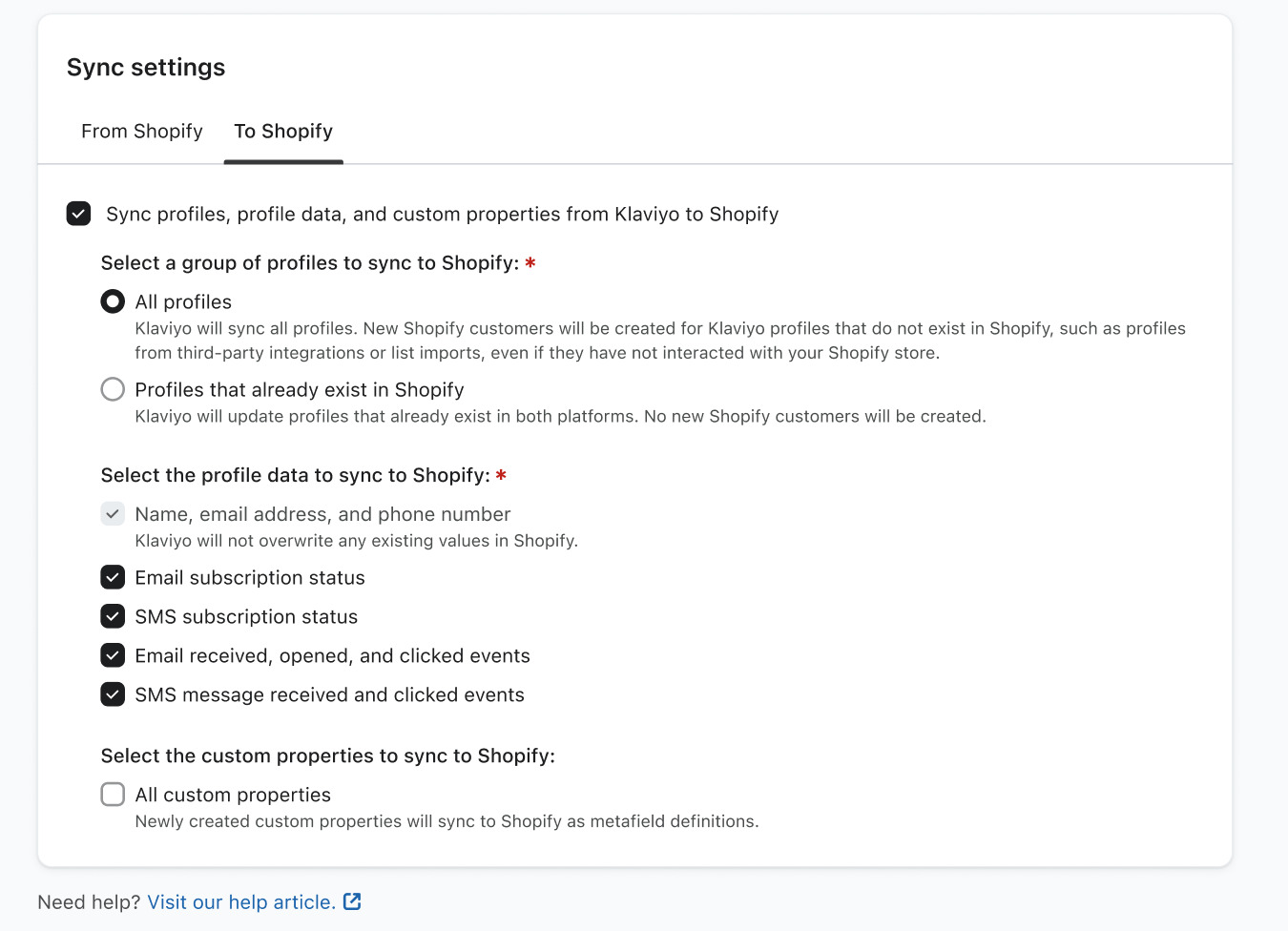
Every purchase event can trigger an automation flow instantly. It doesn’t matter whether it’s an abandoned cart reminder or a post‑purchase thank-you message. You don’t need to configure custom fields or integrate APIs since it’s all native.
- Native Shopify and WooCommerce integrations keep product and customer info consistently updated with real-time data sync
- Real‑time purchase triggers power flows based on actual customer behavior (viewed product, checked out items, purchased)
- Product recommendation blocks populate dynamically from your store catalog and personalize emails automatically
In practice, an abandoned cart flow in Klaviyo starts automatically when a shopper leaves the checkout process. The system pulls in exact products, images, and prices. You can split workflows based on cart value or customer history, then track revenue from each message.
Meanwhile, GetResponse is designed for general marketing. Think lead generation, webinars, and content funnels. It especially suits:
- Course creators
- Digital product sellers
- Membership and content-driven businesses
Marketer and Creator accounts get a Recommendations block. MAX accounts can send personalized recommendations. Meanwhile, abandoned cart campaigns are available in GetResponse, but only on the Marketer plan.
G2 cumulatively states that GetResponse users appreciate the platform’s ease of use. However, some note that its reporting capabilities are lacking both in depth and detail.
That said, GetResponse shines for ecommerce‑adjacent businesses. These include digital product sellers, course creators, and membership sites. Its funnel builder and landing page tools make it ideal for nurturing leads and selling services.
Running an ecommerce brand that wants Klaviyo-level automation without Klaviyo-level pricing? There’s a third option worth considering, and we’ll cover it in detail below.
You can also explore a detailed breakdown of Klaviyo alternatives if you want more options.
GetResponse vs. Klaviyo: Which should you choose?
The Klaviyo vs. GetResponse choice comes down to the type of business you run and how you plan to scale it.
Choose Klaviyo if:
- You run an established ecommerce store on Shopify, WooCommerce, or similar
- You need advanced segmentation, predictive analytics, and revenue attribution to track sales from every campaign
- You require deep behavioral automation, from abandoned cart to post-purchase flows, tied to real customer behavior
- You have the budget, time, and team capacity to make the most of its feature set
Klaviyo’s architecture is built for ecommerce. However, it comes at a significantly higher cost, which may not be suitable for small businesses.
Choose GetResponse if:
- You’re a small business owner, course creator, or digital product seller
- You want a broad toolkit, including email, funnels, webinars, and landing pages, at a competitive price
- You need an easy-to-use visual conversion funnel builder that shows the full customer journey
- You value an accessible, generalist platform over the technical depth of specialized, best-in-class tools
GetResponse’s strength lies in versatility. However, it lacks the ecommerce features many online stores need.
The trade-off in plain terms: Choosing between Klaviyo vs. GetResponse means considering either ecommerce depth or general-purpose breadth.
If you run an ecommerce store and find Klaviyo too expensive and GetResponse too generic, you can explore some GetResponse alternatives. There’s a third option that deserves a serious look. It’s built specifically for online stores, at a price that makes more sense.
Consider a third option: Omnisend for ecommerce growth
You’ve probably noticed the gap between Klaviyo vs. GetResponse. Klaviyo is powerful but expensive. Meanwhile, GetResponse covers many use cases but lacks true ecommerce depth.
That’s exactly where Omnisend fits in.
Omnisend offers the automation depth you need without the steep pricing that makes Klaviyo hard to justify at scale. Here’s what sets it apart:
- $79 ROI for every $1 spent: The platform offers among the highest returns in the industry. Behavior-based automation that converts at the right moment drives this ROI.
- Free plan with full ecommerce features: Omnisend doesn’t offer a stripped-down free trial. You can access automations, segmentation, and product-based workflows from day one.
- Global SMS marketing: Omnisend’s international SMS marketing works across regions where Klaviyo and GetResponse face delivery limits. It’s a stronger option for cross-border sellers.
- Ecommerce-native integrations: Omnisend connects seamlessly with Shopify, WooCommerce, BigCommerce, Wix, and more. Its 305+ app integrations make it easy to unify your store, marketing, and data.
- 24/7 customer support: All users, regardless of their plan, have access to strong and responsive support. This includes live chat, which has a median four-minute response time.
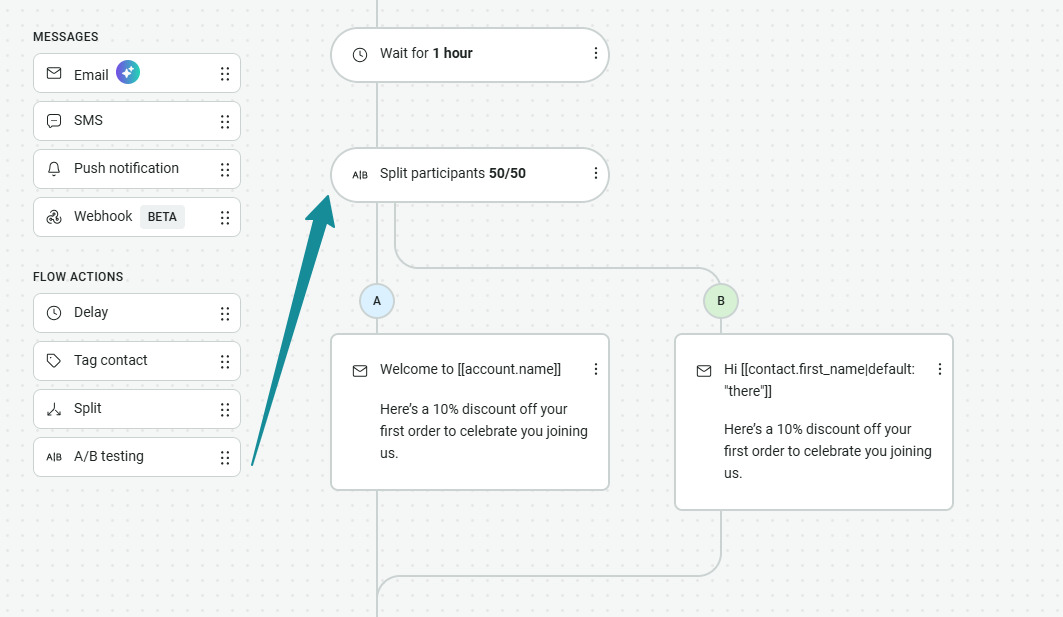
- A/B testing: You can run advanced A/B tests across full emails, subject lines, and sender names. This works alongside product recommendations and pre-built ecommerce workflows to optimize every campaign element.
Omnisend is the value-and-ROI leader for ecommerce brands wanting automation depth without enterprise pricing.
You can read this detailed Omnisend vs. Klaviyo breakdown to see how the two compare head-to-head. Here’s how a real brand is putting Omnisend to work:

FLEXTAIL’s growth with Omnisend
Outdoor gear brand FLEXTAIL used Omnisend to improve automation and drive more revenue from email and SMS. By mapping customer journeys, segmenting audiences, and refining workflows, it achieved stronger engagement and $235K in attributed sales.
Read the case study.
Making the call: Klaviyo vs. GetResponse (or Omnisend)?
Having compared Klaviyo vs. GetResponse, the difference between the two is clear.
Klaviyo is the better fit for ecommerce brands that want deep data, advanced automation, and have the budget to match. GetResponse works well for small businesses, creators, and marketers who need a broader toolkit at a fair price.
For ecommerce brands that want the best of both worlds, Omnisend is worth noting. It provides native store integrations and multichannel automation, with strong ROI and far fewer trade-offs.
Your next step is simple. Choose the platform that aligns with your growth strategy, and test it in real campaigns.
Quick sign up | No credit card required