
 Omnisend AI


 OFFER
OFFER








Drive sales on autopilot with ecommerce-focused features
See FeaturesKey takeaways 
Choosing the right ecommerce platform, like Magento or Shopify, significantly influences your business's revenue, scalability, and marketing effectiveness.
Shopify is ideal for small to medium B2C businesses seeking speed and simplicity, while Magento excels in customization and B2B functionalities for larger enterprises.
Shopify offers predictable subscription pricing and ease of use, whereas Magento has higher initial costs but provides greater flexibility and control for complex setups.
Regardless of the platform you choose, integrating with Omnisend can enhance your marketing efforts through powerful email and SMS automation.
Reveal key takeaways
Choosing the right ecommerce platform is critical for efficient operations and long-term growth. Choosing between Magento vs. Shopify can directly impact revenue, marketing performance, scalability, and total cost of ownership.
Now known as Adobe Commerce, Magento, and Shopify remain two of the most widely adopted ecommerce platforms in 2026. To make the right choice, you need to understand their core differences in pricing structure, ease of use, customization, and B2B capabilities and scalability.
In this comparison of Magento vs. Shopify, we break down their pros and cons, features, flexibility, and growth potential to help you decide which platform aligns with your business goals.
And remember that no matter which platform you choose, your marketing shouldn’t be limited.
Omnisend integrates seamlessly with both Shopify and Magento, helping you drive sales on autopilot with powerful email and SMS automation.
Get started with Omnisend today and increase your revenue with pre-built automation workflows
Quick sign up | No credit card required
Magento vs. Shopify at a glance
Both Shopify and Magento are great for building online stores. Shopify powers 26% of ecommerce sites globally, while Magento accounts for about eight percent. Below is a high-level comparison to help you quickly understand their differences.
Quick comparison table
Here’s a quick rundown of what you can expect from both platforms:
| Magento | Shopify | |
|---|---|---|
| Beginner-friendly | No | Yes |
| Scalability | Yes | Yes, with add-ons |
| Security | Yes, and can be improved with add-ons | Yes |
| Robust inventory and product management | Yes | Yes |
| Budget-friendly | No | Yes |
| Performance tracking | Yes | Yes, with add-ons |
| Multi-stores | Yes | Yes, with add-ons |
| Reliable payment gateways | Yes | Yes |
| Support | Yes | Yes |
| SEO capabilities | Yes | Yes, with add-ons |
| Product promotions | Yes | Yes, with add-ons |
| Time to launch | Three to six months | Hours to a few days |
| Best for | Large enterprise/B2B | SMB B2C |
The bottom line:
Shopify is the top choice for most growing B2C businesses that want speed and simplicity. Magento wins for enterprises requiring deep customization and B2B features.
The fundamental difference
Before we dive deeper into this Shopify vs. Magento comparison, let’s look at their main differences.
Shopify is a proprietary SaaS (Software-as-a-Service) platform for building online stores. Its monthly subscription includes hosting, security, updates, and support, making costs more predictable. Aside from fast setup, you get speed and simplicity. However, customization options are limited.
Like WooCommerce, Adobe Commerce is open-source and self-managed. It offers a paid enterprise version with better customization and control. However, it comes with high implementation costs and ongoing maintenance.
Shopify vs. Magento features comparison
Both Magento and Shopify are full-service ecommerce platforms. However, when comparing Shopify vs. Magento, you’ll notice the following differences in features:
| Features | Magento | Shopify |
|---|---|---|
| Multi-channel selling | ⚠️ Via extensions and integrations | ✅ Native (Amazon, eBay, Meta, TikTok) |
| International selling | ✅ Native multi-store, multi-language | ✅ Shopify Markets (currencies, domains, taxes) |
| Analytics and reporting | ✅ Advanced reporting (Adobe Commerce) | ✅ Built-in dashboards |
| Order and inventory management | ✅ Native, highly configurable | ✅ Native, streamlined |
| Mobile optimization | ⚠️ Theme and dev-dependent | ✅ Responsive themes and mobile app |
| SEO tools | ✅ Advanced native SEO controls | ✅ Built-in SEO plus apps |
| Apps/extensions | ✅ 3,800+ extensions | ✅ 16,000+ apps |
| Checkout customization | ✅ Fully customizable | ⚠️ Shopify Functions (rules-based) |
| Hosting and uptime | ⚠️ Self-hosted or cloud-managed | ✅ Managed SaaS, 99.99% uptime |
| Marketing and promotions | ✅ Native tools + automation | ⚠️ Apps required |
| B2B functionality | ✅ Native B2B suite | ⚠️ Limited/add-ons |
| Headless commerce | ✅ PWA Studio | ✅Hydrogen and Oxygen |
| AI and personalization | ✅ Adobe Sensei AI | ✅Shopify Magic |
When users search for “Magento 2 vs. Shopify,” they’re typically referring to Magento Open Source. It’s the modern, PHP-based version of Magento that replaced Magento 1 and now serves as the foundation for Adobe Commerce.
Shopify features
Shopify offers an extensive feature set, making it one of the most popular ecommerce solutions:
- Multi-channel selling: Sell across multiple marketplaces and social channels, including Amazon, eBay, Facebook, and Instagram
- Powerful analytics: Access insights about your store’s performance, customers, and the effectiveness of marketing efforts
- Mobile optimization: Shopify themes are responsive, and you can manage your store on the go with the Shopify mobile app
- SEO features: Edit meta titles and descriptions, create 301 redirects, and generate sitemaps
- Expansive app store: Over 16,000 apps, including email marketing platforms and abandoned cart recovery tools, to customize your store’s functionality
- Reliable hosting: 99.99% uptime and fast load times, with unlimited bandwidth on all plans
- Shopify Markets: Sell globally from a single store with localized currencies, domains, taxes, and payment methods
- Shopify Functions: Customize discounts, shipping logic, and payments at checkout
- Headless commerce: Using Storefront API, Hydrogen, and Oxygen, Shopify allows for a decoupled frontend
Magento features
Magento offers robust features designed for enterprise-level businesses:
- Customer segmentation: Group customers based on attributes like location, gender, order history, and lifetime spending
- Flexible APIs: Integrate with ERPs, CRMs, and other business systems
- B2B functionality: Set custom catalogs and pricing and provide quote requests, requisition lists, and quick ordering
- Global selling: Localize your store for international markets with multiple languages, currencies, and tax rates
- Strong SEO: Take advantage of layered navigation, canonical tags, and rich snippets
- Marketing tools: Create landing pages, banners, targeted coupons, promos, and loyalty programs, and send automated email reminders
- Admin permissions: Set roles and permissions for different admin users to control access to backend features
- Adobe Sensei AI: Leverages Sensei AI for product recommendations, personalized search results, and customer segmentation
- Headless commerce: Supports ecommerce setups via APIs, allowing businesses to integrate with complex tech stacks
- Magento extensions: 3800+ extensions and integrations, including ERPs, payment gateways, CRMs, and shipping carriers
When deciding between Magento vs. Shopify, you can’t go wrong. Both platforms have great marketing tools. However, marketing automation is what mainly drives revenue. Omnisend integrates with both platforms to provide advanced email and SMS automation.
Magento vs. Shopify pricing: Total cost of ownership
Shopify pricing breakdown
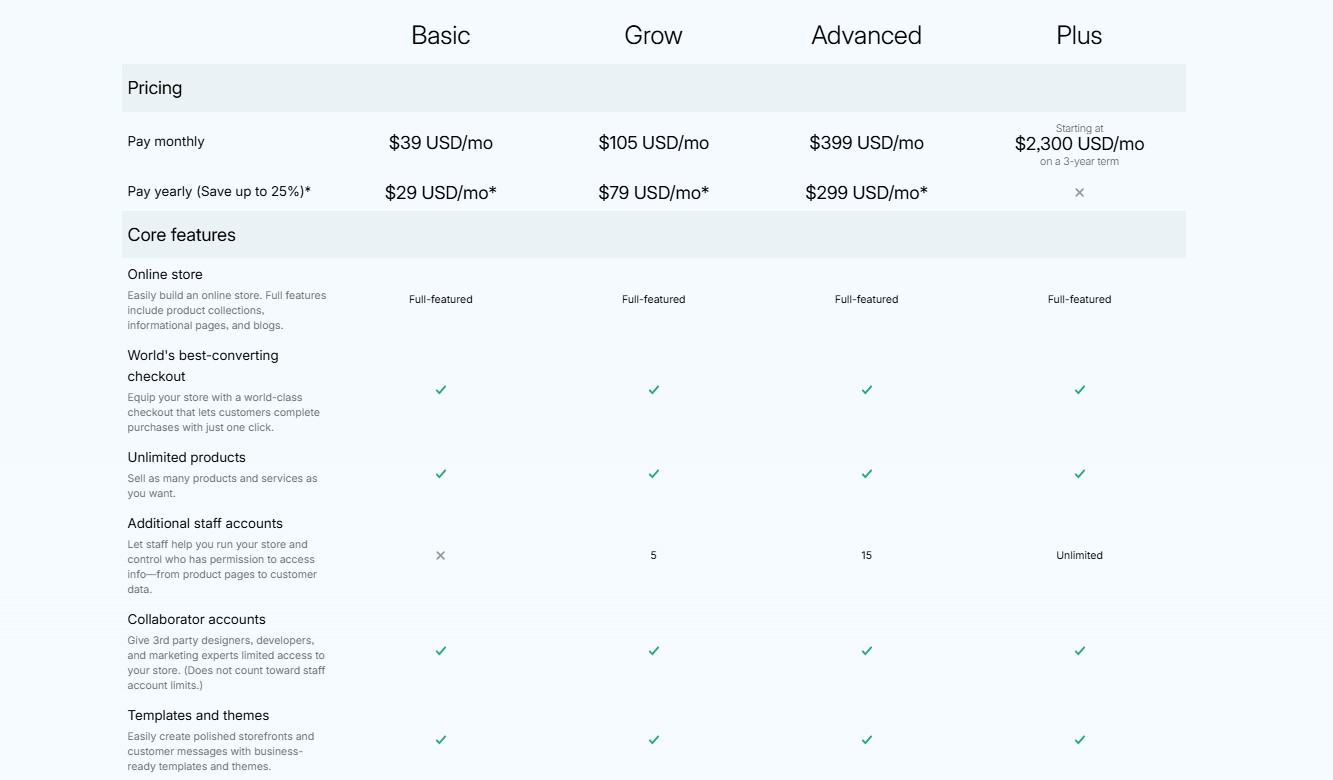
Shopify pricing is subscription-based, starting at $29/month for the Basic plan. The Grow plan for small teams starts at $79/month, while the Advanced plan is $299/month.
If you already have a website, you can choose the Shopify Lite version, which costs $9/month. As your business outgrows the standard plans, you can migrate to Shopify Plus, which starts at $2,300/month. It’s designed to handle massive traffic and global operations.
Shopify charges a zero to two percent transaction fee depending on your plan. You don’t have to pay these fees when using Shopify Payments. This helps sellers with a large customer base reduce costs.
Magento pricing breakdown
Magento offers three plans: Magento Open Source, Adobe Commerce (formerly Magento Commerce), and Adobe Commerce Cloud.
Magento Open Source is free to install, but it might be expensive in the long run. The add-ons can cost $2,000 or more per month. You’ll have to pay for hosting or hiring Magento developers to customize your store.
TCO comparison table
Here’s a Magento vs. Shopify breakdown of the costs to run and scale your store over a course of three years:
| Business size (annual GMV) | Platform | First year cost (build + running costs) | Three-year total cost |
|---|---|---|---|
| Small (<$500K) | Shopify (Basic/Grow) | $4,500–$8,000 | $12,000–$18,000 |
| Small (<$500K) | Magento (Open Source) | $25,000–$45,000 | $45,000–$75,000 |
| Medium ($500K–$2M) | Shopify (Advanced) | $15,000–$35,000 | $40,000–$65,000 |
| Medium ($500K–$2M) | Magento (Open Source) | $55,000–$90,000 | $110,000–$160,000 |
| Enterprise ($2M+) | Shopify Plus | $65,000–$150,000+ | $180,000–$350,000+ |
| Enterprise ($2M+) | Adobe Commerce | $120,000–$250,000+ | $300,000–$550,000+ |
Magento hidden costs to consider:
- Hosting costs: Around $100–$1,500/month, depending on traffic and infrastructure
- Initial development: A professional Magento build costs $15,000–$100,000+
- Ongoing maintenance: Budget $500–$2,000/month for a developer or agency to apply security patches and manage your server
- Adobe Commerce: Licensing starts at $22,000/year (Adobe Commerce) or $40,000+/year (Commerce Cloud)
Break-even analysis
For most businesses, Shopify is more cost-effective in the early stages. However, with around two to five million in GMV, Magento’s higher upfront investment can begin to pay off. It delivers lower per-transaction costs and better long-term ROI.
Which is more cost-effective?
Shopify is typically more cost-effective for small to mid-sized businesses. This is due to low setup costs, predictable pricing, and minimal maintenance.
However, if your business requires multiple custom integrations and specific B2B workflows, Magento (Adobe Commerce) is more affordable.
Ease of use and setup time
Most ecommerce merchants aren’t web designers or developers. However, even if you’re familiar with web development, you’ll want to work with a professional to keep your platform as user-friendly as possible.
Shopify ease of use
Most merchants can launch a basic Shopify store in a few hours to a few days. The platform provides a unified dashboard for managing products, orders, analytics, marketing, and apps.
Shopify also offers 24/7 support, extensive documentation, and step-by-step tutorials. While this reduces the learning curve for non-technical users, Shopify has its own pros and cons.
Magento ease of use
A full Magento implementation can take three to six months. It requires familiarity with PHP development, MySQL databases, and server administration. Magento can be useful for businesses with in-house developers or agency support.
Verdict
Shopify is the winner for non-technical users due to its reduced learning curve and fast setup.
Customization and flexibility
When evaluating Magento 2 vs. Shopify, customization is a deciding factor. Let’s see how both platforms compare in this regard.
Shopify customization options
You can customize a Shopify store using Liquid. It’s an open source template language for loading dynamic content, such as product details and collections. Merchants can also extend their stores through 16,000+ apps, covering subscriptions, bundles, and advanced analytics.
At checkout, Shopify Functions enables rules-based customizations for shipping methods and payment adjustments. With Shopify Plus, you can access Scripts and Flow for advanced automation and workflow customization.
Magento customization options
Magento provides full access to the source code, allowing unlimited customization. With 3,800+ extensions, complete checkout control, and deep API integrations, merchants can modify the store’s frontend and backend.
When customization matters most
Customization is critical for:
- Complex B2B ecommerce workflows
- Unique checkout flows (subscriptions, bundles, custom payment logic)
- Deep ERP/CRM integrations
- Multi-store environments with shared inventory
Verdict
Magento wins for unlimited customization potential. Meanwhile, Shopify wins for delivering 80% of customization needs with 20% of the effort.
Scalability and performance
As your business operations become more complex, performance directly affects revenue. Even a one-second delay in page load time can reduce conversions.
Shopify scalability
Shopify offers automatic scaling through its fully managed infrastructure. It includes hosting and security, with a 99.99% uptime guarantee and global CDN. The platform can also handle 10,000+ transactions per minute.
Merchants don’t need to configure servers or optimize performance manually. For high-volume brands, Shopify Plus provides additional capacity, automation tools, and priority support.
Magento scalability
Scaling your business with Magento requires excellent hosting quality and technical execution. Performance optimization requires manual configuration, including caching layers, CDN setup, and database tuning.
When properly configured, Magento can support large catalogs and complex enterprise operations. However, if you don’t want a self-managed infrastructure, Adobe Commerce Cloud is an option. It offers managed hosting and auto-scaling for enterprise merchants.
Performance comparison
Shopify generally delivers consistent load speeds globally due to its managed CDN. This makes it well-suited for flash sales and Black Friday traffic spikes.
With the right hosting environment and technical team, Magento can match or exceed performance.
Verdict
Shopify wins for hands-off scalability. Magento wins for detailed control over performance with the right resources.
Apps, plugins, and integrations
Both Magento Marketplace and the Shopify App Store offer extensive libraries of third-party apps, plugins, and integrations to improve and grow your online store.
Shopify app ecosystem
The Shopify app store has over 16,000 apps, many of which are free to install. The best Shopify apps help make the store experience good.
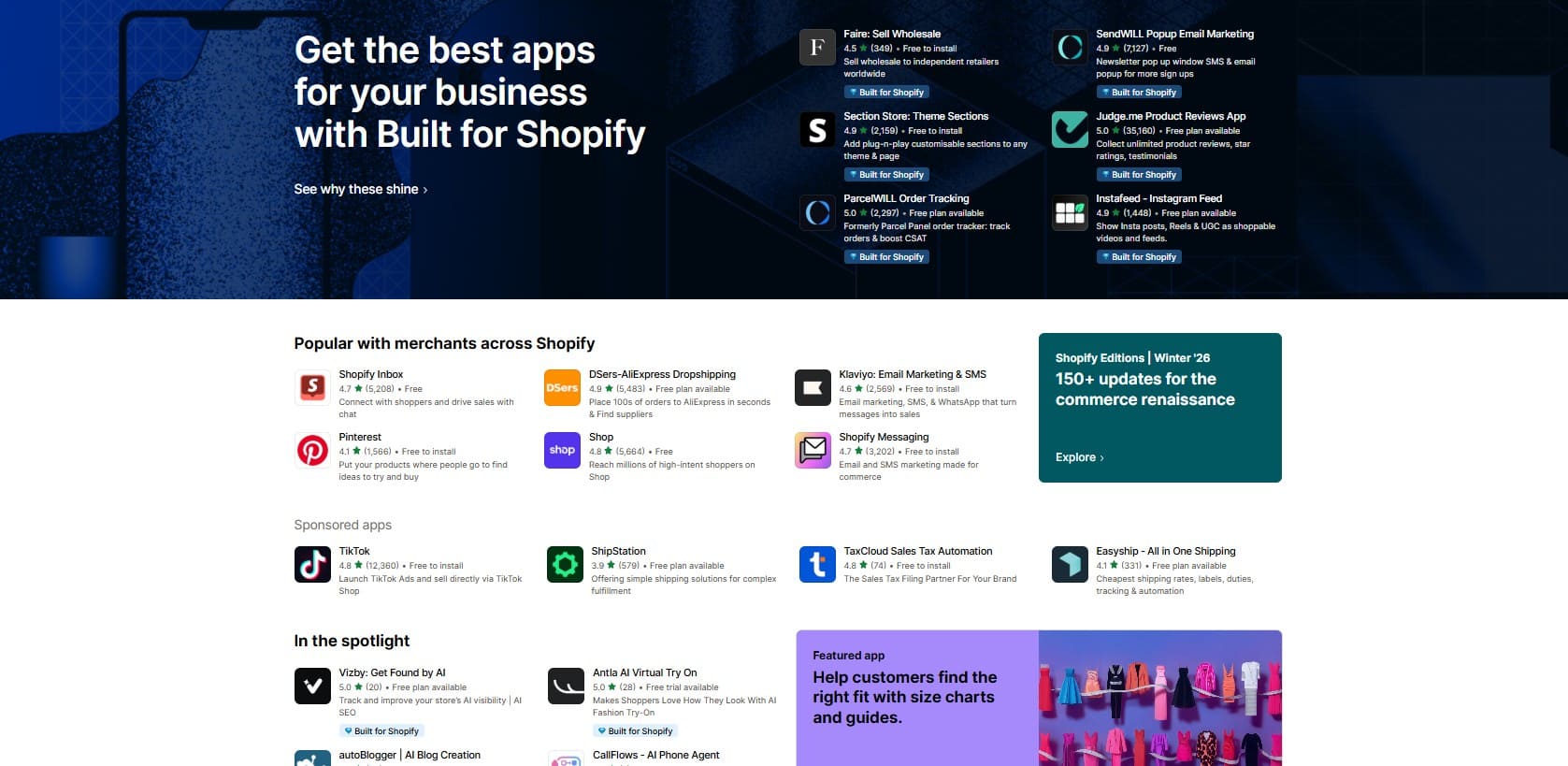
Installation is typically one-click, with apps vetted through Shopify’s review process. Some popular app categories include email marketing, loyalty programs, shipping, and accounting. Shopify also integrates with platforms like Klaviyo, Omnisend, Gorgias, and Yotpo.
Magento extension marketplace
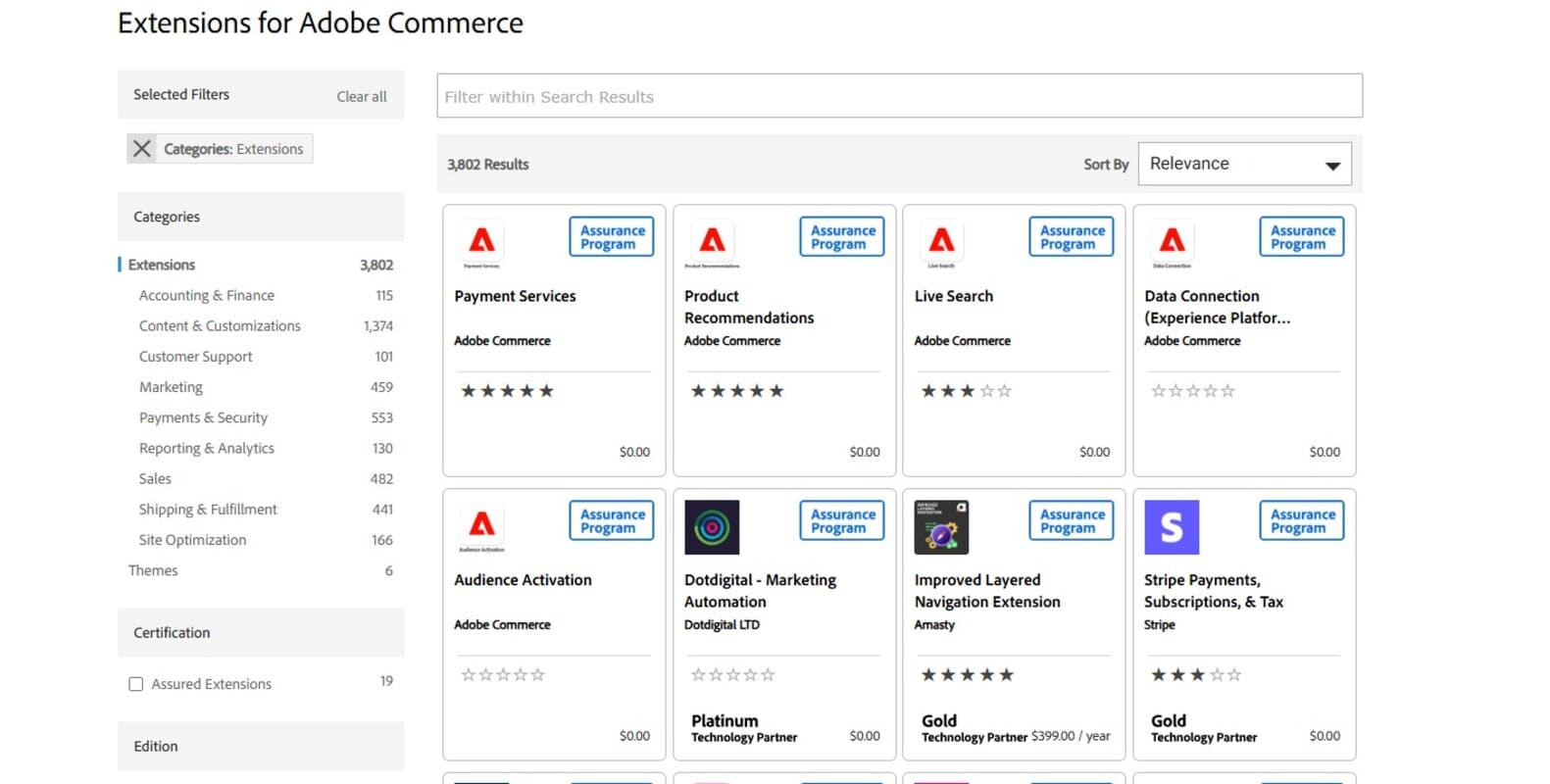
Magento Marketplace offers 3,800+ free and paid extensions for customer support, marketing, website optimization, and analytics. Magento supports deeper integrations with Adobe tools, ERPs, CRMs, and fully custom-built solutions.
Omnisend offers native plugins for both Magento and Shopify. This helps merchants on either platform build and run omnichannel marketing campaigns. With pre-built automation workflows and seamless data sync, you can focus on growing your business rather than managing technical integrations.
Start free and join 150,000+ stores that chose Omnisend for growth
Quick sign up | No credit card required
Themes, templates, and customization
Both Magento and Shopify have a vast collection of templates and themes to help you create a visually pleasing online store.
Shopify themes
Shopify offers 24 free themes and 1,000+ paid themes in its official theme store. They’re professionally designed and mobile-responsive by default. The paid themes start at $140, with premium options priced higher based on features.
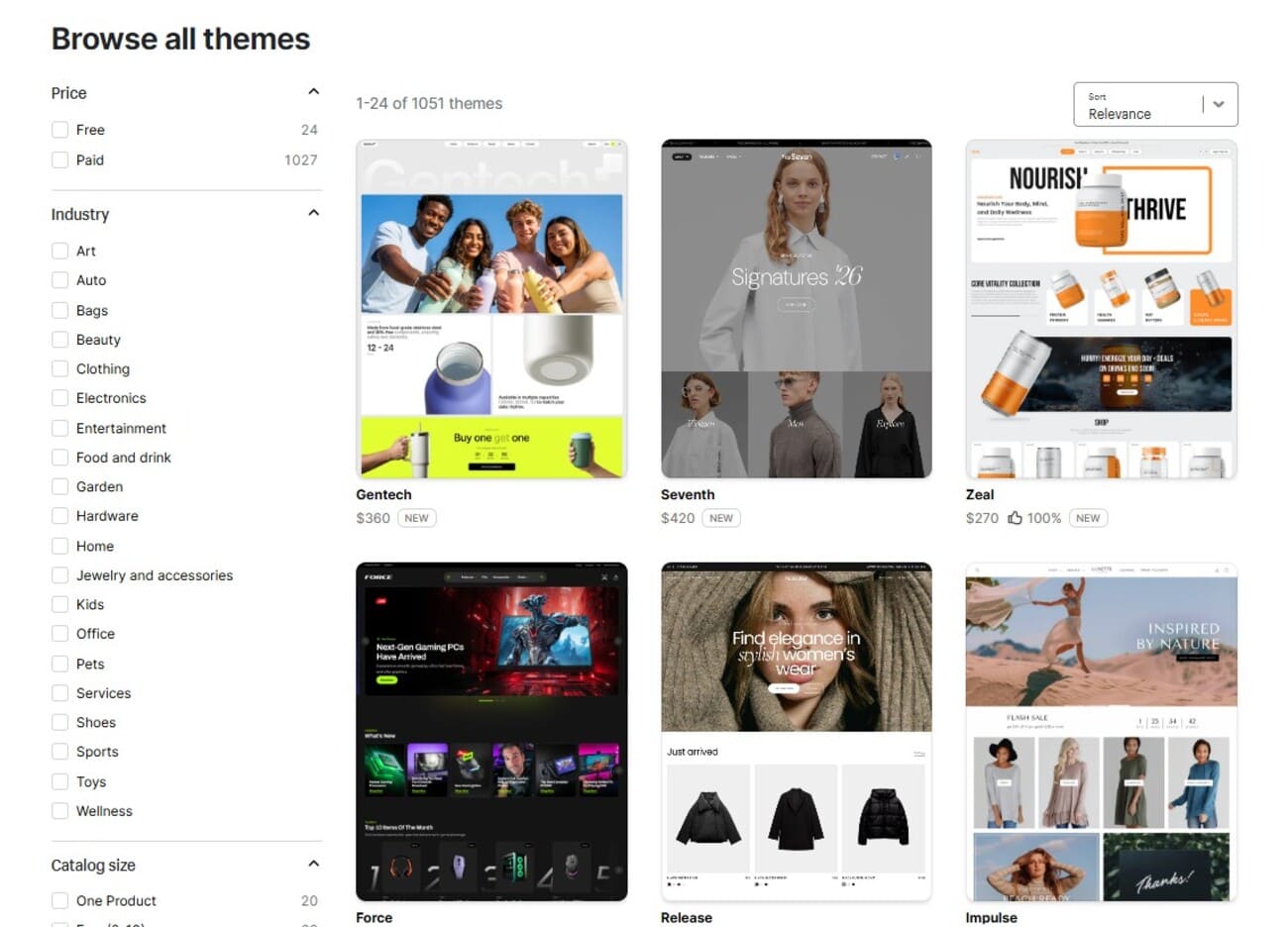
With Shopify Online Store 2.0, you can enable dynamic page customization with its “sections everywhere” feature. For advanced users, Shopify supports headless commerce through its Storefront API, Hydrogen (a React-based framework), and Oxygen hosting.
Magento themes
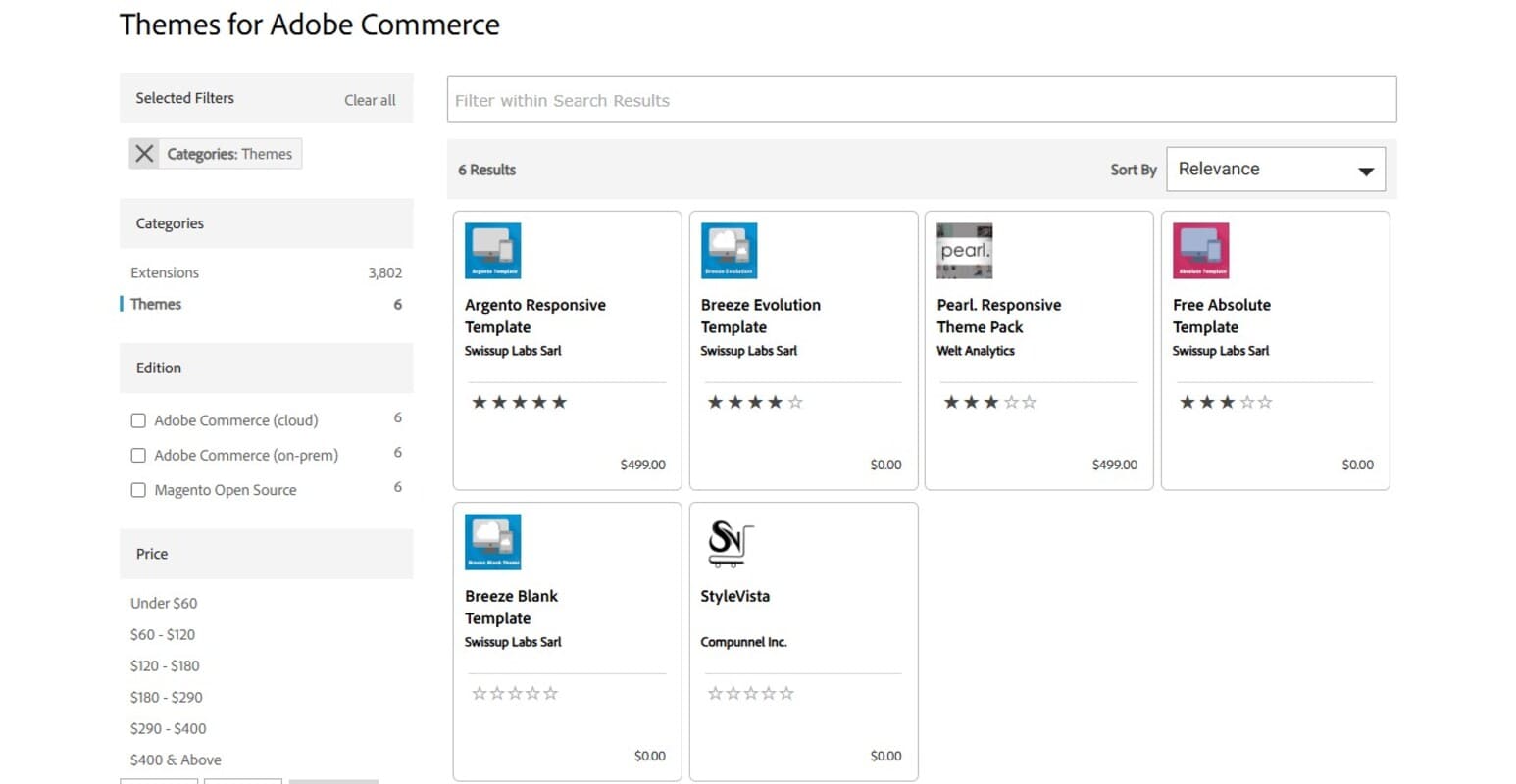
Magento Marketplace offers six themes, priced from $0 to $499. Because Magento provides full access to the source code, many businesses install custom themes. The platform also supports headless and composable commerce architectures via PWA Studio or a custom frontend framework such as React JS.
Verdict
Shopify wins for out-of-the-box design quality, consistency, and mobile readiness. Magento is excellent for businesses planning to invest in a fully custom storefront design.
Security and compliance
If you want your store to be safe from potential threats, platform security should be at the top of your must-have list.
Shopify security
Shopify provides SSL certificates and Level 1 PCI DSS compliance by default, the highest standard for payment security. It also manages 24/7 monitoring, hosting security, and security patches. Its internal security teams handle security for millions of stores globally, supported by a public bug bounty program.
Magento security
Magento security requires additional setup and certification. It depends heavily on hosting quality and merchant diligence.
The ecommerce platform has experienced notable incidents, including a 2025 SessionReaper attack that affected unpatched stores. This highlights the importance of proactive maintenance.
That said, manually installing security patches often requires testing to avoid disrupting customizations.
Security verdict
Shopify wins for hands-off, enterprise-grade security and built-in compliance. Magento suits organizations with dedicated security teams that want full control over their security setup.
SEO and marketing capabilities
Organic traffic and lifecycle marketing impact customer acquisition costs and long-term profitability. SEO and automation are key factors when choosing between Magento vs. Shopify.
Shopify SEO features
Shopify offers essential SEO tools for building successful Shopify stores, including:
- Customizable meta titles and descriptions
- Automatic XML sitemap generation
- 301 redirects
- Mobile-optimized themes
- Fast built-in hosting
However, Shopify uses fixed URL structures (for example, /collections/, /products/, /pages/). This limits full URL customization, which advanced SEO teams may find less flexible.
Magento SEO features
Magento allows more SEO control with features like:
- Fully customizable URLs
- Advanced metadata management
- Canonical tags
- Layered navigation optimization
- Support for rich snippets
However, this flexibility requires technical SEO knowledge to configure properly.
Marketing capabilities
Shopify includes Shopify Email, social channel integrations, and built-in abandoned cart recovery. Magento, on the other hand, provides landing page builders, loyalty tools, and advanced promotional rules.
Marketing automation platforms such as Omnisend offer email marketing software that integrates with Shopify and Magento. It offers sophisticated email and SMS workflows, segmentation, and campaign automation. With these features, Omnisend helps clients get an average of $79 for every $1 spent.
B2B and enterprise capabilities
B2B and enterprise governance features are essential for large ecommerce brands.
Magento B2B features (native)
Magento (Adobe Commerce) includes a robust native B2B suite that’s excellent for complex wholesale operations. Its features include:
- Custom catalogs per company
- Tiered pricing and negotiated quotes
- Requisition lists and quick ordering
- Approval workflows and role-based permissions
- Company account management
- Deep ERP and CRM integrations via APIs
Shopify Plus B2B features
Shopify Plus enables B2B on Shopify with company profiles, custom pricing, and wholesale storefronts. You can also implement more advanced logic, such as custom pricing rules, via Shopify Plus Scripts and Functions or third-party apps.
While powerful, Shopify’s B2B capabilities are app-dependent and still growing compared to Magento’s native B2B framework.
Enterprise tier comparison: Shopify Plus vs. Magento (Adobe Commerce)
| Feature | Shopify Plus (from $2,300/month) | Adobe Commerce (from $22,000/year) |
|---|---|---|
| Dedicated support | Priority support | Enterprise support + account team |
| SLAs | 99.99% SLA | Cloud SLA (Commerce Cloud) |
| Multi-store management | Expansion stores | Advanced multi-store architecture |
| API rate limits | Standardized limits | Highly configurable |
| Checkout customization | Via Scripts/Functions | Full control |
Verdict
Magento wins due to its robust B2B capabilities and native functionality. Shopify Plus is excellent for B2B businesses that prioritize speed and simplicity over deep customization.
Magento vs. Shopify: Pros and cons
Consider the following when comparing Magento vs. Shopify for your ecommerce needs.
Magento vs. Shopify Pros
| Magento | Shopify |
|---|---|
| Open-source platform: Allows frontend and backend modifications | Intuitive interface: Minimizes the learning curve for non-technical users |
| No platform transaction fees: You only pay standard payment gateway rates | Managed hosting: Automatically handles infrastructure, security, and updates |
| Large extensions marketplace: 3,800+ add-ons, especially for enterprise systems | 16,000+ apps in the Shopify App Store: One-click integrations for marketing, shipping, and operations |
| Native B2B functionality: Custom catalogs, pricing tiers, quotes, and approval workflows | Predictable pricing plans: Transparent monthly subscription tiers |
| International selling: Multi-store, multi-language, and multi-currency capabilities | Multi-channel selling: Easy integrations with marketplaces and social platforms |
Magento vs. Shopify Cons
| Magento | Shopify |
|---|---|
| Development expertise: Setup and customization typically require technical knowledge | Restricted customization: Modifications are limited to Shopify’s framework |
| Hosting and security responsibility: Merchants must manage patches and compliance | Transaction fees (0–2%): Apply when not using Shopify Payments |
| Long implementation time: Full builds often take months | Less granular backend control: Infrastructure and server settings aren’t accessible |
| Steeper learning curve: Backend management is more complex | App dependency: May increase recurring costs |
Magento offers maximum control and more B2B capabilities. However, it requires technical skills and longer implementation timelines.
Shopify prioritizes accessibility, speed, and managed infrastructure. However, it lacks backend control and deep customization.
Which platform should you choose?
If you’ve made it this far, the decision to choose between Magento vs. Shopify likely comes down to resources, complexity, and growth plans.
Choose Shopify if
- You want to launch quickly with minimal technical setup
- Predictable monthly costs matter more than full backend control
- You’re a small-to-medium B2C business
- You prefer managed hosting, built-in security, and automatic updates
- Multi-channel selling (Amazon, social, marketplaces) is a priority
- You don’t have dedicated developers in your team
Choose Magento if
- You need full access to the source code and unlimited customization
- You operate complex B2B workflows with negotiated pricing
- You have in-house developers or a retained agency
- You manage large catalogs (10,000+ SKUs)
- You want multi-store management from a single backend
- You need strict data and compliance controls
Decision framework
| Business scenario | Shopify | Magento |
|---|---|---|
| Launching your first store | ✅ Best fit | ❌ |
| Small-to-mid B2C brand | ✅ Best fit | ❌ |
| High-growth DTC brand | ✅ Shopify Plus | ❌ |
| Enterprise B2B with complex pricing | ❌ | ✅ Best fit |
| 10,000+ SKU catalog | ❌ | ✅ Best fit |
| Multi-store, global operations | ⚠️ Possible | ✅ Best fit |
| Limited technical team | ✅ Best fit | ❌ |
| Dedicated dev resources | ❌ | ✅ Best fit |
Regardless of which platform fits your business, your marketing automation should work as hard as you do, which is why 150,000+ online stores choose Omnisend as an expert-approved platform for email and SMS automation.
Omnisend’s ecommerce features, including product recommendations and automated workflows, integrate with both platforms, so you won’t have to compromise on marketing capabilities.
Wrap up
The choice between Magento vs. Shopify depends on three key differences: ease vs. control, predictable vs. variable costs, and managed infrastructure vs. self-managed flexibility.
For most growing ecommerce businesses, Shopify offers the fastest path to launch and the lowest total operational effort.
For enterprises with complex requirements and dedicated technical resources, Magento provides unmatched flexibility and control.
No matter which platform you choose, you can use Omnisend for Shopify and Magento. It helps you reach, convert, and re-engage customers via email and SMS automations. Focus on building customer relationships through personalized marketing. That’s where sustainable growth comes from.
Start free today and drive more sales with Omnisend’s pre-built automation workflows
Quick sign up | No credit card required
Frequently asked questions
Is Magento still relevant in 2026?
Magento is still widely used for large, highly customized ecommerce operations. Adobe will continue developing its apps, and thousands of extensions support complex use cases.
Can I migrate from Magento to Shopify?
A Magento-to-Shopify migration is possible. However, it may take two to eight weeks and cost $2,000–$20,000+, depending on the catalog size. You also need to consider preserving SEO rankings, migrating data, and reinstalling integrations.
What about Shopify Plus vs. Adobe Commerce for enterprise?
Shopify Plus prioritizes speed, managed infrastructure, and predictable pricing (starting from $2,300/month). Adobe Commerce focuses on deep customization and native B2B tools (starting from $22,000/year). Shopify Plus is designed for fast-scaling brands, while Adobe Commerce is designed for enterprises with complex workflows.
Which platform is better for SEO?
Magento offers greater control over URLs, metadata, and technical SEO elements. It’s great for advanced SEO teams.
Shopify provides strong built-in SEO, fast hosting, and automatic sitemaps. It works well for most merchants without heavy technical optimization.
How do marketing tools compare between platforms?
Shopify relies more on apps, while Magento includes more native tools. Platforms like Omnisend integrate with Shopify and Magento. They add to segmentation, email, and SMS workflows, and lifecycle marketing performance.
This article was researched and written by our experts following a precise process.
See the process
TABLE OF CONTENTS
TABLE OF CONTENTS


Subscribe and don’t miss any updates!
No fluff, no spam, no corporate filler. Just a friendly letter, twice a month.