Omnisend AI


 OFFER
OFFER








Klaviyo SMS vs. Omnisend SMS: Functionality & pricing comparison for 2025
With over 130+ pre-built integrations and flexible APIs, you can easily centralize data from across your tech stack
Make the most out of your data and unlock powerful growth marketing possibilities with these other top marketing tools.
Build any custom integration with our open, flexible APIs that are simple to use and implement.
Check out apps that have been stealing all the spotlight.
Email and SMS marketing insights, ecommerce resources, and the latest Omnisend news
Expert-led sessions covering email, SMS, and ecommerce marketing strategies.
Educational video and live training to help you make the most out of Omnisend.
Omnisend's SMS marketing services empower you to:
Start leveraging SMS marketing to boost engagement and sales today.
Start free Quick sign up | No credit card requiredDrive sales on autopilot with ecommerce-focused features
See Features
SMS marketing boasts a staggering 98% open rate, making it an incredibly effective channel for urgent communications and promotions.
To maximize ROI, businesses should prioritize consent-based opt-ins and focus on sending relevant, timely messages rather than overwhelming their audience.
Automated SMS campaigns, like abandoned cart reminders, generate significantly higher revenue per send compared to standard promotional texts, highlighting the importance of automation.
Compliance is crucial in SMS marketing; always obtain explicit consent, provide opt-out options, and respect sending hours to maintain a positive sender reputation.
SMS marketing is the best way for businesses to communicate urgent messages that have a high chance of being opened and read. According to Omnisend’s data, text messages hold a 98% open rate, and 90% of the messages are opened in the first three minutes. As you can see, the channel’s value is undeniable.
You may not have known this, but SMS marketing is one of the highest-ROI channels available. The problem is, many brands either don’t know where to start or are not using it to its full potential. Many people think that receiving promotional content via SMS is annoying, which may stop businesses from trying the channel altogether, but it’s only so when you overstep the boundaries.
We’ll explain to you how text campaigns work, share some real-world examples, and provide best practices so you can get the benefits without annoying your customer base.
Quick sign up | No credit card required
If you’re wondering “what is text marketing?”, the concept is pretty straightforward. SMS marketing is a direct digital channel that allows you to send promotional, transactional, and conversational text messages to opted-in subscribers.
The acronym SMS stands for Short Message Service, meaning these messages only consist of plain text. This distinguishes it from MMS (Multimedia Messaging Service), which allows you to send media like images, GIFs, and videos.
When you’re building a text message marketing strategy, the golden rule is consent. SMS is strictly a permission-based channel, so you can only send campaigns to those contacts who have explicitly opted in to receive them from your brand.
The greatest advantage of SMS is that it’s an owned marketing channel, unlike most social media. You don’t have to worry about a sudden algorithm update hiding your content from your audience. Instead, you have complete control over your timing, targeting, and messaging.
It sits right alongside email as one of the few marketing channels your brand owns outright, which gives a reliable and direct line to your customers.
If you’re new to the channel, you might be wondering: how does SMS marketing work? At its core, the mechanics are quite simple: a brand signs up with an SMS marketing platform (like Omnisend, for example), builds a list of opted-in subscribers, and uses that platform to send text messages from a dedicated phone number.
All of that is easy as pie, but when you set up your account, you’ll need to choose the type of phone number you want to send from, which could be a little more complicated for SMS rookies. There are three main options available:
Once you get all that sorted out and finally hit “Send” on a campaign, your messages travel through SMS gateways. There’s no magic or shady operations going on behind the curtain. SMS gateways are the technology that connects your marketing platform directly to mobile carriers.
The messages are then delivered straight to your subscribers’ native messages app, which means your recipients don’t need to download any apps to get your texts.
Because this technology is so direct, most SMS messages are delivered within seconds of sending, which makes it an incredibly effective tool for time-sensitive offers and updates.
SMS marketing is not a single format. There are distinct types of text messages, each suited to different moments of the customer journey.
Promotional SMS refers to messages sent specifically to drive a commercial action. You’ll typically use these for regular sales, product launches, flash sales, exclusive offers, and more. They can be sent out as one-off campaign blasts to your list, or set up as behavior-triggered automations.
Here are a few common promotional use cases:
Behavior-triggered texts are incredibly effective for ecommerce brands. According to the Omnisend 2026 Ecommerce Marketing Report, automated SMS messages generate an average of $0.74 per send, compared to just $0.15 for standard campaigns, which is five times the difference.
Transactional SMS messages are triggered by a customer’s own action to inform them about the status of their transaction. In simpler terms, this basically includes things like order confirmation, shipping update, or a delivery notification.
There’s a crucial legal distinction to remember with these texts: just because you can send transactional SMS does not automatically mean you have consent for promotional SMS.
A few examples of transactional SMS use cases include:
Following up on the consent part, if a customer has explicitly opted in for promotional messages, you can successfully pair these transactional texts with a post-purchase cross-sell or upsell.
Conversational SMS is designed as an ongoing dialogue where messages actively adapt based on customer responses. This approach goes way beyond simple confirmation messages or basic keyword-triggered replies.
In the image below, you can see the difference between regular “two-way” messages and a true conversational SMS:
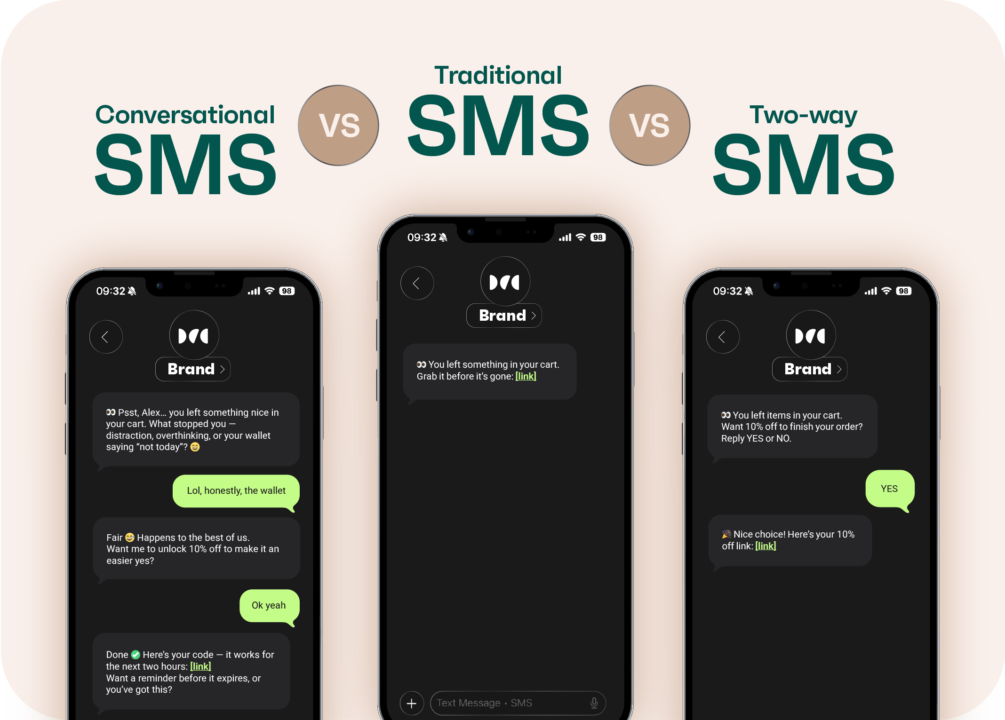
This kind of responsive, back-and-forth experience can be powered by automation, AI, human agents, or a combination of all three.
Seeing real examples from actual ecommerce brands makes it easier to understand what effective text messaging looks like in practice, not just theory. The examples below cover the most common campaign types you’ll use to engage your audience.
Brand name: Draper James
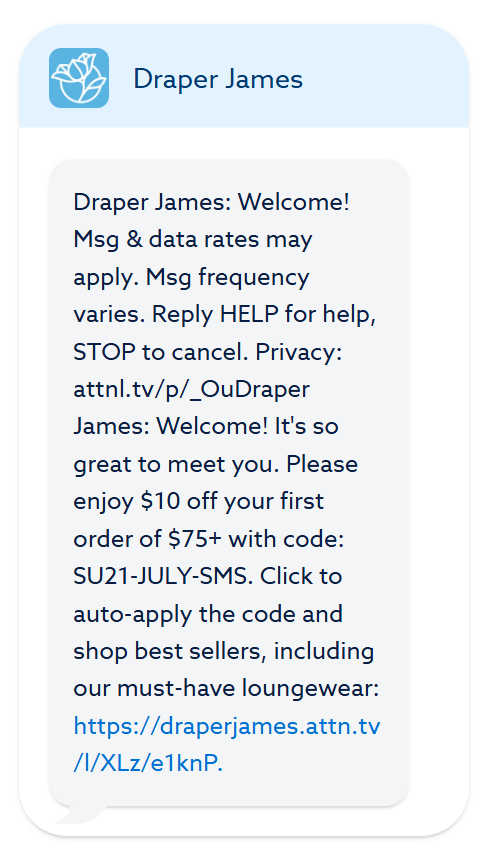
Why this works:
Key takeaway: Always deliver your promised incentive immediately in your very first welcome text, and make the discount code as easy to use as possible.
Brand name: Knix
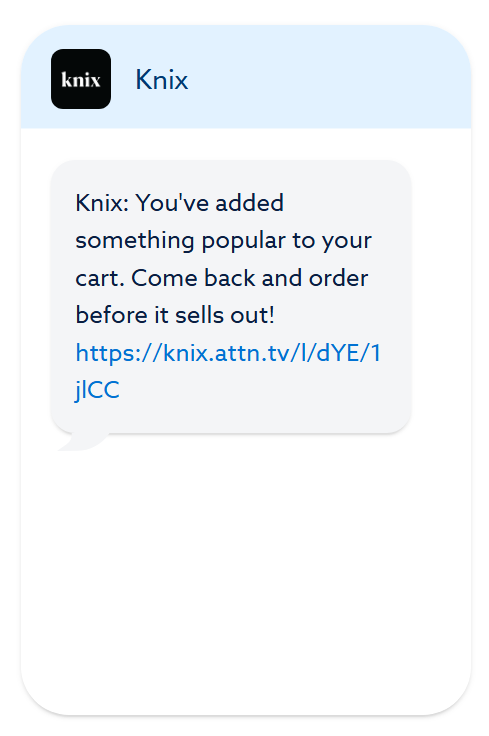
Why this works:
Key takeaway: Make your abandoned cart reminder SMS as easy as possible, preferably with a link that takes the user directly to the checkout page.
Brand name: Lovesac
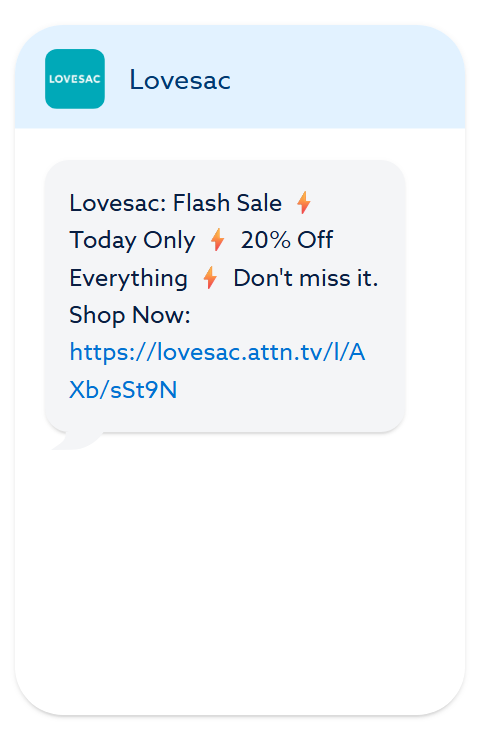
Why it works:
Key takeaway: Use strict time limits to drive immediate action for your promotional messages, and be as concise as possible.
Brand name: Parks Project
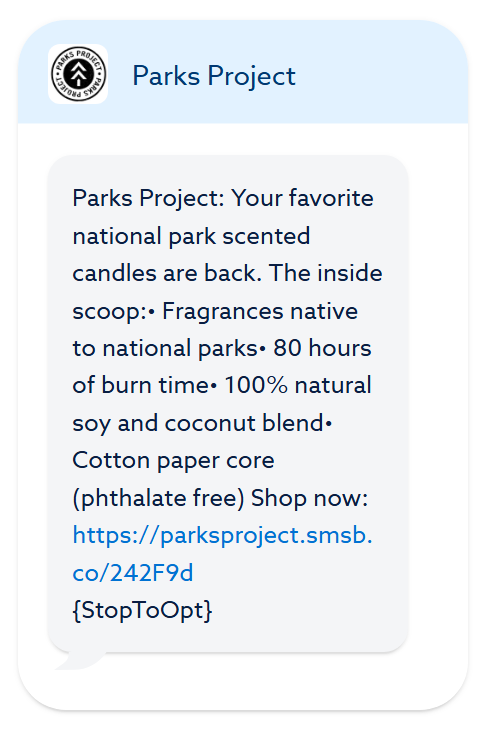
Why this works:
Key takeaway: Capitalize on high-intent shoppers by notifying them the second their desired item is available, but also consider reminding them about the item itself.
Brand name: Forever 21
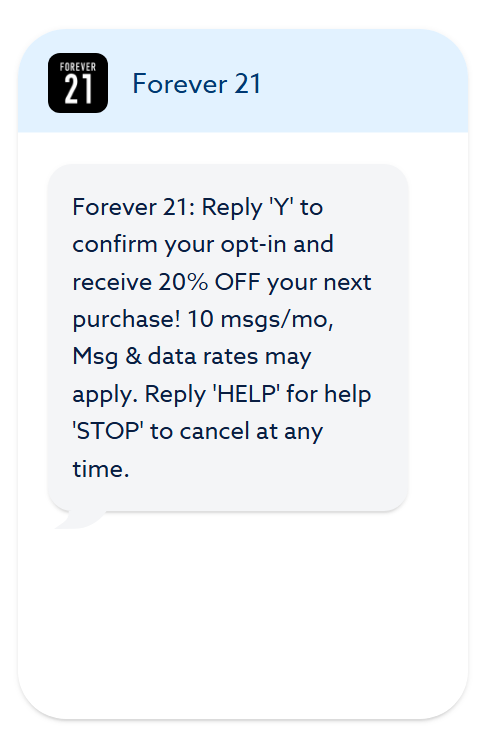
Why this works:
Key takeaway: When asking for opt-in verifications, make sure you communicate everything clearly and give the recipient something extra for their effort.
Brand name: Meet Blume
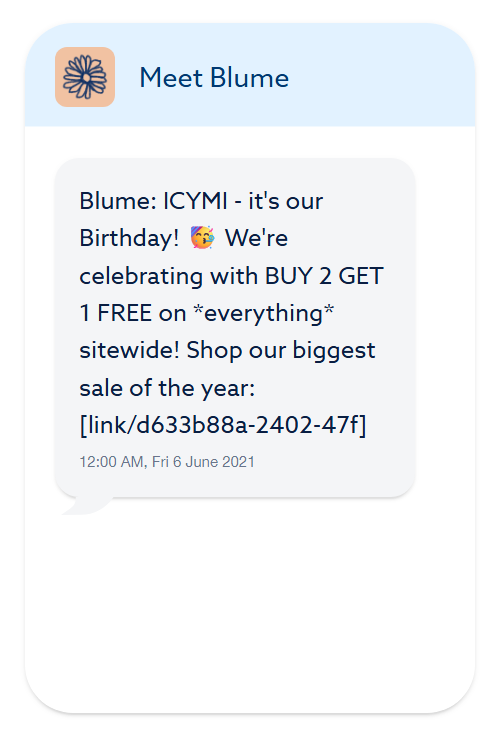
Why this works:
Key takeaway: You don’t have to focus on users’ birthdays alone, as your own birthday can be just as effective.
Building a high-quality SMS list is all about getting genuine opt-ins from your audience, not partaking in lazy list buying. You should never rely on imported phone numbers or coerced sign-ups, because the quality of your list directly affects the success of your campaigns.
To make it as simple as possible: if you send a promotional SMS to someone who doesn’t know you, you’ll get blocked. Or worse, reported.
Here are the best methods to grow your audience naturally:
If you want to learn more specifically about growing your SMS list, check out this video on it:
On another note, maintaining list hygiene is just as important as gathering new contacts. Regularly removing inactive subscribers and honoring opt-outs protects your deliverability and sender reputation. You don’t want to harm them, as it can take a long time to get back where you were.
When it comes to texting your customers, SMS compliance is non-negotiable. Non-compliant SMS campaigns face heavy fines and severe carrier filtering that can quickly destroy your deliverability.
Please note upfront that this section provides a general overview, so for legal advice specific to your business situation, you should consult a qualified legal professional.
While specific laws vary by country, there are universal best practices for compliance that apply across regions. Keep these rules in mind to ensure your text marketing stays on the right side of the law:
Manual management of SMS compliance is prone to error and could be overwhelming, so relying on platforms that do this automatically is your best option. Omnisend, for example, includes TCPA-compliant opt-in flows and automatically handles opt-out processing. It significantly reduces the compliance risk for ecommerce brands and makes life easier for you.
If you think that effective SMS marketing is just about sending messages to your list, think again. The more important part is sending the right message to the right person at the exact right moment. It’s not very easy, but it’s definitely doable.
Here are the key best practices you should follow:
“Brands that rely on automation don’t have to convince people to buy. They’re just responding to customers who have already shown intent.”
— Evaldas Mockus, VP of Marketing, Omnisend
Instead of blasting the audience with SMS, think about building an omnichannel strategy, especially around product launches and holidays. Use SMS selectively so it complements your strategy, not drives subscribers away.
— Andrius Šeršniovas, Conversion Specialist at Omnisend
 | CLVmaxers’ omnichannel strategy CLVmaxers is a boutique agency that focuses on maximizing the customer lifetime value of ecommerce brands. First, they build a solid email foundation, upon which they later add the SMS layer for extra push. This synergy creates a sophisticated strategy that runs mostly on autopilot with occasional manual campaigns. Read the full case study |
Most platforms are great at showing you basic engagement metrics like clicks and opens, but they rarely connect those numbers to actual revenue. And closing that loop is essential because it shows you exactly how much money your text campaigns are generating for your business.
Different metrics answer different questions. Some tell you if a message successfully reached and engaged your audience, while others reveal if that engagement actually drove tangible business results.
Here are the key metrics you need to track:
If you want a platform that allows you to see all these numbers in action, Omnisend’s reporting dashboard tracks all of the above per campaign and per automation flow. Revenue attribution is also built-in, so you can see how much money each campaign generates.
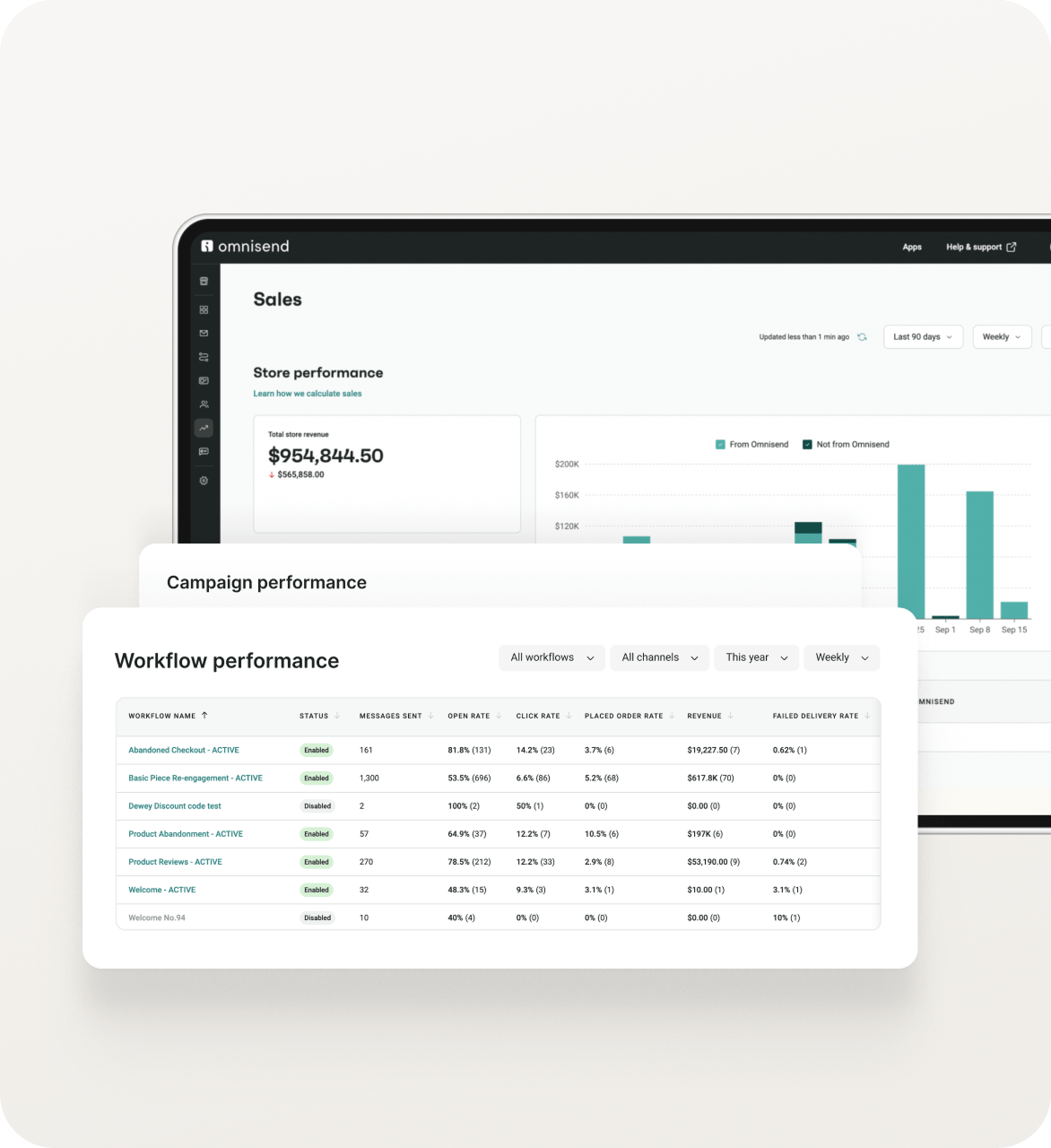
Getting started with text messaging on Shopify or other platforms doesn’t require a massive contact list or a highly complex technical setup. On the contrary, you can have the basics running within just a few hours. The key is to take it step-by-step to build a solid foundation.
Here’s exactly how to launch your text message strategy:
If you want to see a video of how it all works in reality, check out our quick guide on setting up SMS marketing campaigns:
The most important thing is to avoid configuration fatigue. Don’t feel pressured to do everything at once. Start small with a single automated flow, focus on delivering quality messages over sheer volume, and steadily grow your strategy from there. Time is on your side here, so don’t rush it.
SMS marketing offers a direct line of communication to a highly engaged, opted-in audience. If you pair text messages with email marketing, it can become a serious engine of ROI for your business.
The best part about it is that you don’t need to implement a complicated strategy right from the start to see results. The brands that get the most out of text messaging are the ones that start simple with a basic welcome flow or an abandoned cart reminder, and steadily build from there. As cliche as it sounds, Rome wasn’t built in a day.
If you’re looking for the right platform, Omnisend is built specifically for ecommerce email and SMS marketing. It offers global SMS coverage, behavior-triggered automations, and TCPA-compliant list-building tools.
What’s more, because email and SMS live under one roof, you don’t need to sign up for different tools and handle different tabs and bills. And if you missed it, keep in mind that Omnisend customers earn $79 back for every $1 spent, which is one of the strongest documented ROI figures in the industry.
Quick sign up | No credit card required
Text marketing is a digital strategy where brands send promotional, transactional, or conversational messages directly to a subscriber’s mobile phone. It’s a permission-based channel, which means you can only text people who have explicitly opted in to receive communications from your business. Texting people who haven’t signed up for it is a strict no-go.
Yes, these terms are usually used interchangeably. SMS stands for Short Message Service, which is the technical term for a standard text message. If a message includes media like an image, a GIF, or a video, it’s called an MMS, but most people just call it texting.
Yes, it’s entirely legal, but only if you follow regional compliance regulations like the TCPA in the US. The most critical rule is that you must have explicit consent from the recipient before texting them, and you must always provide a clear way to opt-out. Anything less than that is just asking for trouble.
Yes. In fact, it’s incredibly effective. Text messages hold an average open rate of 98%, with most being read within minutes. Because you’re reaching an opted-in audience directly on their phones, it drives high engagement and strong returns, especially when paired with an email strategy. Just make sure you stick to the sending frequency you promised; otherwise, you could annoy your audience, and they will unsubscribe.
You make money by sending targeted offers to high-intent shoppers. The most profitable strategy, especially for ecommerce brands, is using automated messages (abandoned cart reminders, welcome discounts, post-purchase follow-ups, etc.). Once set up, they work without your continuous input and convert subscribers into paying customers.
First, choose a platform like Omnisend that handles both email and SMS. Next, secure a compliant phone number, launch a welcome flow, and set up a website popup to start collecting opted-in contacts.
Most ecommerce brands stick to sending one text campaign per week or two to four SMS per month. You can find your own number with time by following engagement metrics and paying close attention to the unsubscribe rate. If people start unsubscribing rapidly, you may want to slow down and see if it stops.

TABLE OF CONTENTS
TABLE OF CONTENTS

What’s next


No fluff, no spam, no corporate filler. Just a friendly letter, twice a month.