Omnisend AI
 OFFER
OFFER




The best time to send Black Friday emails varies by audience, but our internal data shows 6-9 AM and 8-10 PM consistently outperform midday sends.
Email type influences send times too. Early access teasers work best at 6 AM for eager VIPs, flash sales need lunchtime urgency, and last-chance emails perform at 8 PM when FOMO peaks.
Whichever campaigns you create, tools like Omnisend let you schedule emails and build automation flows for segments, which trigger based on the rules you set for optimal timing.
Additionally, Omnisend’s new Optimize Send Time for Better Performance feature can now handle this timing automatically for each individual contact.
Join us below to learn when to send Black Friday emails and how to optimize your messaging for maximum sales in 2026.
Visit our Black Friday hub for articles, videos, podcasts, tools and more to help you succeed
Quick sign up | No credit card required
Why Black Friday email timing matters
Black Friday email timing matters because customers receive dozens of promotional messages every hour, and businesses should aim for when competition is lowest and attention is highest. Black Friday timing determines whether your emails get opened or buried.
Timing also directly impacts revenue. An email opened within the first hour typically generates more clicks than one opened after six hours. Fresh emails get attention, while buried emails get deleted. Each hour of delay reduces your campaign’s earning potential.
Time zones create additional challenges. Your 9 AM EST email hits California at 6 AM when people are asleep and London at 2 PM during their afternoon slump. Single-send strategies force you to pick winners and losers among your audience segments.
The risk is that you compound the problem by following the same playbook: sending at 9 AM, noon, and 5 PM. These peak times create inbox traffic jams where your message drowns in the competition and fails to generate revenue.
What is the best time of day to send Black Friday emails?
Common send windows are 6–9 AM for deal hunters, 12–2 PM for lunch-break shoppers, and 8-10 PM for after-work shoppers. Black Friday creates the most crowded inbox environment of the year, so send times can double or halve your open rates, directly impacting revenue. Your optimal windows depend on customer habits, time zones, and what your competition does.
Common send windows
- Morning (6–9 AM): Deal hunters check phones before getting out of bed. They’re comparing prices, making lists, and planning their shopping day. Open rates peak, but purchases might wait until later.
- Midday (12–2 PM): Lunch breaks mean time to browse and buy. Credit cards come out, and abandoned carts get completed. These customers moved past research into buying mode.
- Evening (8–10 PM): Relaxed shoppers make impulse decisions. Last-chance messaging works because FOMO peaks when people have time to think about missing out. Purchase rates often exceed morning sends.
The table below shows what time to send Black Friday emails for different email types:
| Email type | Optimal time | Why this timing works |
|---|---|---|
| Early access teasers | 6–7 AM | Loyal customers check email first, want exclusive deals |
| Main sale launch | 8–9 AM | Catches morning email routine, provides all-day shopping window |
| Flash sales | 12–1 PM | Lunch browsers are ready to make quick purchases |
| Inventory updates | 3–4 PM | Reminds shoppers about available items during the afternoon lull |
| Final hours | 8–10 PM | Evening shoppers respond to urgency messaging |
| Thank you/preview | 11 PM–12 AM | Post-purchase excitement leads to future planning |
Your data overrides any general advice. If most customers consistently open by 7:30 AM, send your emails before then, regardless of conventional wisdom.
When to start sending Black Friday emails (October kick-off)
Mid-October offers clearer inboxes and receptive audiences building their gift lists, so start then. Brands beginning campaigns in late November compete with hundreds of messages daily, and in terms of Black Friday competition, it means starting early or getting buried.
Brands sending emails during the week of October 22 saw order increases of 26% in 2023 compared to the previous year, according to Omnisend data. Early engagement provides list segmentation opportunities and customer insights before November chaos.
Early October strategy
Send “coming soon” teasers featuring your best products. Build VIP lists for early access. Share gift guides helping customers plan purchases. These touchpoints prepare subscribers without triggering fatigue. Early October emails should provide value, not push sales.
Mid-to-late October execution
Launch pre-sale events for loyal customers. Test subject lines and content formats while open rates stay higher. Build automated sequences for cart and browse abandonment, as workflows need refinement before traffic spikes. Mid-to-late October shifts toward offers.
Learning from October’s data
Products with high click rates deserve featured placement in November campaigns. Low performers get cut or bundled. Watch which subject lines drive opens: “Early Bird Special” might outperform “Exclusive Preview” for your audience. October reveals your winners and losers.
Early data shapes inventory decisions. If kitchen gadgets generate 3x more clicks than beauty tools, adjust your November focus accordingly. Order extra stock for proven performers before suppliers run out. October essentially becomes your testing ground for Black Friday success.
Best days to send Black Friday emails in November
Combine email and SMS across the November 22–December 1, 2026 window to beat competitors. Let the show begin during the first days of the month. That’s the time to start sending irresistible marketing messages and increasing your email cadence.
Also, consider supplementing emails with SMS messages. You can send an SMS to those who didn’t open your emails or to your most engaged customers to increase their anticipation even more.
November 13th can be another holiday season tentpole. Two weeks before Black Friday, you can expect significant growth in competition. Don’t let other retailers steal your customers: it’s time to reveal your trump cards and create more actionable campaigns for these days.
If nothing else, you can reinforce them with Black Friday SMS.
Finally, the Cyber 10. This period usually starts towards the end of November and concludes on the Tuesday following Cyber Monday, marked by the day known as Cyber Tuesday.
These 10 days are the peak time for Black Friday. Arm your emails and SMS with the best deals and offers. It’s most likely that Thanksgiving Day, Black Friday, and Cyber Monday will be the most intense both in sales and competition-wise.
It’s worth noting that Cyber 10 doesn’t always start on a Monday. It usually begins on the Sunday before Black Friday and finishes on the Tuesday after Cyber Monday.
This year, you still have an opportunity to hop on and maximize your revenue during this period. Here’s a complete list of Cyber 10 dates in 2026:
| Day | Date |
|---|---|
| Day 1 | 11/22/2026 |
| Day 2 | 11/23/2026 |
| Day 3 | 11/24/2026 |
| Day 4 | 11/25/2026 |
| Day 5 | Thanksgiving |
| Day 6 | Black Friday |
| Day 7 | 11/28/2026 |
| Day 8 | 11/29/2026 |
| Day 9 | Cyber Monday |
| Day 10 | Cyber Tuesday |
Here’s what those dates mean for your Black Friday timeline:
- Days 1–4 are pre-Thanksgiving buildup days
- Day 5 is Thanksgiving
- Day 6 is Black Friday
- Days 7–8 are the weekend after Black Friday
- Day 9 is Cyber Monday
- Day 10 is Cyber Tuesday (the day after Cyber Monday)
Ultimately, remember not to wait until Black Friday to start your deals. Promote them in advance.
These are a few email content ideas:
- Sale announcement emails
- Thanksgiving Day emails
- Sale reminder emails
- Final hours emails
- Best-sellers on sale emails
- Cyber Monday emails
- Cyber Tuesday (the last chance) emails
Best practices for perfect Black Friday email timing
Segmenting for relevance, maximizing reach with resends, layering channels, and testing help you reach more customers and generate better results throughout the campaign. Note that Omnisend’s send-time optimization feature (covered later in the article) can handle this timing automatically per contact.
Segment for relevance
Send early access to loyal customers at 6 AM when they check their email first. New subscribers get product education at lunch when they have time to browse. Geographic segments need region-specific timing, too. VIPs deserve different treatment from first-time subscribers.
Maximize reach with resends
Send campaigns again 24–48 hours later using fresh subject lines and different timing. Morning non-openers might engage with evening sends. Change “Black Friday Starts Now” to “Final Hours: 40% Off” to create renewed urgency. Many subscribers miss your first email.

Fashion retailer Naked & Famous Denim recorded 7.47% additional revenue using Omnisend’s automated resending, reaching 2,100 extra subscribers per campaign.
Layer channels for better results
Add SMS to critical touchpoints: cart abandonment, flash sale alerts, and final hour reminders. Customers who miss emails often see text messages immediately. Omnisend lets you add SMS to any email automation workflow. Email alone misses opportunities.
Test and adjust throughout
A/B test send times starting in October. Track open rates and let customer behavior and results guide your Black Friday schedule. Additionally, try multiple Black Friday email templates to see which designs get the most clicks. What worked last year might fail today.
Let Omnisend find the best send time for you
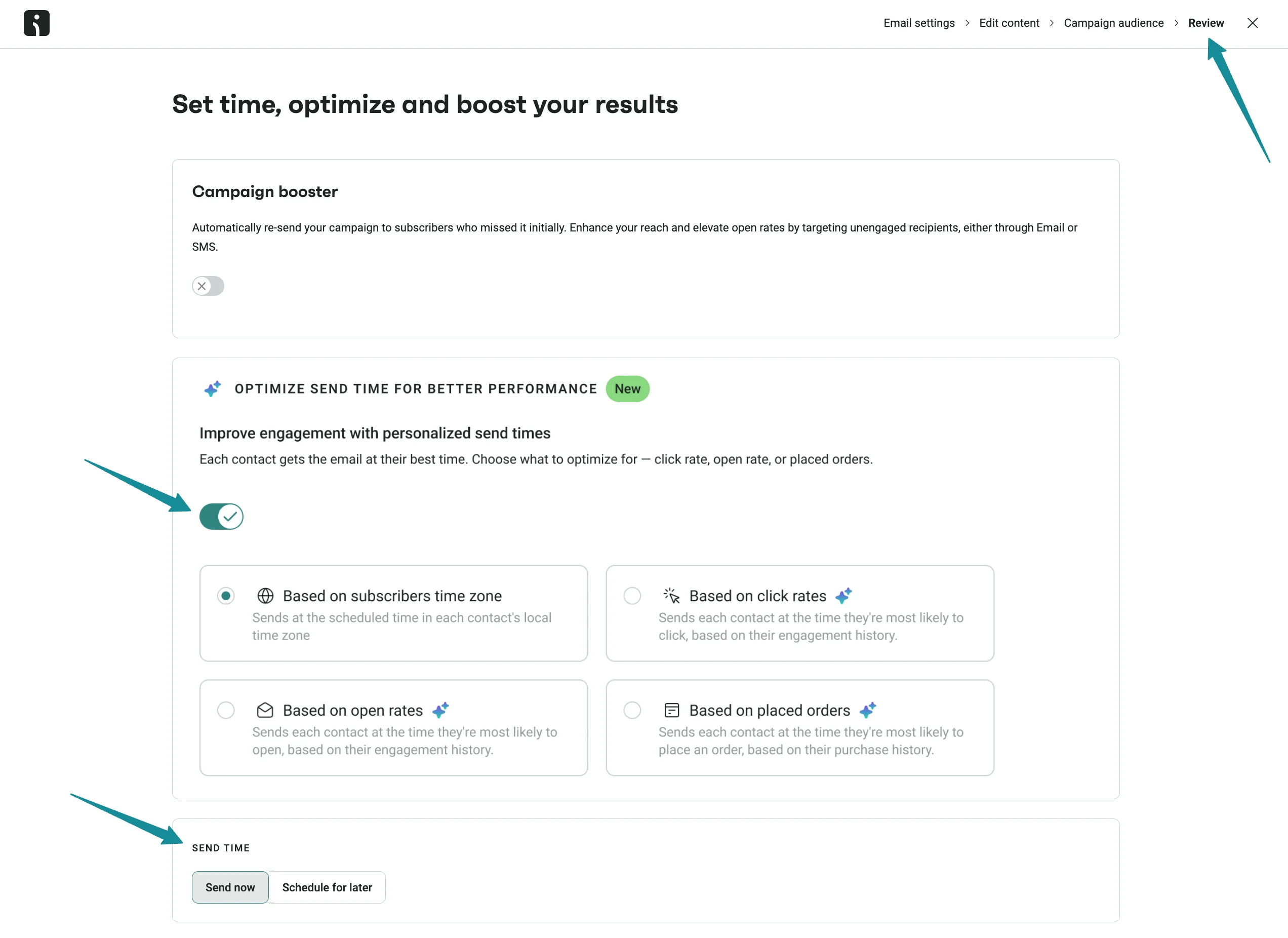
Use Omnisend to time each contact’s email individually instead of trying to guess the perfect send time for your entire list. The feature fixes the time zone and inbox competition problems by delivering messages when subscribers are actually active.
When scheduling your campaign, you just pick the date, and Omnisend then evaluates each contact and selects the exact hour they should receive the email within a 24-hour window.
You can choose from four distinct delivery modes:
- Subscriber’s time zone: Sends at the same local time for everyone, regardless of where they live.
- Click rates: Sends when a contact is most likely to click a link.
- Open rates: Sends when a contact is most likely to open the email.
- Placed orders: Sends when a contact is most likely to make a purchase.
To use the engagement-based delivery modes, your store must have previously sent at least 10 email campaigns. You also need to be on the Pro plan or have the Personalized sending time add-on. Please note that this optimization feature is available for email campaigns only.
Send Black Friday emails that actually get opened
Start campaigns in mid-October to build anticipation. The best time to send emails overall is at unconventional times to avoid inbox competition. Segment your audience for relevant messaging at optimal moments, and test resend strategies to capture missed opportunities.
Better yet, use Omnisend’s send-time optimization feature to remove the guesswork altogether and automatically deliver messages when each individual subscriber is most active.
Your data beats industry benchmarks every time. Track when your customers open, click, and buy. Use October to test and refine your approach before November’s chaos. Remember that timing varies by audience segment, geographic location, and email type.
In short, Black Friday email success comes down to timing strategy, not luck.
Quick sign up | No credit card required
Best time to send Black Friday emails: FAQs
When should I start sending Black Friday emails?
Should I send Black Friday emails on Thanksgiving?
Is it better to send Black Friday emails in the morning or the evening?
Does timing change for Black Friday vs. Cyber Monday?
Can Omnisend automatically pick the best time to send my Black Friday email campaigns?
It automatically evaluates each subscriber’s engagement history, and you can choose to optimize based on a contact’s past open rates, click rates, placed orders, or their local time zone.
Omnisend automatically delivers your email campaign within 24 hours at the time when the subscriber is statistically most expected to engage.