Omnisend AI

 OFFER
OFFER




![Black Friday marketing: Strategies, ideas, and examples [2026]](https://www.omnisend.com/blog/wp-content/uploads/2026/08/BF-Marketing-1280x720.webp)

Black Friday marketing is how ecommerce brands plan and promote their Black Friday and Cyber Monday offers. It can cover email, SMS, push, and paid ads from early list-building through the Cyber Monday campaign.
Build your campaign around nine steps: review past results, grow your list, segment audiences, choose offers, prepare automations, schedule messages, coordinate ads, connect Black Friday with Cyber Monday, and follow up after purchase.
Quick sign up | No credit card required
Plan early with last year’s data
Begin reviewing results and planning resources in July or August where possible, four months before the November 27, 2026 sale date. Review last year’s Black Friday results before deciding on products or discounts; your store data will show what generated sales and what reduced profit.
Focus on these four key areas before you build your campaign:
- Top-selling products that performed well without heavy discounts
- Discount levels that increased sales without reducing profit too much
- The busiest shopping days and hours during the campaign
- Cart abandonment rates to identify opportunities for automated recovery emails
Once you know when your customers are most active, use that data to determine the best time to send Black Friday email campaigns. If this is your first Black Friday marketing campaign, start building your email list as early as possible. Create a clear schedule for the months ahead.
| Month | What to do |
|---|---|
| July–August | Pull last year's numbers, set revenue and list goals |
| September | Grow your list, lock offers and discount depth |
| October | Build segments and flows, warm the list |
| Early November | Send teasers, open early access to subscribers |
| November 27–30 | Launch, restock, send the last-chance email |
Don’t rely only on industry averages when planning your Black Friday marketing campaigns. Your own sales data shows what drives results. Use a Black Friday checklist to keep every task on schedule and reduce last-minute mistakes.
How to set clear Black Friday goals
Set goals for four metrics: average order value, customer reactivation, new customer acquisition, and inventory targets.
Here’s why:
- AOV (average order value): Bundle complementary products and create minimum purchase incentives
- Customer reactivation: Send exclusive previews to customers who bought last year but went quiet
- New customer acquisition: Monitor new customer numbers and segment them for appropriate targeting
- Inventory targets: Set baselines for sales numbers across all categories
Track these metrics weekly during your campaign.
Why you should audit your website and tech stack
Your site will face its highest traffic during BFCM. One crash during peak hours can cost you thousands in lost sales. Run this audit by September:
- Mobile optimization: Most traffic arrives via phones. Test your entire purchase flow on mobile devices to ensure a seamless experience. Fix any elements that require zooming or horizontal scrolling.
- Site speed: Slow pages kill conversions. Compress images, remove unused apps, and upgrade your hosting plan if your current plan struggles to handle regular traffic.
- Checkout flow: Remove unnecessary steps. Guest checkout should be prominent. Payment options should include digital wallets for faster completion.
- Email capacity: Confirm your email service can handle increased volume. Some providers throttle sends, which delays time-sensitive campaigns
Grow your list before the sale
Build your subscriber list before Black Friday to reach more shoppers on launch day. Strong list growth is among effective Black Friday marketing tactics because it reduces dependence on paid traffic.
Use these Black Friday marketing ideas to increase sign-ups:
- Offer a sign-up form or early-access Black Friday popup that exchanges an email address for exclusive access or a discount
- Use a multi-step form, so you collect an email first, then a phone number for SMS updates
- Give new subscribers an early-bird offer before the sale begins ( Omnisend’s BFCM research found this to motivate 33% of shoppers)
- Test a Wheel of Fortune pop-up if you want an engaging alternative to a standard discount pop-up
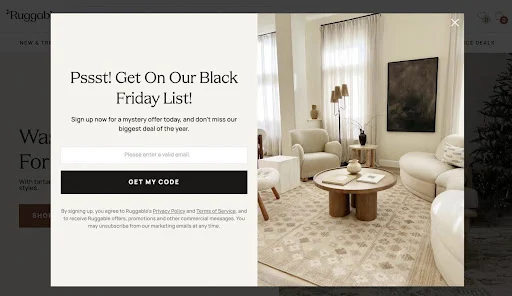
Keep the pop-up to one step, field, and action. Use a single call to action button to reduce friction, just like Ruggable’s form below.
Forms, segments, and automations all run on Omnisend’s free plan, which includes most of its ecommerce-focused features. So, the whole capture setup can be live before you pay anything.
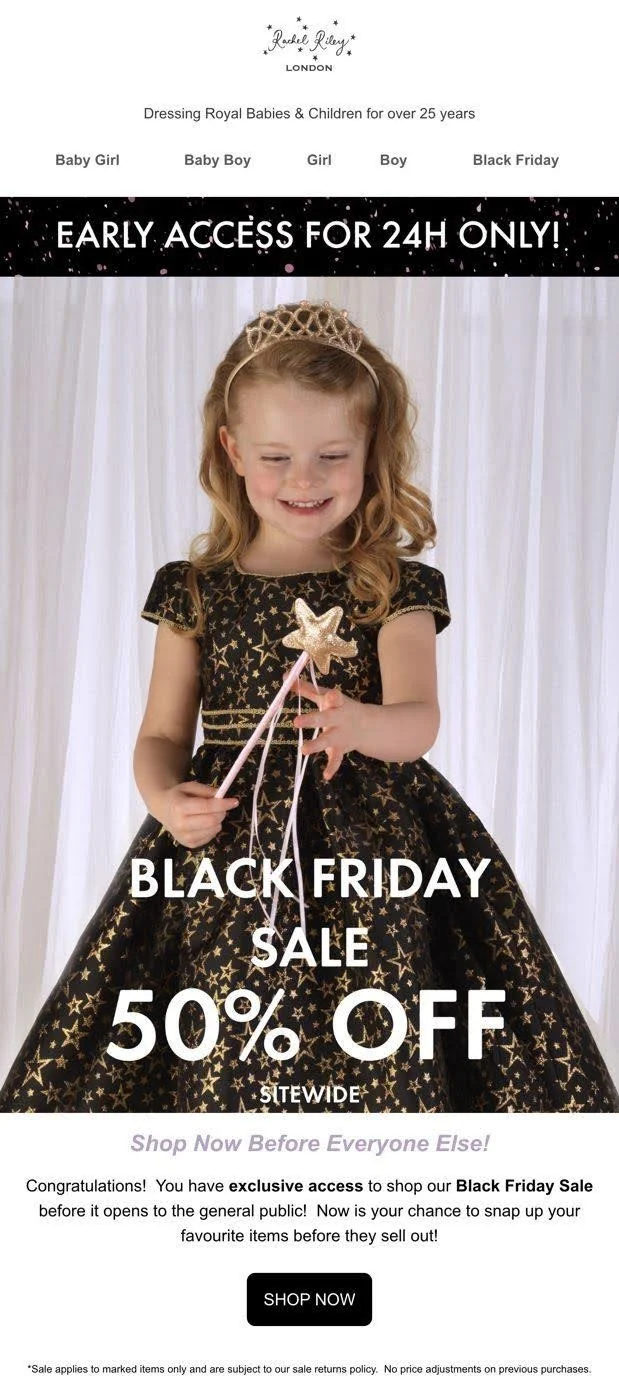
Give shoppers reasons to join your list and reward sign-ups with early access, like Rachel Riley’s campaign below.
Quick sign up | No credit card required
Segment your email and SMS lists
Segment your Black Friday marketing list by what shoppers have done in your store, like bought, abandoned, or only browsed. Build those groups in Omnisend, then send different BFCM offers instead of one sitewide discount.
This is one of the effective Black Friday marketing strategies that increases relevance even without giving discounts.
You can create advanced Black Friday customer segments based on shopping behavior.
| Segment | How to define it | BFCM offer | Best channel |
|---|---|---|---|
| VIPs (top spenders) | Top 10% of customers by revenue over the last 12 months | Early access 24-48 hours before the sale | Email/SMS |
| At-risk customers | Purchased before but haven't engaged for 6-12 months | A win-back offer with a reason to return | Email, followed by SMS |
| Cart abandoners | Added products to their cart but didn't complete the purchase | The abandoned products with a purchase deadline | Automated email and SMS |
| Price-sensitive shoppers | Used a discount code for at least 50% of previous orders | Your simplest Black Friday discount | Email on launch day |
| Full-price buyers | Rarely use discount codes | Early access or new arrivals | |
| Recent buyers | Purchased during the current Black Friday campaign | Product recommendations | |
| SMS subscribers | Opted in to receive text messages | Launch announcements, flash sale alerts, and final-hours reminders | SMS |
Create each segment once and reuse it across email, SMS, and paid advertising. Omnisend’s AI feature can build customer segments from a plain-language prompt.
Also, its RFM analysis groups shoppers by purchase recency, frequency, and spending. Both features are available on the free plan.
Dukier generated about 45% of its email revenue from segmented campaigns during peak sales events like Black Friday, which drove 525% business growth.
If you want a deeper look at building high-performing audience segments, this webinar walks through the process step-by-step:
Decide how deep to discount, and what to offer instead
Choose discount depth using your product margins, previous promotion results, and campaign goal. Calculate what remains after the discount, product costs, fulfillment, and marketing costs. If a percentage discount leaves too little margin, test a bundle, gift, spending threshold, or early-access offer instead.
These four Black Friday ecommerce ideas cover the discount options:
- Tiered discount to raise average order value (AOV), as shown in the table below.
| Spend | Discount | Purpose |
|---|---|---|
| $50+ | 10% off | Entry rung near your average basket, so a $40 order rounds up |
| $100+ | 15% off | Turns one item into two, the biggest jump in the ladder |
| $150+ | 20% off | Stays inside the tested range and rewards your top spenders |
- Bundles and buy one, get one (BOGO) to move slower stock and grow the basket
- Free gift over a spend threshold to protect your headline price
- No discount at all for a premium brand, leading with access, service, or a cause
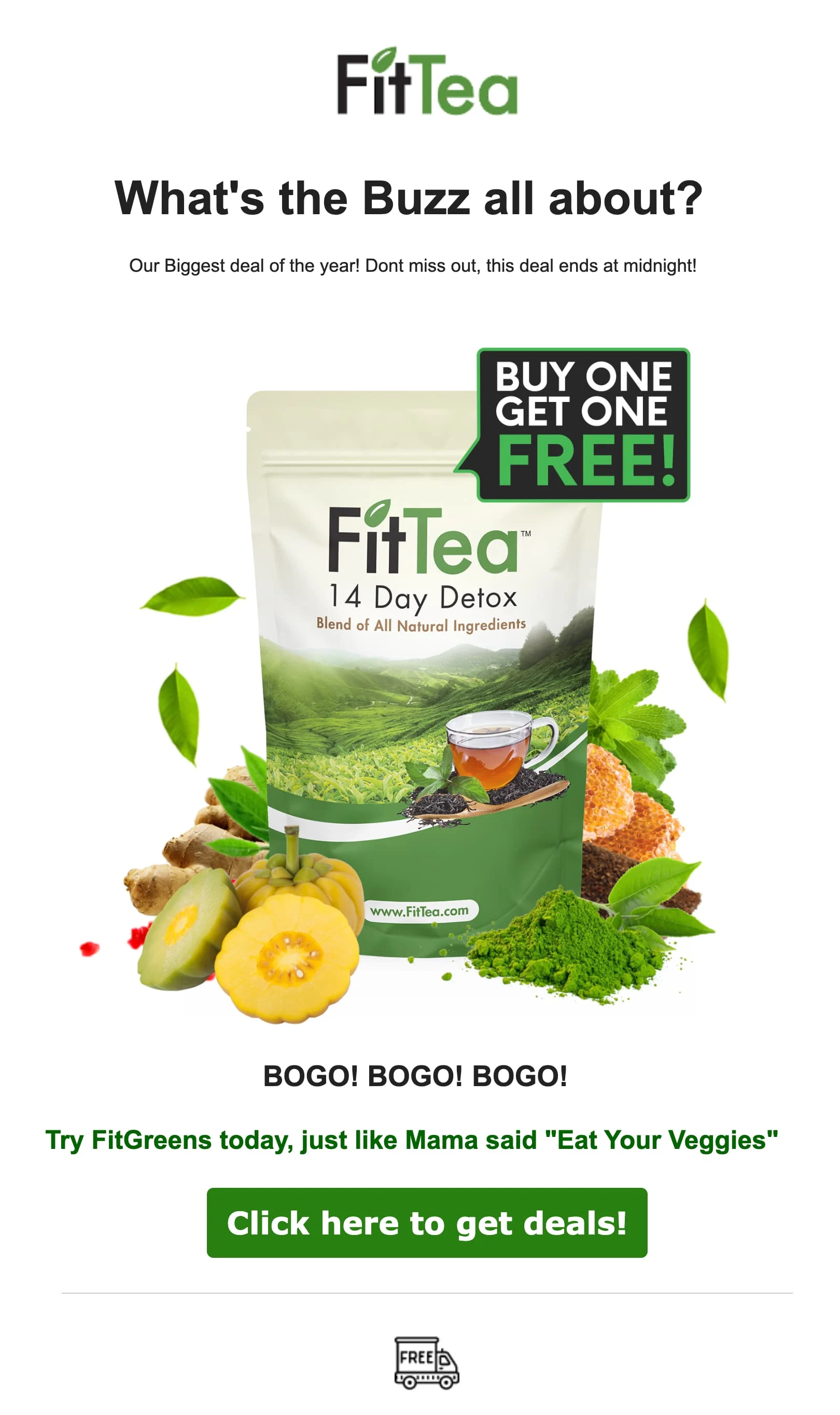
Brands have used these different discount types for their Black Friday marketing campaigns. For example, FitTea keeps its promotion simple with a BOGO offer that expires at midnight.
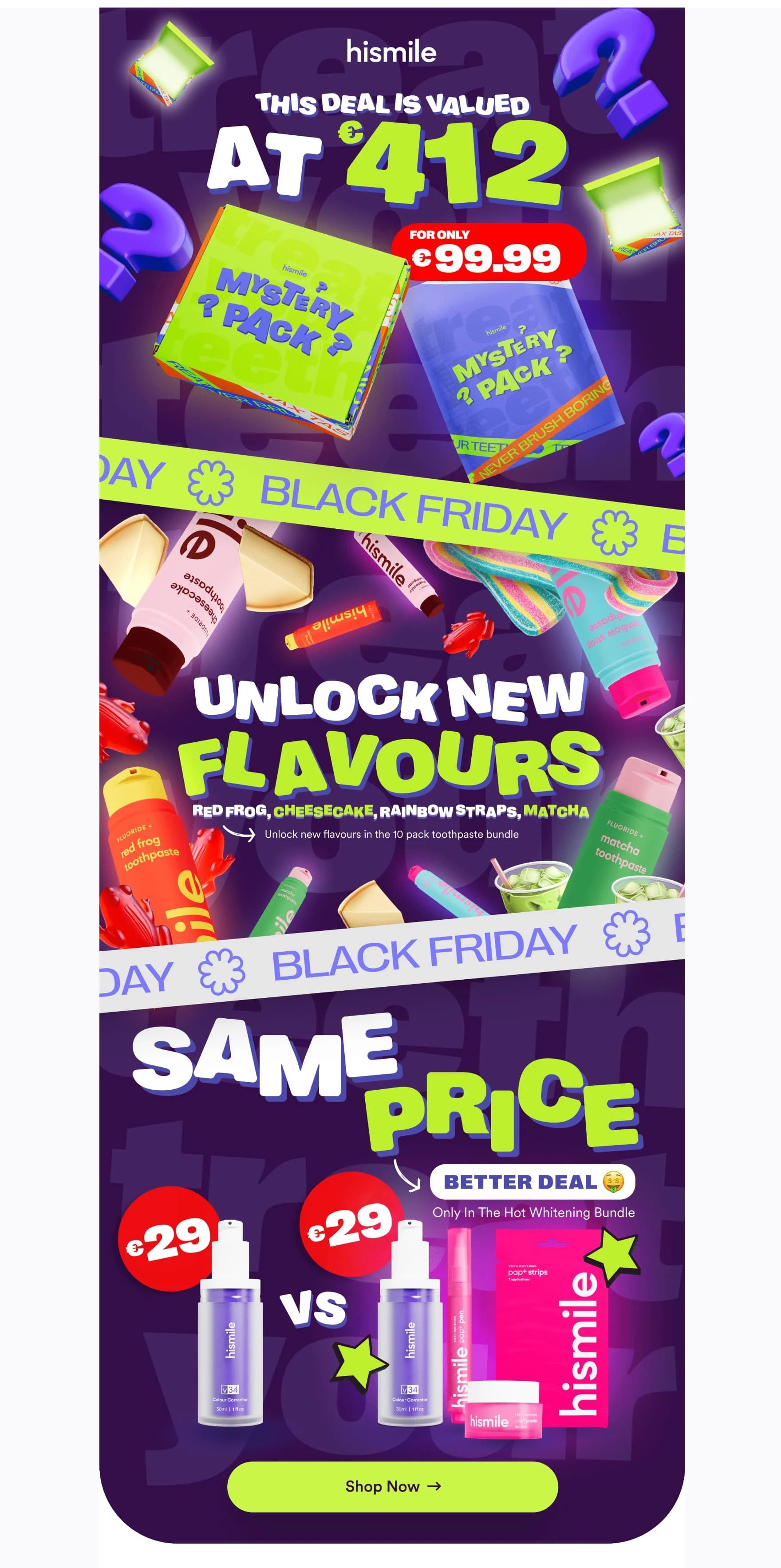
Hismile takes the bundle route – it packages products into one BFCM offer instead of discounting each product separately.
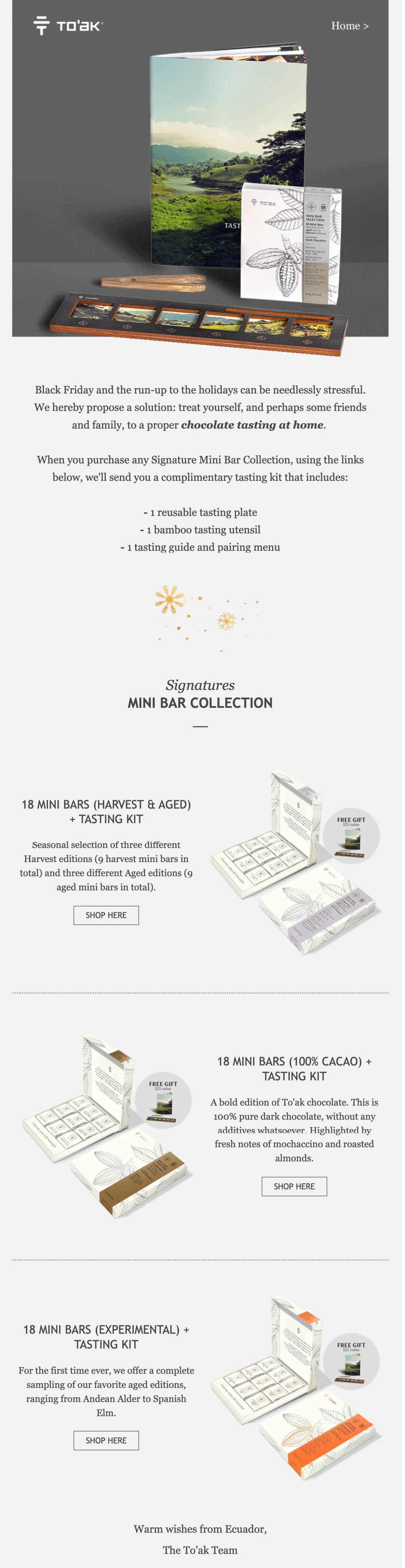
To’ak rewards higher-value orders with a complimentary tasting kit instead of offering another discount.
Amundsen skips discounts altogether and offers customers free waffles in its stores during the campaign.
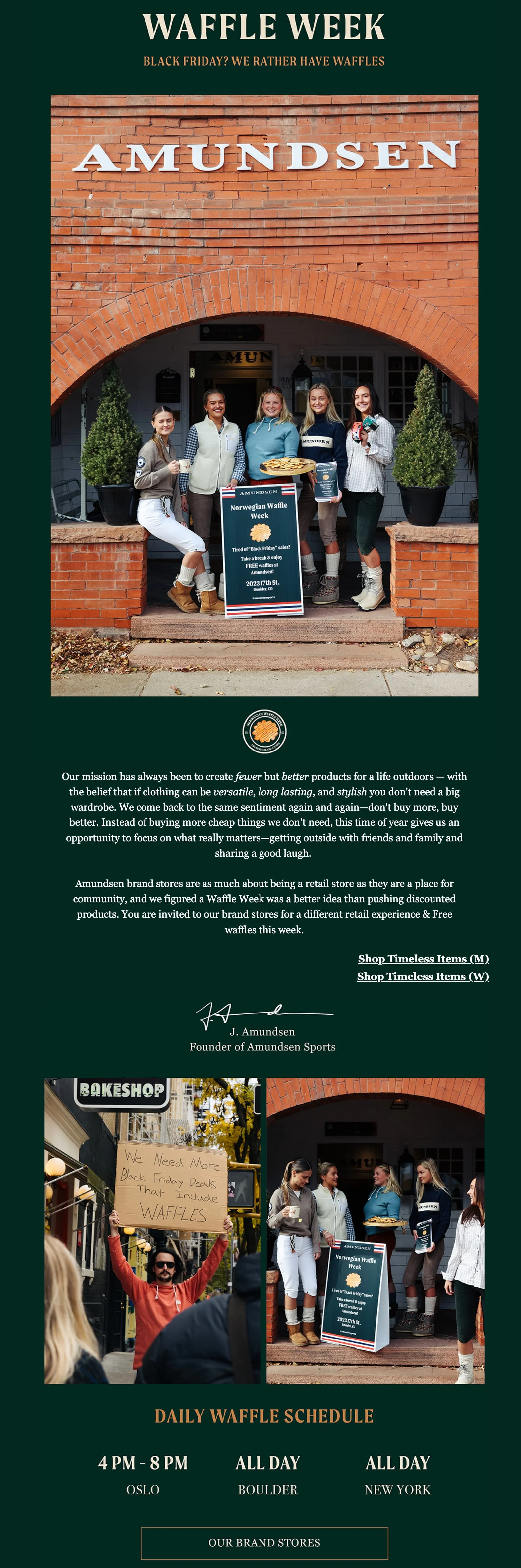

Amundsen’s abandoned cart email achieved a 57% conversion rate. It delivered 1,598% higher revenue per email than promotional campaigns, even without offering a discount.
1. Tiered discounts
Tiered discounts encourage customers to add more items to reach the next discount level. Your average order value increases as customers convince themselves they’re saving by spending more. Set thresholds just above your current AOV to maximize the stretch.
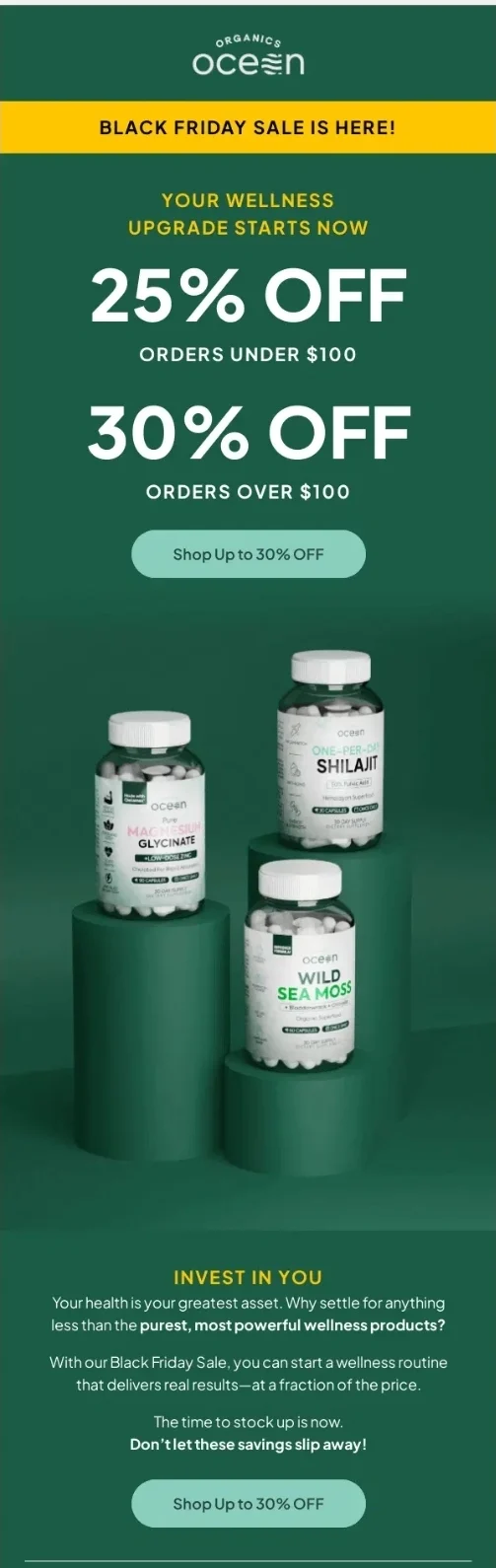
Organic Ocean uses tiered discounts to encourage higher spending. Customers get 25% off orders under $100 and 30% off orders above $100:
2. Product bundles
Pair slow-moving items with bestsellers. For example, skincare brands bundle cleansers with moisturizers. Electronics retailers pair phones with cases and chargers.
Product bundles solve two problems at once: they clear excess stock and introduce customers to products they might not buy individually. Price the bundle 15–20% below individual products to create obvious value.
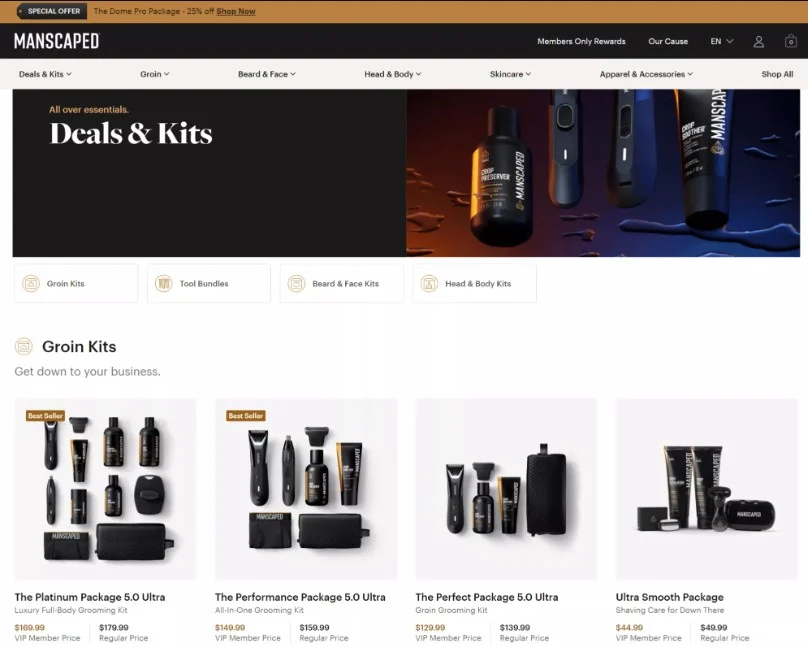
Grooming brand Manscaped provides additional sales tactics you can use for your bundles, including VIP member prices and “Best Seller” labels:
3. Buy one, get one (BOGO)
BOGO works well for consumable products that customers like to buy regularly. Use it for items with healthy margins, so that the offer remains profitable even after the discount.
Variations like “buy two, get one free” or “BOGO 50% off” let you control margins better. Use BOGO to move seasonal items before they become dead stock.
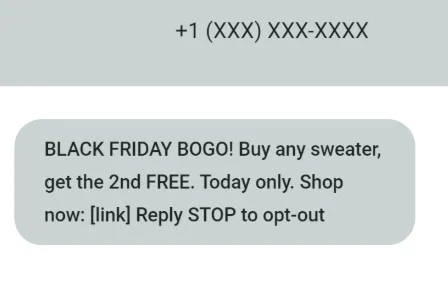
Here’s an example of a Black Friday SMS offering BOGO:
4. Freebies with purchases
Offer a free gift when customers reach a set order value. Choose gifts that cost little but can still feel valuable to customers. Sample sizes, exclusive products, and excess stock can work well for this offer.
You control the cost while customers focus on the bonus value. You can also use gifts to introduce new products that might become future purchases.
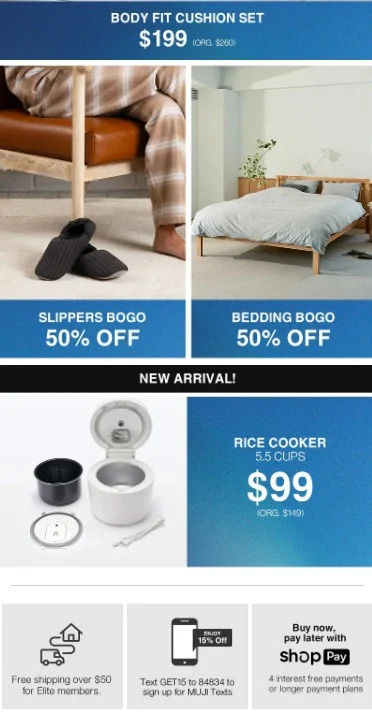
MUJI USA increases order value by pairing its Cyber Week discount with a spending incentive. Customers get up to 30% off, plus free shipping when they spend $50.
Best Black Friday promos for engagement
Your CLV (customer lifetime value) grows with experiences worth returning for, such as exclusive access and gamified shopping, instead of one-time deals and offers that train customers to wait for sales.
Use these Black Friday promo ideas to increase customer engagement:
5. Mystery discounts and gamification
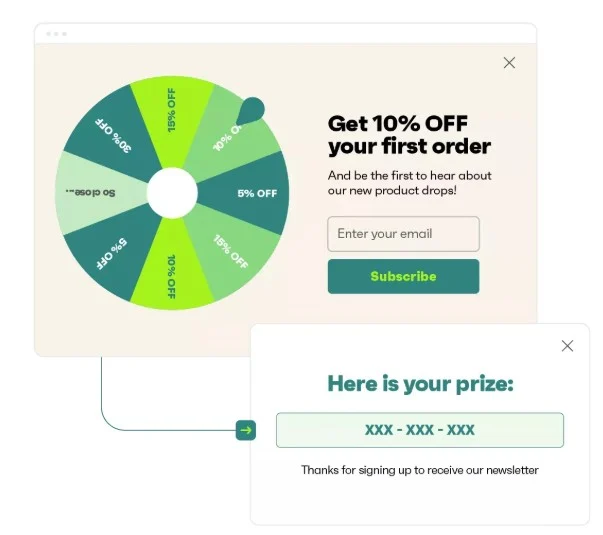
Use mystery discounts to make your Black Friday offers more interactive. Add a Wheel of Fortune-style pop-up or reveal the discount after customers add items to their cart.
The image below shows a Wheel of Fortune pop-up created in Omnisend. The second image shows the prize, which appears after submission:
Even a slight discount, such as free shipping, can improve sales, and a portion of your customers will appreciate the anticipation more than knowing every discount upfront.
6. Flash sales by hour or day
Run different offers on different days during your Black Friday campaign. For example, Monday could offer 40% off products. Tuesday could offer 30% off bestsellers. Wednesday could offer free shipping.
Offering daily deals can get customers to return throughout the week. Hourly sales are suited for stores with high traffic. Smaller stores, on the other hand, may find frequent sales harder to manage. Use time-limited offers and countdown timers to create urgency without devaluing your catalog.
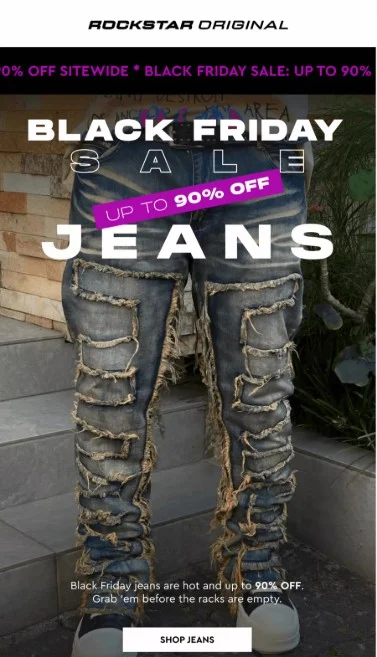
Rockstar Original creates Black Friday flash sale emails, with the one below leading with the subject line, “👖 Fire Flash Sale: Up to 90% OFF Denim.”
7. VIP and subscriber exclusive deals
Run early BFCM sales for your email subscribers, so the people on your list get first pick of your Black Friday offers. SMS subscribers could receive an extra 10% off. Loyalty members could get free shipping on all orders.
Exclusivity makes customers feel special and justifies joining your list. Promote these perks across Black Friday to grow your subscriber base for future campaigns.
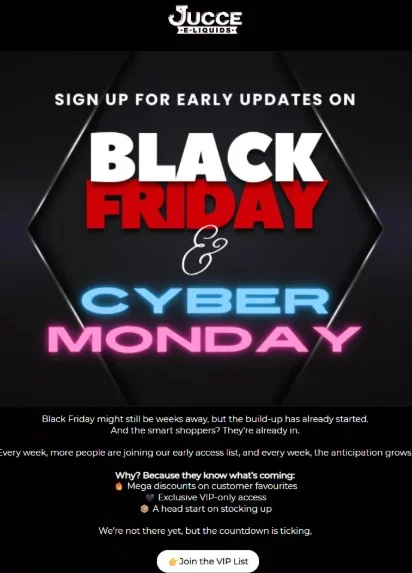
For example, check out this email from Vape Jucce, which uses the subject line “The Countdown Continues… Are You In? ⏳” to promote its VIP list:
8. Free shipping thresholds
Baymard Institute research data showed that extra costs at checkout are the primary reason behind abandonment rates for 40% of shoppers in 2025. So, it pays to offer free shipping thresholds that reward larger purchases.
“Free shipping on orders over $75” often outperforms “15% off everything” for conversion rates because it encourages engagement.
Add your free shipping offer to a top banner on your site, and create SMS campaigns promoting it, like this one:
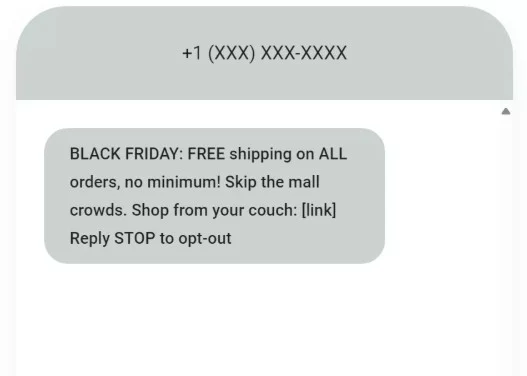
Set your free shipping threshold based on current order patterns and average order value. If your AOV is at $60, put free shipping at $75. This way, customers get a clear target, and the threshold isn’t too difficult to reach.
Expert tips for choosing promotions
Test different offers with smaller customer segments before BFCM to see which ones perform best. The offers that work for fashion stores may not work for electronics retailers. So, use your customer data to choose promotions instead of copying competitors.
Combine offers carefully to avoid making your promotions too complex. Try free shipping with tiered discounts, or add mystery savings to VIP early access. You can also bundle products with a gift, but keep the offer easy to understand.
Track performance by promotion type, not just overall revenue. Know which offers attracted new customers versus which only appealed to discount hunters.
Set up your automated flows
Automated campaigns recover sales throughout Black Friday without requiring you to send every message manually. In our 2026 ecommerce marketing report, automations made up just 2% of all email sends, yet generated 30% of total email-driven revenue.
That makes automation a high-performing part of a Black Friday strategy. Set up these four automations before Black Friday so they run automatically throughout the sale.
| Automation | Trigger | Recommended timing |
|---|---|---|
| Cart abandonment | Shopper leaves products in their cart without buying | Email after 30 minutes, then SMS after one hour |
| Browse abandonment | Shopper views a product but does not add it to the cart | Email later the same day |
| Welcome series | A new subscriber joins your list | Send immediately with an early-access offer |
| Post-purchase | Customer completes an order | Send a thank-you message followed by product recommendations |
Build these automation flows once and reuse them for every sales event. Update the offers for Black Friday while keeping the same triggers and customer journey.

To’ak Chocolate shows the long-term value of automation. 39.4% of its email revenue comes from automated campaigns with Omnisend, creating a steady source of sales beyond scheduled promotions.
Set up these workflows in Omnisend with ready-made templates and launch for free. If you want to build these workflows from scratch, the video below explains each step:
Send on the weekend: Timing, cadence, and channels
Plan a weekend sending schedule that combines email, SMS, and push notifications to keep your offers visible. Use a schedule like this to coordinate your Black Friday marketing campaigns:
| Time | Channel | Purpose |
|---|---|---|
| Thanksgiving evening, November 26 | Teaser: What's coming and when | |
| Black Friday morning, November 27 | Email and push | Launch: One offer, one button |
| Black Friday evening | SMS | Deadline reminder before the day closes |
| Saturday and Sunday, November 28–29 | Quieter offer to non-openers and browsers | |
| Cyber Monday morning, November 30 | Email and push | Relaunch: A new offer, not a repeat |
| Cyber Monday final hours | SMS | Remind shoppers before the offer ends |
Keep these Black Friday marketing tips in mind and exclude customers who have already purchased from the day’s promotional sends.
Use one limited-time offer and one call to action, and keep subject lines under 40 characters. Mention Black Friday early and place the main offer near the top in bold fonts, just like this B-WEAR example:
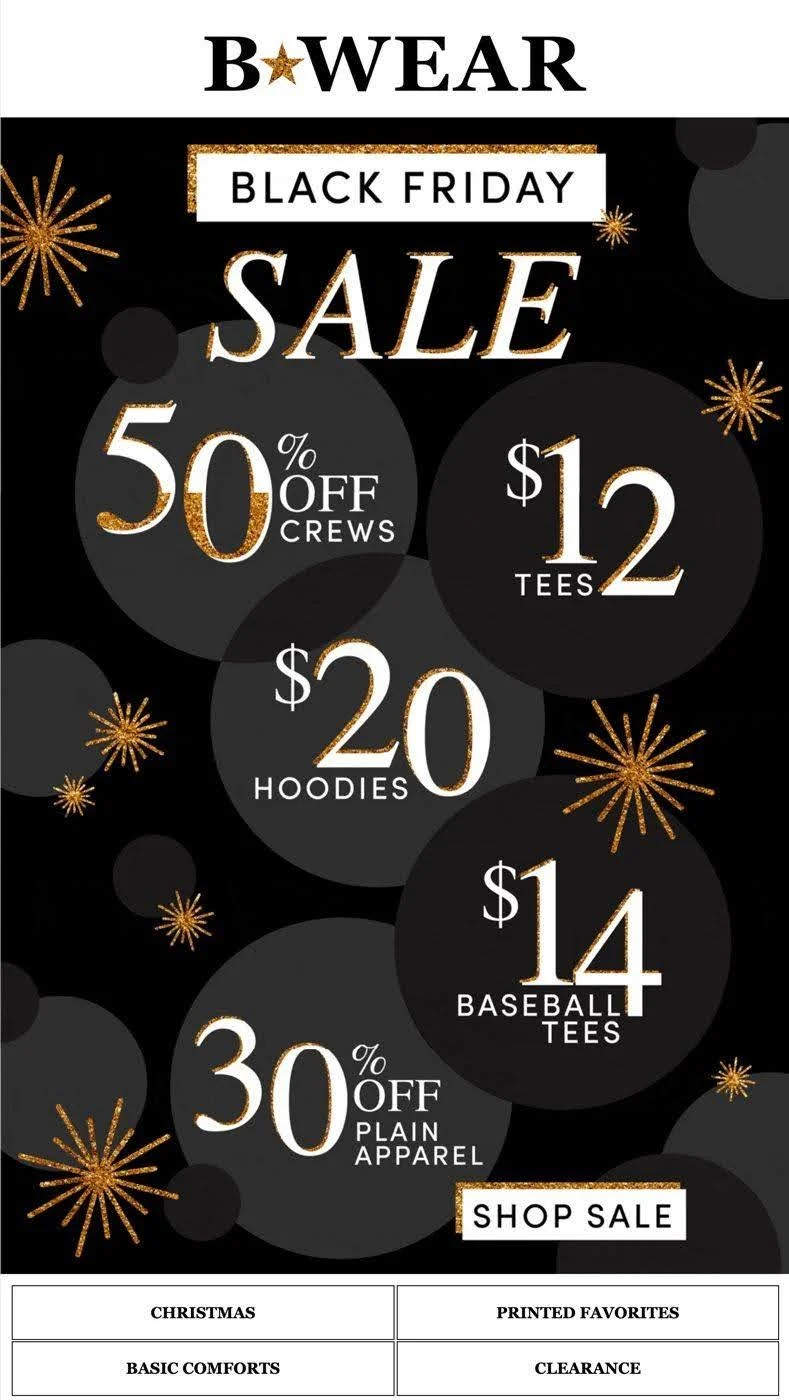

B-WEAR generates up to 40% of its online sales through well-timed and well-designed email and SMS campaigns.
Watch the webinar below for some of the best Black Friday marketing ideas to improve your calendar:
Creating urgency: SMS vs. email
Our BFCM 2023 data tells an interesting story. Email open rates hit 25.4%, a respectable figure for the holiday rush. SMS did better. Click rates reached 5.58% against the campaign email’s 1.41%. The gap comes down to attention, because a text gets read almost immediately.
Your email might say “24-hour flash sale” and hope customers check their inbox today. Your SMS says “Flash sale ends at 2 PM, only three hours left,” and reaches customers immediately. One creates passive awareness; the other creates immediate action.
SMS marketing also bypasses common email obstacles, such as spam folders hiding your message, promotional tabs burying your offer, and media failing to load.
The character limit also forces you to use urgency. You can’t bury the lead in SMS. “40% off everything + free shipping today only, [LINK]” is perfect for quick decision-making.
How to design mobile-first Black Friday campaigns
Follow these Black Friday marketing tips to build winning mobile campaigns:
Choose SMS for time-sensitive messages
Create separate SMS campaigns for messages that need a quick response. For example, a flash sale starting in two hours needs SMS, not an email. Low-stock alerts can also work well when only a few items remain. Early access can feel more exclusive when you send it through SMS.
Time campaigns around shopping patterns
Schedule your promotional messages during peak times. Morning slots (9 AM–12 PM) work well for transactional updates and order confirmations.
Make your messaging clear
Your SMS copy should focus on one offer. For example, “Black Friday: 30% off sitewide ends at midnight” is concise and straightforward. Don’t add free shipping, gift-with-purchase options, or loyalty points to avoid confusion.
Combine channels to cover your customer journey
Add SMS to your existing email automations. A cart abandonment flow could start with an email showing the abandoned items. If no purchase happens, send an SMS two hours later. Your welcome series can also send discount codes via SMS for quick action.
Omnisend lets you create standalone SMS campaigns and email and SMS automations that cover the above. Plus, you can add push notifications to automations.
Sync your segments to Meta and Google Ads
Use your customer segments to build Black Friday ad audiences so your campaigns reach shoppers who already know your brand.
Among Black Friday strategies for retailers, this is the one that runs on data you already own. Sync your segments built on recent behavior, like added to cart, bought before, or opened but didn’t buy.
Cart abandoners and recent visitors come first, because they need a reminder rather than an introduction. Here’s how to split your Black Friday marketing ads budget:
| Audience | Budget priority | Reason |
|---|---|---|
| Retargeting — cart abandoners and recent visitors | 50% | Highest intent and the shortest path back to a full cart |
| Existing subscribers and customers | 30% | You can match them precisely and exclude same-day buyers |
| Cold prospects | 20% | Fills the top of the funnel at the season's highest CPMs |
These audience groups are a good starting point when planning ads for Black Friday across Meta and Google. Exclude same-day buyers from every paid audience the way you do on email.
Amundsen doubled its Facebook click-through rate by targeting its U.S. customer segment instead of broader audiences.
Platform-specific social media strategies that work
TikTok Shop grew from $1 billion Gross Merchandise Value (GMV) in 2021 to $33 billion in 2024, so to say it’s one of your best social commerce opportunities is an understatement.
For Black Friday, create shoppable videos that show your products in use. Partner with micro-influencers who already use your products. Their product demonstrations can give shoppers more context than static product images.
Instagram Shopping needs different tactics. Use feed posts for product discovery and Stories for flash sales. The 24-hour limit on Stories creates natural urgency for Black Friday offers.
Facebook works best for retargeting, as shown by Silver Street Jewellery case study, whose Facebook retargeting campaigns contributed to $100K in sales. Dynamic Product Ads show customers the items they browsed on your site. You’re reaching people who already expressed interest, which costs less than finding new audiences.
How to manage rising social media ad costs
Budget allocation matters more than total spend. Put 50% toward retargeting warm audiences, 30% on lookalike audiences based on your best customers. Use the remaining 20% for broad prospecting campaigns.
Run Black Friday ads when your audience is most likely to shop. If customers usually buy between 7 and 10 PM, focus your spend during those hours. Reduce ad spend during low-conversion hours.
Test ad formats instead of competing only on price. For instance:
- Video ads show products in use and give shoppers more product detail
- Carousel ads showcase multiple products
- Collection ads combine video and product catalogs
Run multiple Black Friday campaign ideas and see which generates the best results. Drop those with the lowest engagement and conversion rates.
How to run effective influencer collaborations for Black Friday
According to SocialCat, nano-influencers (1K–10K followers) generate an average engagement of 2.61%. The rate is higher compared to 1.68% for micro-influencers and 0.68% for macro-influencers.
The smaller the following, the better your ROI because:
- Higher engagement rates with their audiences
- Lower costs per partnership
- More trusted recommendations
- Niche audiences that match your target customers
Create clear briefs that include:
- Key messages and offers
- Required hashtags
- Posting dates and times
- Discount codes unique to each influencer
- Performance bonuses for sales, not just posts
Begin influencer partnerships in October for proper planning and execution. November rushes lead to poor content and worse results.
Let influencers adapt your message to their style. Scripts lack authenticity and can negatively impact your marketing performance.
Using user-generated content (UGC) for Black Friday engagement
UGC costs nothing and can engage your customers across multiple touchpoints, including organic, paid, and social commerce.
Tactics you can use now include reposting and sharing customer photos wearing or using your products, adding quotes to marketing images, and sharing feedback in social shopping listings.
Another top idea is launching branded hashtags in October with small incentives. Combine this with review request emails, and by Black Friday, you’ll have content libraries ready to use.
Reviews can also be used for social posts for your brand. Pair five-star feedback with product images to address the research phase of Black Friday shopping.
Share customer success stories beyond product features. When people see problems solved or experiences improved, they justify purchases as investments, not just deals.
Run Black Friday and Cyber Monday as one Cyber Week
Plan Black Friday and Cyber Monday as one Cyber Week campaign instead of two separate sales. Shoppers return after Black Friday to buy before Cyber Monday ends.
Our BFCM 2025 research found that 42% of merchants achieved better results on Cyber Monday, with average orders 33% higher than on Black Friday.
The marketing ideas for Black Friday campaign should stretch through the entire weekend. Follow these tips:
- Keep the same core offer from Black Friday through Cyber Monday and change the message instead of the discount
- Shift the campaign from a launch announcement on Friday to a last-chance message on Monday
- Retarget Friday non-buyers on Monday, and use SMS for time-sensitive reminders
- Exclude Friday buyers from Monday promotions but send them cross-sell messages instead
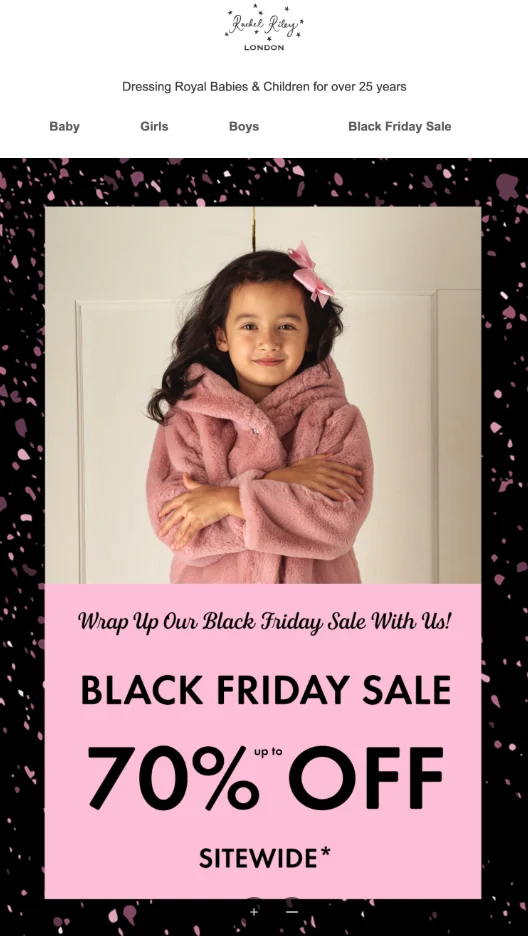
Rachel Riley extended its Black Friday campaign beyond a weekend and increased BFCM revenue by 77% year over year. The final email replaces the launch message with a last-chance deadline to encourage undecided shoppers to buy:
Bring buyers back after the sale
Set up a retention campaign before the weekend ends to bring buyers back. A discounted first order can still be profitable. Relevant follow-up campaigns can increase the customer’s longer-term value.
Plan your retention campaigns before Black Friday finishes so they start running immediately after checkout.
Focus on these follow-up campaigns:
- Post-purchase automation. Thank every customer, then recommend related products a few days later
- Review request. Ask for a product review while the purchase is still fresh
- January reactivation campaign. Reach one-time Black Friday buyers with new arrivals
Rachel Riley has made customer retention part of its post-sale strategy. Its thank-you messages and reactivation flow bring previous shoppers back.
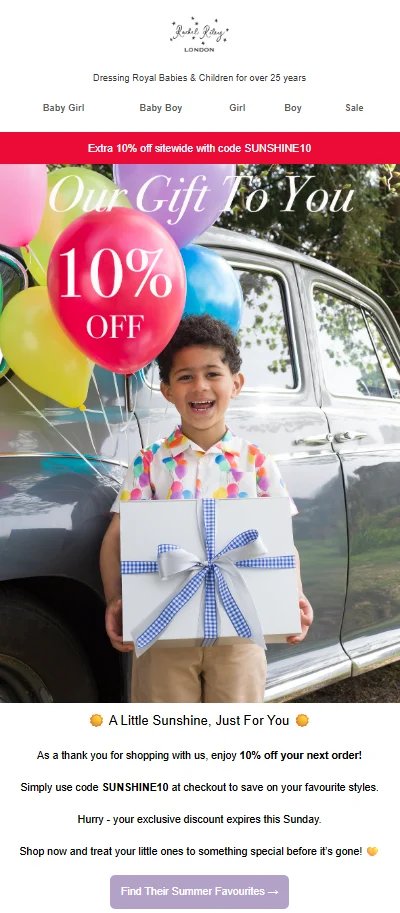
Our customer reactivation flow has been great for bringing shoppers back, while new ‘thank you’ messaging is helping us foster deeper connections.
How to set up immediate post-purchase email sequences
Your post-purchase sequence comes into play the second someone completes checkout. Start with the order confirmation, which is expected and necessary, and is therefore a prime opportunity for engagement.
Include these elements in your confirmation email:
- Order details and tracking information
- Next steps for delivery expectations
- Product care instructions or usage tips
- Links to complementary products they might need
The next message in your sequence should be a thank-you email acknowledging them as a valued customer. It’s best to have this trigger 48 hours post-delivery.
After your thank-you email, your post-purchase sequence could include:
- Day three-five: Review requests. Send your review request while the customer purchase experience is still fresh. Add one-click star ratings to your thank-you or review email. Also, offer 10% off their next purchase for completed reviews.
- Week one: Educational content. Send content that helps customers get more from their purchase. For example, content like training guides with running shoes, morning routines with skincare, or setup tutorials with electronics.
- Week two to three: Cross-sells. Recommend products that improve their original purchase, ideally within a similar price bracket to avoid scaring them away.
How to run January reactivation campaigns that bring customers back
January reactivation starts with segmentation. Divide Black Friday customers into groups:
- One-time purchasers who haven’t returned
- Multiple purchasers showing loyalty signals
- High-value customers (biggest spenders)
- Engaged non-purchasers who browse but don’t buy
Each segment needs different messaging:
- One-time purchasers get “we miss you” campaigns with exclusive comeback offers
- Multiple purchasers receive loyalty program invitations
- High-value customers deserve VIP perks, such as exclusive access and freebies
Time your reactivation emails for different audiences and avoid sending promotional emails before the turn of the New Year to give customers a chance to cool off over Christmas.
Early January catches resolution-makers. Late January targets those recovering from holiday spending. February addresses Valentine’s shopping. March prepares for spring. Each touchpoint builds on previous engagement.
Use progressive discounting to appeal to bargain hunters:
- Start with content and value, not discounts
- If no response, add a small incentive
- Only escalate to larger discounts for valuable customers showing no engagement after multiple touchpoints
Track what brings customers back. Product launches could outperform discounts for reactivation. Exclusive access makes customers feel valued. Personal recommendations based on purchase history show you remember them.
Every post-purchase interaction either builds loyalty or wastes acquisition costs. Turn single purchases into sustained revenue growth by thinking beyond the initial sale.
Conclusion
Successful Black Friday marketing campaigns come down to planning, segmentation, automation, and consistent messaging across Cyber Week.
The checklist below summarizes the key steps to complete before your campaigns go live.
- Plan your calendar from your own data
- Grow your list before the sale with forms and early-access offers
- Build the segments you’ll actually use
- Decide one offer per audience
- Turn on your abandoned cart, welcome, and back-in-stock flows
- Plan the weekend send schedule in advance
- Sync those segments to your Facebook and Google ads
- Run Friday to Monday as one event
- Set up your retention flows
Omnisend runs all of it in one place. Forms grow the list, segments shape every send, and automations keep campaigns running after the weekend ends.
Take a look before you start building your Black Friday campaigns.
Quick sign up | No credit card required
FAQs
When should I start my Black Friday marketing?
How much should I discount for Black Friday?
Do I need SMS as well as email for BFCM marketing?
What’s the average ROI for Black Friday email campaigns?
Quick sign up | No credit card required