Omnisend AI

 OFFER
OFFER









Ever heard that email marketing is dead? If so, don’t worry: it’s a myth. Email has the best ROI of any marketing channel, generating around $79 in revenue for every $1 spent.
Email is a critical channel for anyone who wants to sell online, and email marketing automation platforms — such as Omnisend, Mailchimp, Drip, and other alternatives — offer features specifically designed for ecommerce stores, helping you to communicate with your audience engagingly, increase your conversion rate, and improve sales.
The main expectation of an email marketing platform is that it can reach the recipient’s inbox rather than get caught in the spam filter, and Omnisend, Mailchimp, and Drip all have excellent email deliverability.
There are other similarities, too, such as the ability to create emails from scratch and have them sent automatically. Crucially, though, there are important differences that help each one stand out — from offering tools to specific audiences to differences in the features themselves.
With that said, let’s review Drip vs. Mailchimp and compare them to Omnisend.
1. Email campaigns
An email marketing platform that doesn’t have solid email features is like a bucket with a hole in it: useless. Fortunately, all three platforms have solid functionality in this department, but with some important differences.
Omnisend
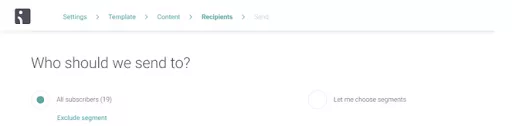
Omnisend has a section dedicated to email marketing campaigns, where users can create a new campaign. You’ll then be guided through a five-step creation process, beginning with selecting a responsive email template.
Omnisend also integrates SMS marketing into campaigns, so you can send different messages across platforms to maximize engagement and sales.

Omnisend also has the Campaign Booster. If members of your audience didn’t open the first email, it can be automatically resent 48 hours later, without annoying those who already opened it.
Another powerful feature of Omnisend is its advanced segmentation. Each email can be sent to specific groups of people, so you can send highly tailored messages, from winning customers back to rewarding the most engaged audience members to encouraging the first sale.
Drip
Drip can create email campaigns. Like Omnisend, there’s a dedicated section for this called Broadcasts. From here, you choose the type of email you want to send (for example, a product launch or a newsletter) and then your audience.

Email drip campaigns also offer audience segmentation with thoughtful features. For example, you can send an email with a discount code, and Drip automatically knows not to send it to anyone who has recently used a discount code to purchase from you.
Another strong feature in Drip is split testing, otherwise known as A/B testing. This is where you compare multiple versions of something to see which performs better.
With Drip, you can test different subject lines and email content to gain insights into what drives higher open rates and conversions. Drip even shows you how much revenue each version generated.
Mailchimp
Mailchimp is perhaps the most well-known email marketing platform, and it didn’t achieve that by being a slouch in the features department. Users can create email campaigns from their dashboard, and Mailchimp guides them through the necessary steps.
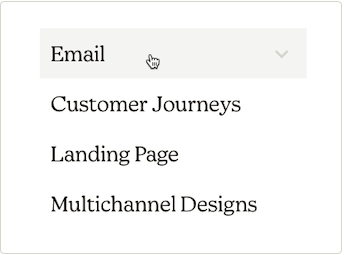
Once you’ve chosen Email, you’re taken to Mailchimp’s email builder, where you can select your recipients, set your subject line, and design your email with either a pre-built template or by creating your own. Like Drip and Omnisend, Mailchimp can also send targeted emails to different audience segments.
Winner: Close tie between all three tools.
2. Marketing automation
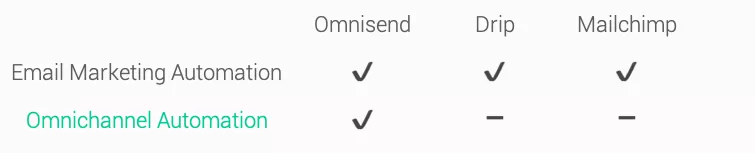
One of the key features you want in your ecommerce platform is marketing automation to save time, gather new leads, and re-engage inactive contacts. All three email marketing tools provide sophisticated email marketing automation features for ecommerce, though if you’re a larger business, you might consider Omnisend’s omnichannel marketing automation.
Omnichannel marketing automation lets you incorporate multiple channels into a single workflow and reach your customers more effectively than with email alone. If you don’t need omnichannel features, Drip and Mailchimp’s marketing automation solutions are great options.
One big thing that sets Omnisend apart from its alternatives is that you can set up split testing (or A/B testing) in the workflow builder and send promotional campaigns to determine which subject line or offer leads to the highest conversions.
Winner: Omnisend.
3. Forms and landing pages
All three platforms offer sign-up and embedded forms, landing page builders, and multiple integrations to provide the most sophisticated solutions.
Mailchimp and Omnisend provide an all-in-one marketing solution with ready-to-use sign-up forms and landing pages that can be customized to your needs, whereas Drip doesn’t — it can only integrate a landing page and doesn’t have its own builder or templates.
Omnisend is also the only platform among the three that offers gamified forms, such as our Wheel of Fortune sign-up form.
According to our 2025 Popup benchmark study, the Wheel of Fortune achieved a 3.5–3.6% conversion rate compared with 1.9–2.0% for standard popups, resulting in an 80–90% increase in subscriber conversion.
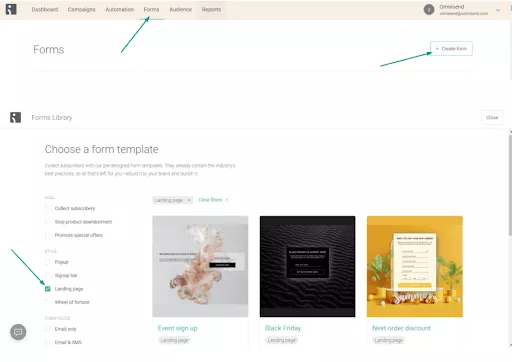
Additionally, Mailchimp has form and landing page templates, but not gamification options like Wheel of Fortune. Drip offers neither and requires its users to rely on integrations instead.
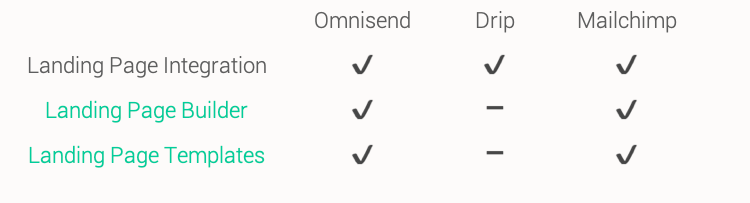
Winner: Omnisend.
4. Analytics and reporting
Collecting data allows you to adjust your business to your customers’ needs and achieve better performance from your marketing efforts. With thorough analytics and reports, you can see how your customers or subscribers react to your campaigns and marketing strategies.
Drip, Omnisend, and Mailchimp all collect significant amounts of such data, and features like advanced segmentation and automation enable comprehensive reporting.
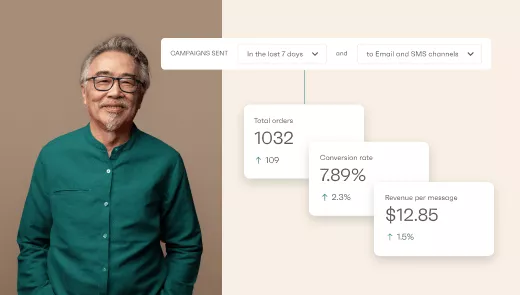
In addition, Omnisend offers in-depth integrations with leading ecommerce platforms, allowing its customers to track the revenue generated by each campaign easily. Advanced reporting is accessible right inside your account:
Winner: Tie. Each platform offers useful analytics, including earned reporting.
Quick sign up | No credit card required
5. Marketing channels
Having the right tools is not enough — ecommerce businesses also need to consider strategies to reach wider audiences. One of the best ways to do that is to integrate multiple channels such as email, push notifications, social media, and text messages.
By reaching out through more channels, you can increase your interactions with customers or subscribers. One thing to note here is that Drip discontinued SMS for new customers. However, it’s possible to combine Drip with dedicated third-party SMS integration.
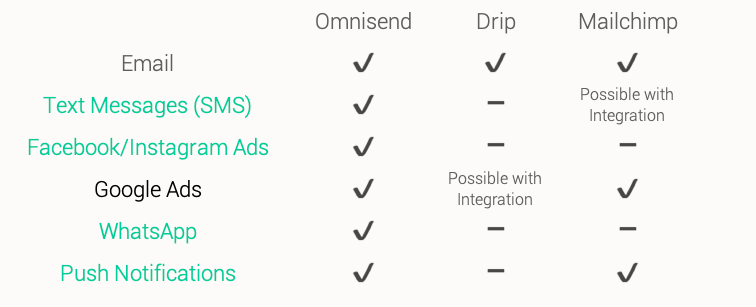
If you want to maximize your omnichannel marketing, Omnisend stands out as an all-in-one platform, offering high quality and versatility to reach many customers across various channels.
Winner: Omnisend.
6. Pricing
Each of the three platforms has different pricing tiers, so you can choose based on your budget and the features you need. However, while the pricing structure is similar, the features and individual pricing plans are different.
Here’s a quick comparison table showing starting plans and their prices for different contact lists:
| Tool | Drip | Mailchimp | Omnisend |
|---|---|---|---|
| 2,500 contacts | $39/month for 2,500 contacts | $75/month for 2,501-5,000 contacts | $30.80/month for 2,001-2,500 contacts |
| 10,000 contacts | $154/month for 10,000 contacts | $93.50/month for 5,001-10,000 contacts | $105.00/month for 10,001-10,500 contacts |
| Free plan | 14-day trial | Free for up to 250 contacts and 500 sends | Yes |
| Features | All features | Depends on the pricing plan | Depends on the pricing plan |
Drip’s pricing structure is the simplest among Mailchimp and Omnisend, offering all available features regardless of the size of the contact email list. The downside is that, while this simplification may be more appealing to some customers, there’s no way to determine which features are needed.
In other words, if you have large contact lists but don’t need all of Drip’s features, you’ll still pay the same amount.
Mailchimp and Omnisend structure their pricing plans similarly. Both offer multiple pricing plans with different feature sets and the ability to adjust all plans based on your contact list size.
However, it’s worth mentioning that Mailchimp’s low price used to make it popular with new ecommerce stores, but the company has recently increased its pricing.
The biggest difference between Omnisend and Mailchimp’s pricing plans is that Omnisend offers much more flexible pricing, including 6,000 emails per month, SMS in your campaigns, marketing automation, and other features for $11.20 for the smallest contact list. This effectively lets small teams try out Omnisend’s top features without investing large budgets.
On top of that, marketers on Omnisend’s Pro plan can enjoy free SMS credits equal to the price they pay for that plan. And unlike the two competitors here, Omnisend’s free plan includes the same full set of features available on its paid plans, including advanced automation.
Winner: Omnisend.
7. Integrations
Drip, Mailchimp, and Omnisend all offer considerable integrations for ecommerce brands. Overall, Mailchimp’s broader library wins for teams using diverse marketing stacks. However, Omnisend’s native BigCommerce support is a significant advantage that Drip lacks:
- Drip: 50+ native integrations, including Shopify, Shopify Plus, WooCommerce, and Magento. No native BigCommerce integration; connects via Zapier
- Mailchimp: 300+ integrations, which is the broadest library of the three, covering a wide range of tools across CRM, ecommerce, analytics, and social
- Omnisend: Single-click integrations for Shopify, Shopify Plus, BigCommerce, and WooCommerce, plus over 230 other integrations with ecommerce tools
Winner: Mailchimp.
8. AI-powered features
The adoption and widespread use of AI have become particularly important for email marketing tools, and all three tools offer AI features and automations, but at different levels.
Mailchimp stands out from Drip and Omnisend, offering the most comprehensive AI feature list, available for Standard and Premium plans:
- Write with AI for generating email copy
- Creative Assistant for importing brand assets automatically
- Content Optimizer, which analyzes and improves content
- Send Time & Send Day Optimization for predicting the best sending times
- Predictive Segmentation for identifying more engaged contacts
Drip also offers some AI-powered tools, but they’re not as extensive, and there’s no support for generative content tools. However, Drip’s AI focuses on providing predictive and behavioral segmentation for smarter tagging, scoring purchase likelihood, and identifying behavioral triggers.
Omnisend’s AI functionalities are similar to those of Mailchimp:
- Generative AI for email copy
- Forms AI for building and editing signup forms
- Predictive AI offering product recommendations, RFM analysis, customer lifetime value (CLV) forecasting, and audience segmentation
- MCP integration allows customers to store data in ChatGPT and Claude
Winner: Tie between Mailchimp and Omnisend.
9. Deliverability
From a high-level perspective, all three platforms show consistently strong deliverability rates, but independent testing reveals slight differences. Drip continues to show the highest deliverability rates in the industry, around 99.8%. In the case of Mailchimp, the tool reports 99% deliverability, while Omnisend reports 97%.
It’s important to note that these are official numbers reported by all three tools themselves, but independent and competitor testing show different rates that vary even more when you compare these tests over the years.
Winner: Tie between all three tools.
10. Customer support
Customer support is an important part of any service, and timing is critical — especially if you’ve got your next big campaign ready to go. After all, nothing is worse than a support team on vacation on Black Friday, when you’re most likely to need them.
Omnisend offers full round-the-clock support across all plans, including the free plan. Customers can choose between live chat and email to get the assistance they need.
Mailchimp and Drip’s email marketing software offer 24/7 online assistance on all paid plans, but Drip provides full migration support starting at 17,500 contacts. However, it’s worth noting that Mailchimp’s free plan includes email support for 30 days, but the Essentials and Standard plans offer 24/7 support.
Winner: Omnisend.
Final thoughts
Mailchimp and Drip are two of the most popular email marketing platforms, and both offer unique features for different needs. Drip is specifically built for ecommerce and offers customers advanced automation and attribution options, along with Shopify and WooCommerce integrations.
Mailchimp caters to a wider and less experienced audience, offering a large integration library with an AI suite and multiple templates to choose from. Costs vary, but both email marketing software solutions are valid and preferred choices for different clients.
In comparison, Omnisend caters to small and medium-sized ecommerce businesses that need effective tools designed for enterprises with a particular need for unified SMS + email automation.
| Drip | Mailchimp | Omnisend |
|---|---|---|
| — Best for ecommerce-depth automation — Revenue attribution and behavioral triggers — No feature gating — everything included — Ideal for established Shopify/WooCommerce stores | — Best for beginners and general marketing — Broadest integration library (300+) — Strong AI suite on Standard+Wide template library and familiar UI | — Best for omnichannel ecommerce — Email + SMS + push in one workflow — $79 ROI per $1 spent (2025 data) — 24/7 support on all plans — Offers a visual workflow builder and highly personalized emails — Automation split testing |
Each of these email marketing tools provides different features and primarily addresses a particular type of business, so it’s hard to declare any of these platforms as an absolute winner. Rather, you should determine which one best meets your needs and wants before making a decision.
Quick sign up | No credit card required
Frequently asked questions
Is Drip or Mailchimp better?
There’s no straight answer to which is objectively better than the other. However, to choose the appropriate tool, you need to evaluate your needs:
- Drip is typically better for ecommerce stores that are looking for high-level behavioral automation
- Mailchimp has a great selection of integrations and AI content tools for beginner teams, starting companies, and general marketers
- Omnisend offers deep personalization and advanced automation for unified email and SMS workflows
Is Drip cheaper than Mailchimp?
Yes, the overall pricing overview shows that Drip provides services at lower prices than Mailchimp. While both offer free trials, Drip’s pricing plans start at $39/month for 2,500 contacts, but Mailchimp’s start at $75/month for 2,501-5000 contacts.
Does Drip have a free plan?
No, Drip doesn’t offer a free plan, but they do offer a 14-day free trial. Both providers allow you to choose the number of contacts you need, adding additional flexibility in managing budgets and necessary features.
Does Mailchimp do drip campaigns?
Yes, they do, although you’ll find different terms used to describe them. Mailchimp refers to these campaigns as automated journeys or customer journeys.