
 Omnisend AI


 OFFER
OFFER






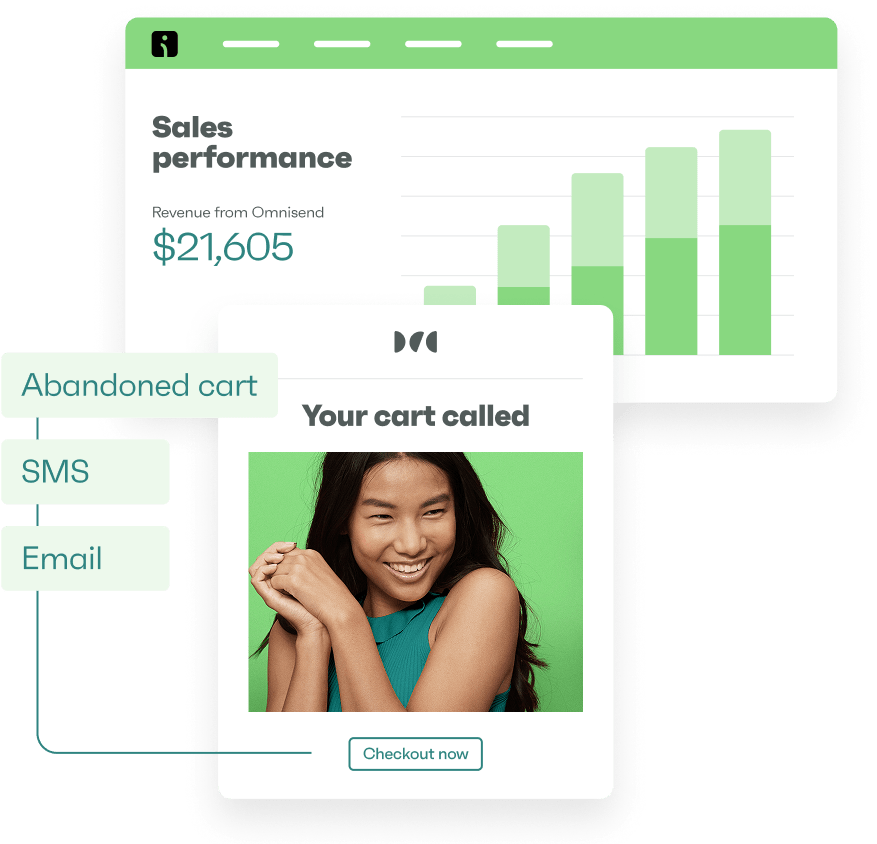
Drive sales on autopilot with ecommerce-focused features
See FeaturesAd platforms change their rules overnight, and acquisition costs keep climbing. This volatility makes ecommerce growth and profits harder to predict. That’s why you need a good customer acquisition strategy.
Stronger iOS privacy updates and the phase-out of third-party cookies have made customer data harder to access. However, many ecommerce brands still rely on one-time purchases to drive profit and attract new customers.
Acquisition doesn’t end when someone clicks an ad or lands on your site. It is complete when you turn a visitor into a paying customer, and you can reach them again automatically through controlled platforms. This way, you stop paying repeatedly for engagement.
This guide takes an ecommerce-first approach to customer acquisition, backed by data from 10,000+ ecommerce brands. You’ll learn practical customer acquisition strategies for online stores, along with key metrics, benchmarks, and examples.
Start building your owned channels with Omnisend’s high-converting popups, forms, and landing pages
Quick sign up | No credit card required
Customer acquisition strategies to win in 2026
Customer acquisition has changed in 2026. Paid advertising costs more, third-party cookies are disappearing, and privacy regulations such as GDPR and CCPA restrict online customer tracking.
To succeed, you need customer acquisition strategies that balance ecommerce marketing automation with authentic customer relationships.
- First-party data: Prioritize email and SMS capture through signup forms, gated content, quizzes, and checkout opt-ins. First-party data gives you consented, direct access to customer details without relying on external platforms.
- Privacy-first acquisition: Tell customers how you use their data and let them change preferences easily. Respecting their privacy helps you build trust and strong relationships over time.
- AI-powered personalization: Trigger relevant automated messages at scale using customer data. Combine behavioral triggers with personalized product suggestions.
Omnisend’s AI tools analyze browsing patterns, purchase history, and engagement signals in real time to create highly contextual automated campaigns.
- AI-driven conversational commerce: Use chat assistants to answer high-intent customer questions, suggest products, and capture contacts. Customers can contact you via WhatsApp, Instagram DMs, website chat, and live shopping.
- Intent-driven content and SEO: Focus on bottom-of-funnel (BOFU) content that answers specific, high-intent questions. This includes comparisons, pricing, and “best for” guides. Pair them with fast mobile performance and long-tail keywords.
- AI-powered social listening: Use AI social listening tools to monitor customer pain points, brand and competitor mentions, and trends. Then, use these insights to tailor your content, product positioning, and paid campaigns.
- Referrals and influencer partnerships: Invest in referral programs, creator partnerships, and brand collaborations. These customer acquisition strategies help you acquire warmer leads at a lower cost.
- Data-led decisions: Aim for a lifetime value to acquisition cost ratio of 3:1 to 4:1. This means you earn $3–$4 for every $1 spent on acquiring a customer. Focus on acquiring and retaining customers rather than minimizing CAC — track profitability by channel.
What to do now
- Centralize your customer data so teams act based on similar insights
- Audit your top three acquisition channels using LTV, not just CAC
- Refresh your content to target high-intent search queries
Strategy comparison: 2026 channels
| Strategy type | Time to results | Typical CAC range | Best for |
|---|---|---|---|
| First-party data | One to two months | Low | Building owned audiences |
| AI-powered personalization | One to three months | Low to moderate | Increasing conversion rates |
| AI-driven conversational commerce | Days to weeks | Low | Nurturing high-intent buyers |
| Privacy-first acquisition | Ongoing | Low | Driving stronger retention and higher lifetime value |
| Intent-driven SEO and content | Six to nine months | Very low (long-term) | Sustainable acquisition and demand capture |
| Referrals and influencer partnerships | One to two months | Low | High-trust acquisition and retention-focused growth |
| Data-led LTV:CAC optimization | Ongoing | Varies | Scaling profitably across channels |
The complete guide to omnichannel marketing automation for ecommerce
Maximize customer engagement and revenue by making your marketing efforts more relevant.
Get my copy
Why does customer acquisition matter for ecommerce?
If you stop acquiring new customers, your revenue will depend entirely on repeat purchases from existing buyers.
Here’s why customer acquisition is crucial.
Drives predictable revenue growth
New buyers are likely to bring more revenue. A fitness equipment store may experience a revenue surge during the winter, followed by a dip during summer. Ongoing acquisitions bridge these gaps and ensure steady cash flow year-round.
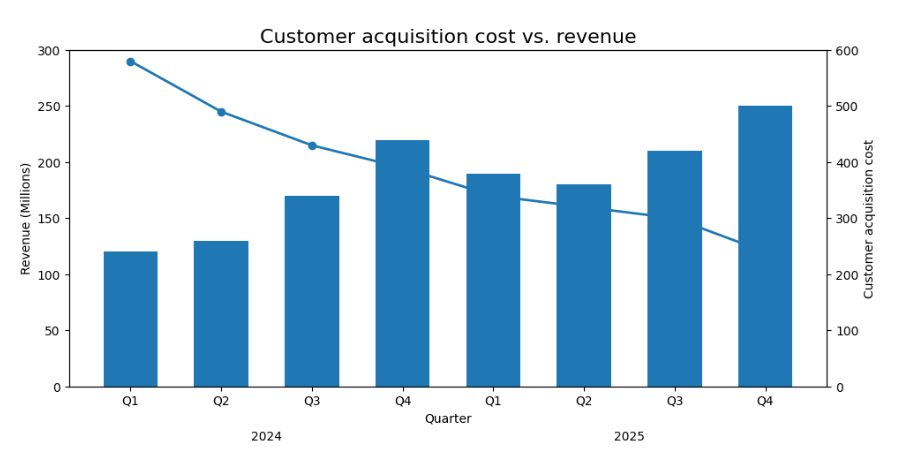
With time, revenue rises while customer acquisition cost (CAC) drops, as illustrated by the chart below:
Builds a competitive moat
Brands with efficient customer acquisition strategies gain a competitive edge over those relying on paid ads. Owned email and SMS channels are more cost-effective in the long term.
For instance, your competitors pay $30–$120 every time they acquire a customer through Google Ads. Meanwhile, by building an email list of 50,000+ subscribers, you can reach your audience at almost zero incremental costs.
Establishes customer lifetime value (CLV)
Every first-time purchase starts the retention cycle, transforming a one-off buyer into a long-term customer. Understanding customer lifecycle stages helps you maximize the value of each acquired customer.
For instance, you can predict when a skincare customer who bought their first moisturizer is ready for a subscription.
Pair acquisition with reliable customer retention strategies to build long-term relationships and increase customer lifetime value (CLV). The formula to calculate CLV is:
CLV = Average order value × purchase frequency × customer lifespan
Provides optimization insights
Every acquisition campaign reveals valuable insights. You learn which channels convert, which messages resonate, and which audiences respond. Use these insights to refine targeting, improve offers, and increase conversions.
Creates owned marketing channels
Strategic customer acquisition builds multiple marketing channels you can control. If someone clicks a paid ad but never joins your email or SMS list, you must spend again to interact with them. However, when they subscribe, they become part of your owned audience, which you can reach repeatedly at no additional cost.
10 customer acquisition strategies for ecommerce
There are several ways to acquire customers. Here are some proven methods.
1. Email marketing and list building
Email marketing ecommerce strategies deliver the lowest customer acquisition costs. It’s your owned marketing channel for reaching customers directly. Once you build a list, you can nurture and convert subscribers at almost no extra cost.
According to Omnisend’s data, email marketing ROI offers an impressive 76x return.
Implementation tactics:
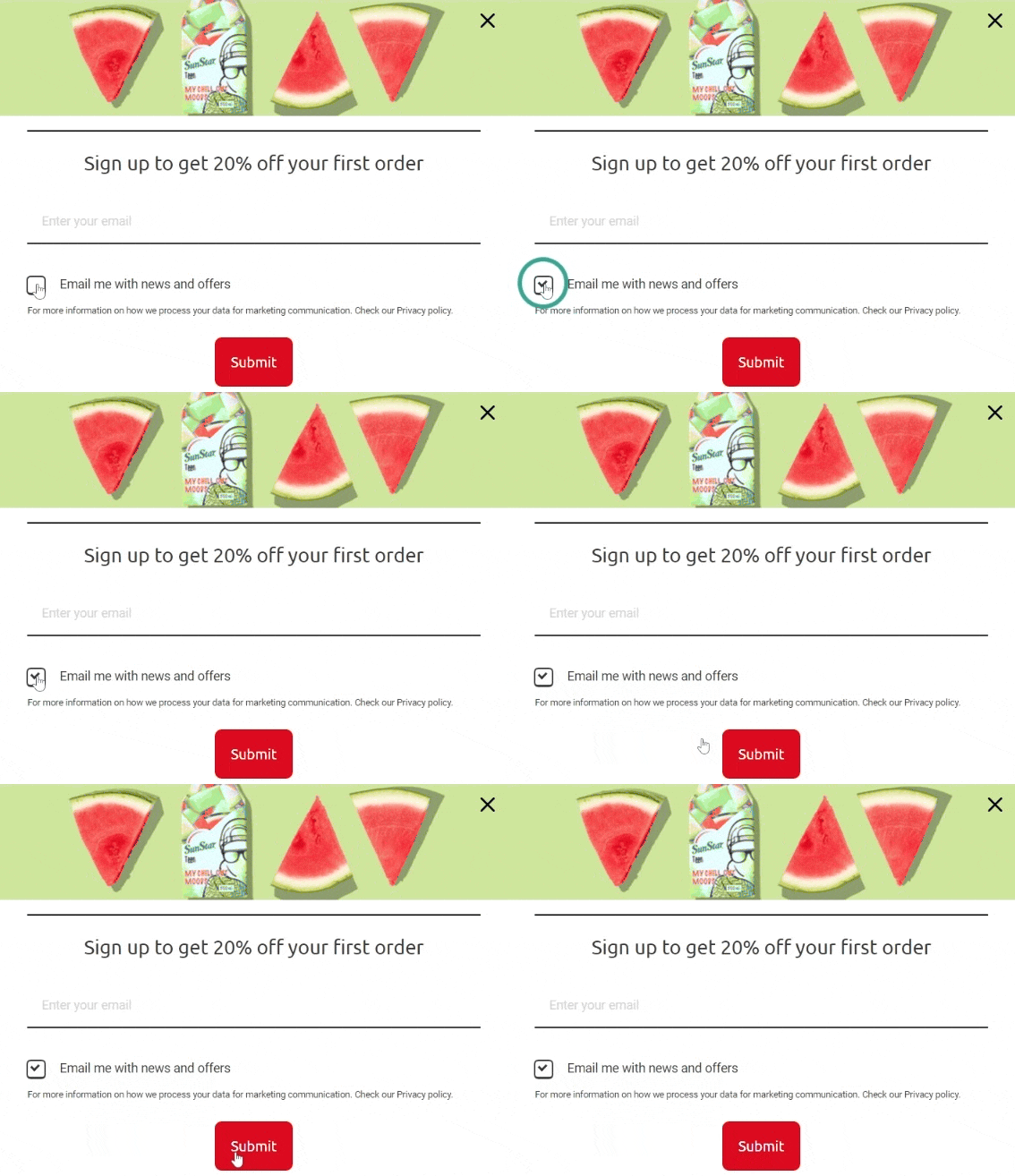
- Use exit-intent popups with compelling first-time buyer discounts to capture visitors before they leave, like this Omnisend popup:
- Automate a welcome sequence of three to five emails that adjusts based on what products subscribers viewed before signing up
- Segment your list by signup source, product interest, and engagement level to personalize emails instantly
- Collect preferences gradually through post-purchase surveys and preference centers to refine targeting
- A/B test incentives like discounts, free shipping, or gifts to identify which ones drive the highest conversion rates
A clothing store grew its list by 2,500 subscribers/month using a checkout discount popup. It converted 18% of visitors and drove $47,000 in sales at a customer acquisition cost of just $8.
Omnisend provides pre-built email popups that are optimized for conversion, behavior-based triggers, strong deliverability infrastructure, and automated welcome series tailored for ecommerce.
Unlike generic tools, ecommerce-focused platforms pull product data directly into email campaigns for seamless personalization.
Simply connect your store and trigger tailored messages with Omnisend’s automated email workflows.
 | Success story Blue Drop Studio helped SUIHE Jewelry increase email revenue by 435% in just 30 days of using Omnisend. It’s welcome automation alone drove $6,400 in revenue. Read the full report here |
2. SMS marketing for instant engagement
Text messages yield up to 98% open rates, compared to roughly 29% for email. This visibility makes SMS ideal for time-sensitive and high-intent messages.
Used alongside email, SMS marketing becomes one of the most effective customer acquisition strategies.
Implementation tactics:
- Offer exclusive SMS-only incentives in addition to email signups to encourage opt-ins
- Send tailored product recommendations based on browsing or purchase history
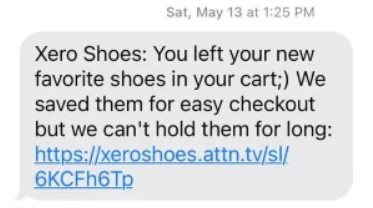
- Trigger abandoned cart SMS (like the one shown below) within one to three hours when interest is still high. Our data shows that cart recovery texts sent within one hour convert up to three times better than those sent after 24 hours:
- Limit frequency to two to four messages monthly to avoid overwhelming subscribers
A beauty brand recovered 23% of abandoned carts using SMS at just $4 per recovery, while email alone recovered only 12% within the same duration.
Similarly, Silver Street Jewellers increased abandoned cart revenue per email by 3,762% after integrating email with SMS. Pairing SMS with abandoned cart emails drives more conversions and ROI.
Omnisend combines email and SMS in unified automated workflows that trigger based on customer behavior. Unlike tools limited to the USA, UK, Canada, and Australia, Omnisend supports global SMS reach.
Always collect proper consent and include clear unsubscribe options to maintain compliance, deliverability, and trust.
3. Content marketing and SEO
Content marketing is one of the most effective long-term customer-acquisition strategies, delivering compounding returns. It targets customers in the research phase, building awareness before they’re ready to buy.
It takes six to nine months to see meaningful organic traffic. However, once your content ranks, it attracts consistent traffic without increasing acquisition costs.
Implementation tactics:
- Create comparison guides targeting high-intent searches like “best [product]” or “[product] vs. [competitor]”
- Share how-to and educational content that answers common or specific customer questions
- Optimize product pages with persuasive descriptions, customer reviews, and relevant keywords
- Secure backlinks through guest posting on authoritative industry blogs and digital PR outreach
- Repurpose high-ranking blog posts into videos, social media posts, and email newsletters
- Refresh and optimize existing content with AI tools to keep it accurate and competitive
Always connect content to owned channels. Add email-capture forms to blog posts to convert traffic into subscribers.
An outdoor gear retailer published a detailed camping checklist guide that ranks for “camping essentials.” It drives 12,000 monthly visitors, achieves 3.2% email list conversion rate, and captures 384 new subscribers at zero CAC.
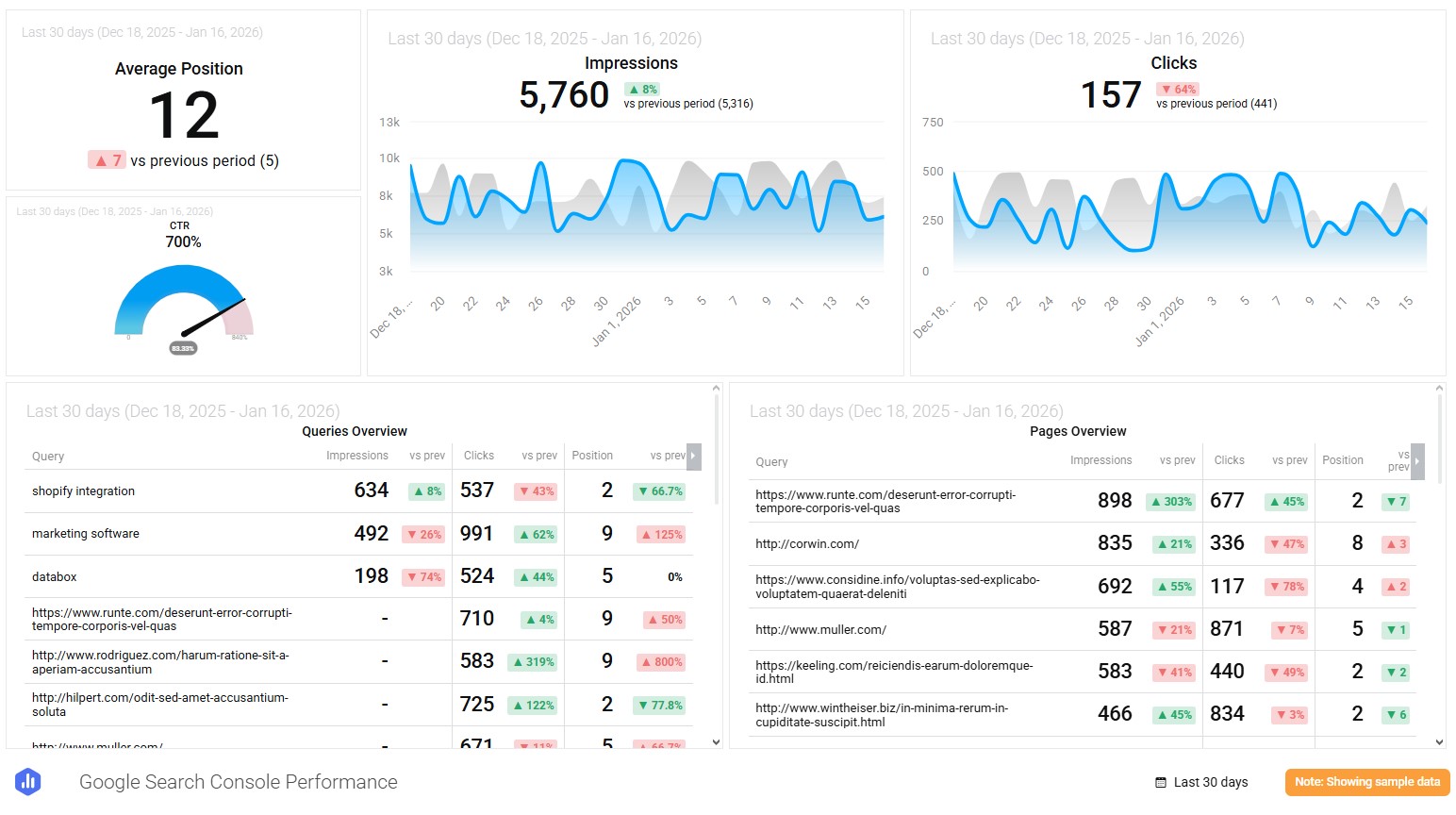
To monitor keyword performance, you can use Google Search Console, as shown below:
4. Paid advertising (PPC and social)
Paid advertising is among the most reliable ecommerce customer acquisition strategies, delivering instant visibility and traffic. It’s ideal for marketing new products, implementing seasonal campaigns, and testing campaign messaging.
However, CAC has increased by 60% over the past five years. To reduce CAC, convert paid visitors into owned email and SMS audiences.
Implementation tactics:
- Use Google Shopping ads to capture bottom-of-the-funnel traffic — shoppers already searching for products
- Run remarketing campaigns on Facebook and Google, and promote email signup incentives instead of just product ads
- Test TikTok ads for younger demographics with short, entertaining videos that don’t sound sales-y
- Track conversions accurately across platforms to identify which ads drive sales and revenue
- Reserve 10–15% of your budget for testing new channels like TikTok Shop and Pinterest Shopping
A home decor brand achieved a $42 CAC on Google Shopping ads, with an average order value of $180. It generated a 4.3x return by targeting high-intent “buy [product]” keywords rather than broad awareness phrases.
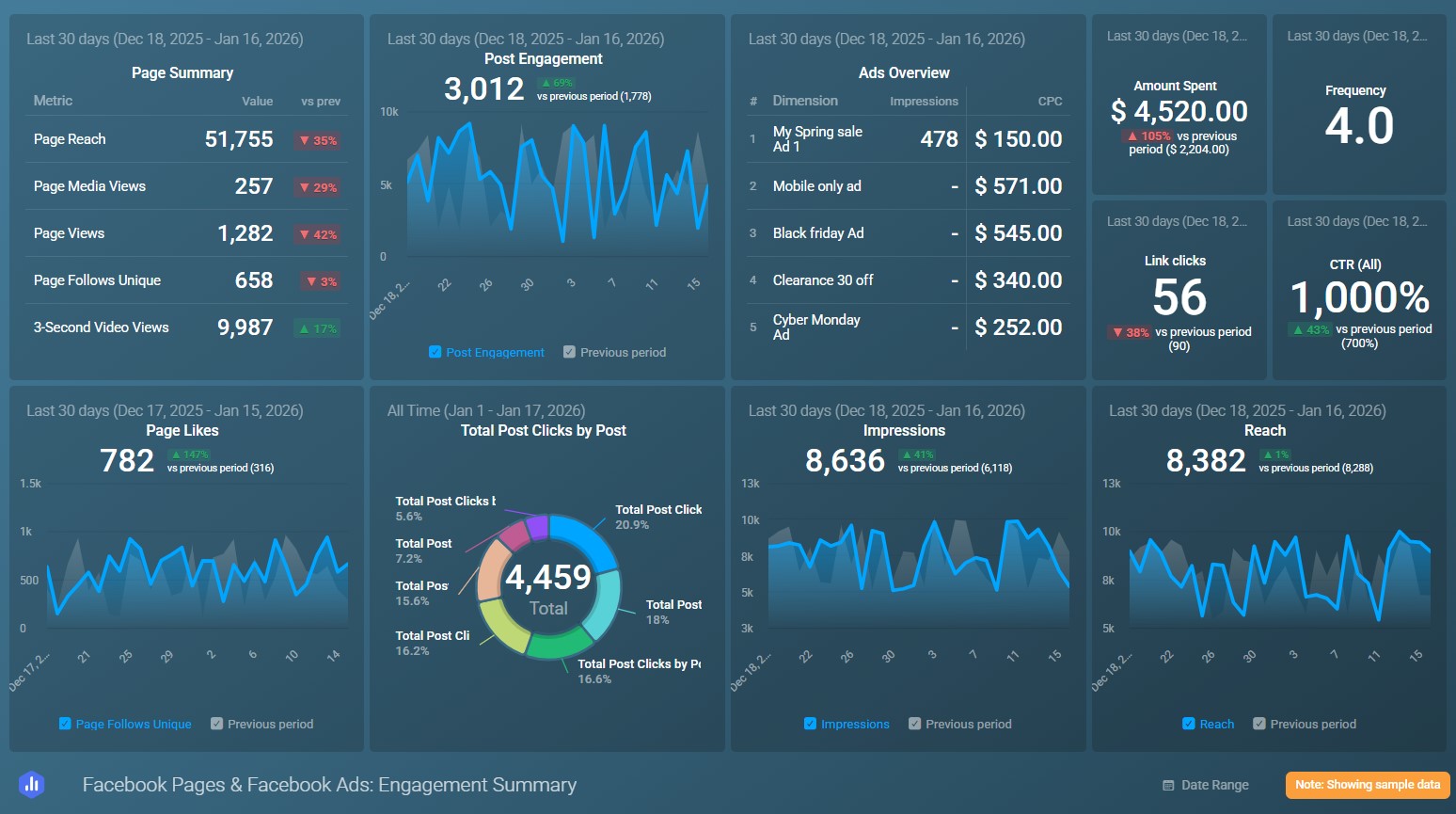
Track campaign performance using a dashboard like this:
Tools like Omnisend integrate with ad platforms and let you sync ad audiences, track conversions, and capture email and SMS subscribers.
5. Social media marketing
According to recent Reddit discussions, organic reach on social platforms has declined. Still, social media remains one of the most crucial customer acquisition strategies because it drives brand awareness.
The key is choosing platforms that match your audience and product type.
Implementation tactics:
- Post three to five times weekly using a blend of product features, lifestyle content, and user-generated content
- Lean into native platform formats like Instagram Reels, TikTok videos, and Pinterest Idea Pins
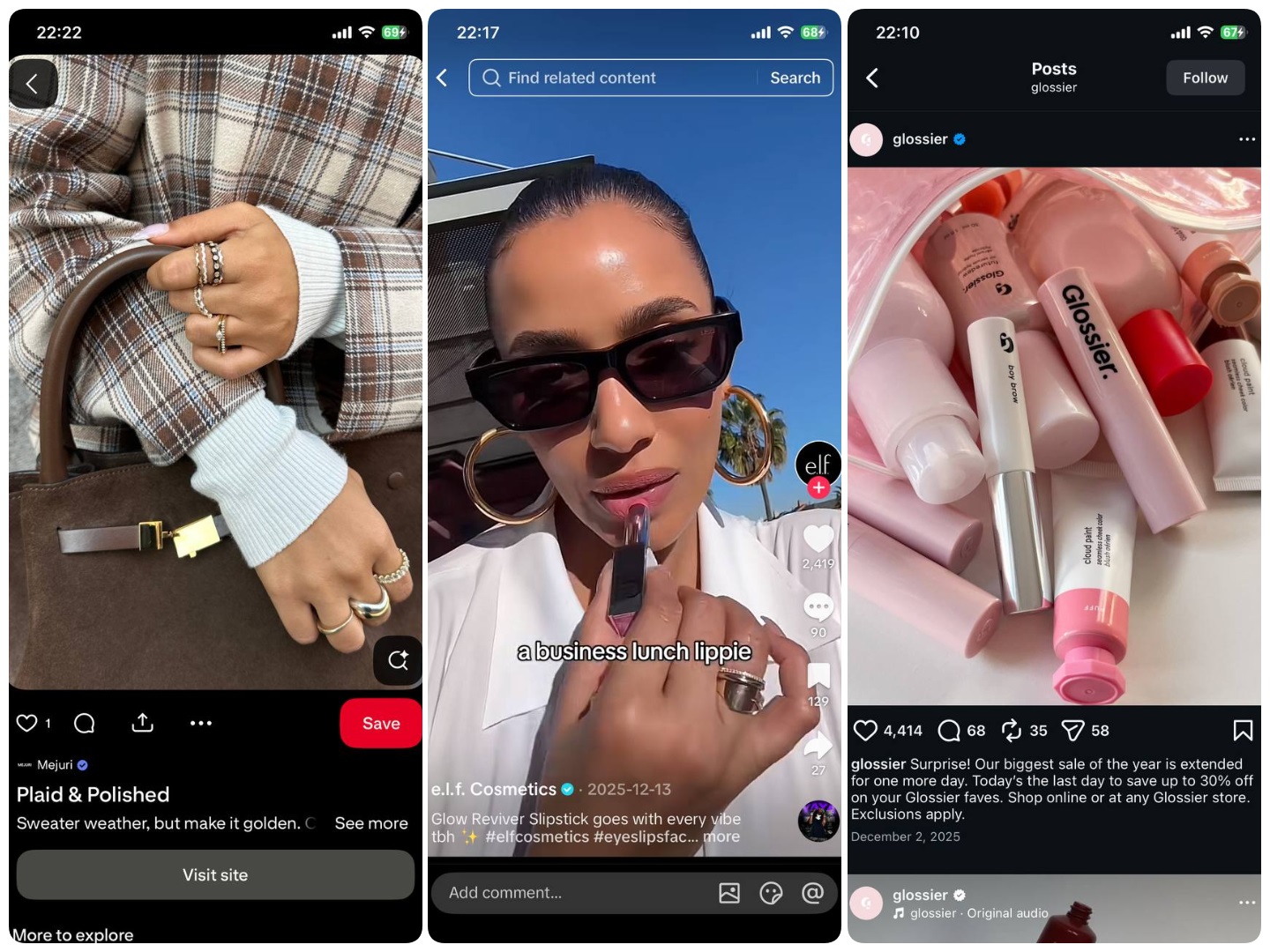
- Host social media contests or giveaways to maximize engagement and attract new followers
- Collaborate organically with micro-influencers (1,000–10,000 followers) who have smaller but more engaged audiences than celebrity influencers
- Add clear calls to action and product links to drive traffic from social media
A jewelry brand grew its TikTok account to 45,000 followers in six months by sharing daily care tips. That drove 8,000 website visitors monthly at zero CAC.
Social media delivers the most value when it feeds your owned channels. Use shoppable features such as Instagram Shopping or TikTok Shop to drive direct sales while capturing email or SMS opt-ins at checkout.
Track social-to-email signups as a core KPI. Even a two to three percent conversion rate adds up over time.
6. Influencer and affiliate marketing
These performance-based customer acquisition strategies let you reach existing, engaged audiences. The financial risk is also lower since you only pay when your partners drive results.
Implementation tactics:
- Work with micro-influencers in your niche who have engaged communities and authentic content
- Offer 10%–20% commission on sales or use hybrid compensation with a standard fee plus commission
- Assign each influencer a unique discount code and UTM link so you can clearly attribute sales, and you can integrate affiliate platforms with Omnisend to monitor which influencer codes drive the highest customer lifetime value, not just one-time sales
- Join affiliate networks like ShareASale, Rakuten, or Impact to reach credible partners
- Build an affiliate resource kit with product images, descriptions, and unique brand guidelines
A skincare brand partnered with 15 beauty micro-influencers. It acquired 340 new customers at a $28 CAC, compared with $65 on Facebook ads.
Influencers also create valuable content. Negotiate content usage rights upfront so you can reuse top-performing content in emails and paid ads.
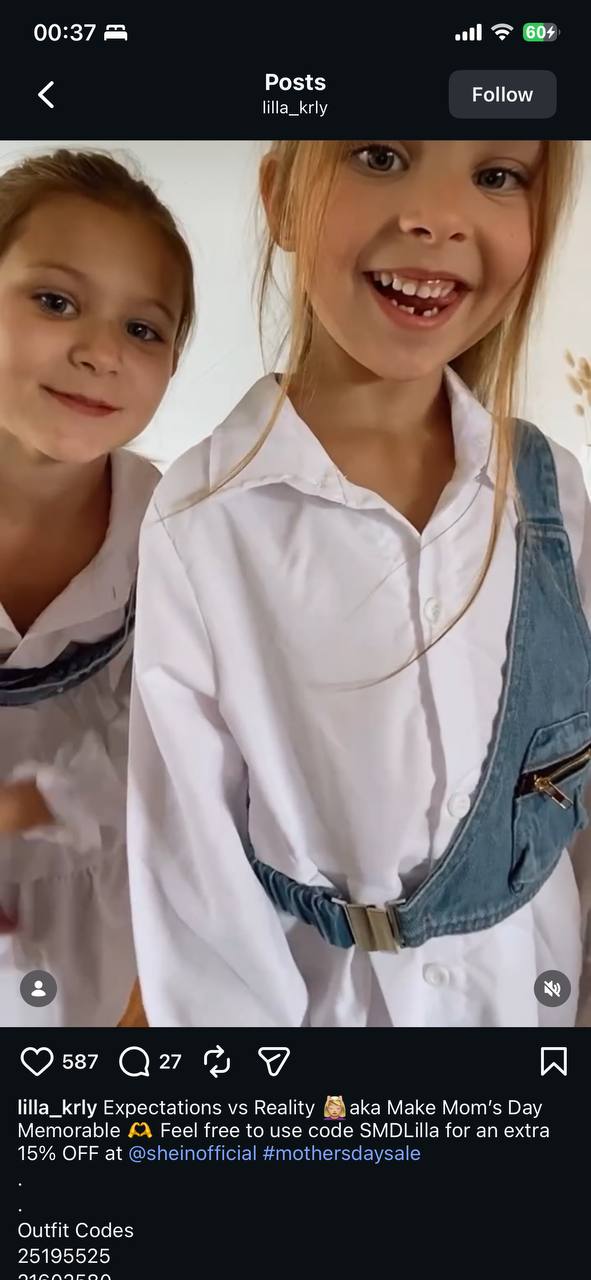
Here’s a great example of a Mother’s Day influencer campaign on Instagram:
7. Referral programs
People trust recommendations from friends more than ads. This is why referrals convert better and reduce CAC.
It’s among the most reliable customer acquisition strategies that create a snowball effect, where each new customer can bring in the next.
Implementation tactics:
- Start with a simple double-sided reward, like a 20% off discount for both the referrer and new customer, such as this MeUndies email:

- Simplify sharing with one-click buttons for email, SMS, and social media platforms
- Automate referral program emails that trigger post-purchase when customer satisfaction is high. Omnisend’s automated workflows can trigger personalized referral invitations seven to 14 days after delivery
- Showcase your referral program offers prominently in order confirmations and post-purchase emails
- Gamify the experience using tiered rewards where multiple referrals unlock VIP status or exclusive perks
- Integrate referral program software with Omnisend to track referral attribution accurately and spot your best-performing advocates
A subscription box company’s referral program generated 18% of new customers at a $16 CAC, compared to $48 from paid channels.
8. Promotions and discounts
These customer acquisition strategies help first-time shoppers overcome hesitation. When used right, they attract new customers while protecting your margins.
Start by calculating your minimum viable discount by working backward from your target profit. If your gross margin is 50%, a 15% discount still leaves a 35% margin to cover costs and profit.
Implementation tactics:
- Create a discount ladder that rewards deeper commitment, such as a 10% off for email signup, 15% for SMS opt-in, and 20% for first purchase — each step collects more valuable customer data
- Test free shipping against percentage discounts to see which drives higher conversion and order value
- Use gift-with-purchase offers, as a free item carries a higher perceived value than a percentage discount, while costing you less
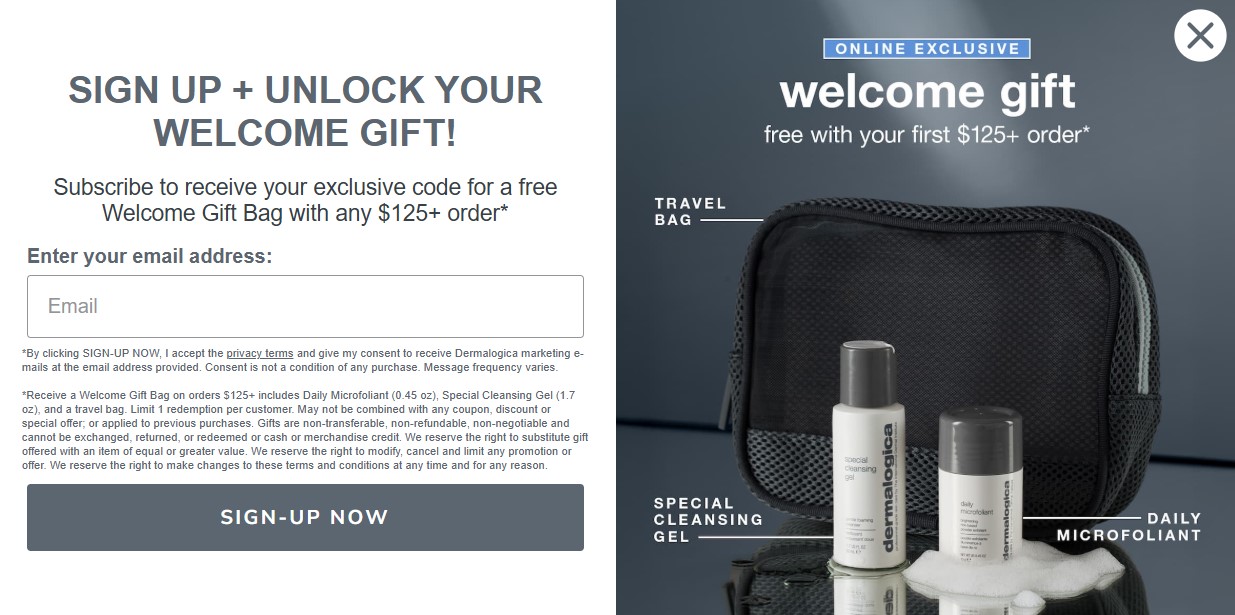
Dermalogica uses a welcome gift to drive signups without training customers to wait for discounts:
- Create urgency with limited-time offers, countdown timers, or low-stock messages to drive instant sales
- Segment offers by acquisition source (paid traffic, email subscribers, social followers) to tailor-fit incentives
A wellness brand tested “15% off” versus “free shipping on orders over $50” for first-time customers. Free shipping increased conversions by 31% and raised average order value by 22%.
A marketing automation tool like Omnisend can trigger various welcome discounts depending on the acquisition source. This allows you to test offers across channels while keeping them personalized.
9. Marketplace and partnership channels
These customer acquisition strategies provide access to built-in traffic and strong buying intent. You may pay higher commissions, but you gain product visibility that you couldn’t generate alone.
Implementation tactics:
- List products on marketplaces relevant to your niche, such as Amazon for electronics or Etsy for handcrafted goods
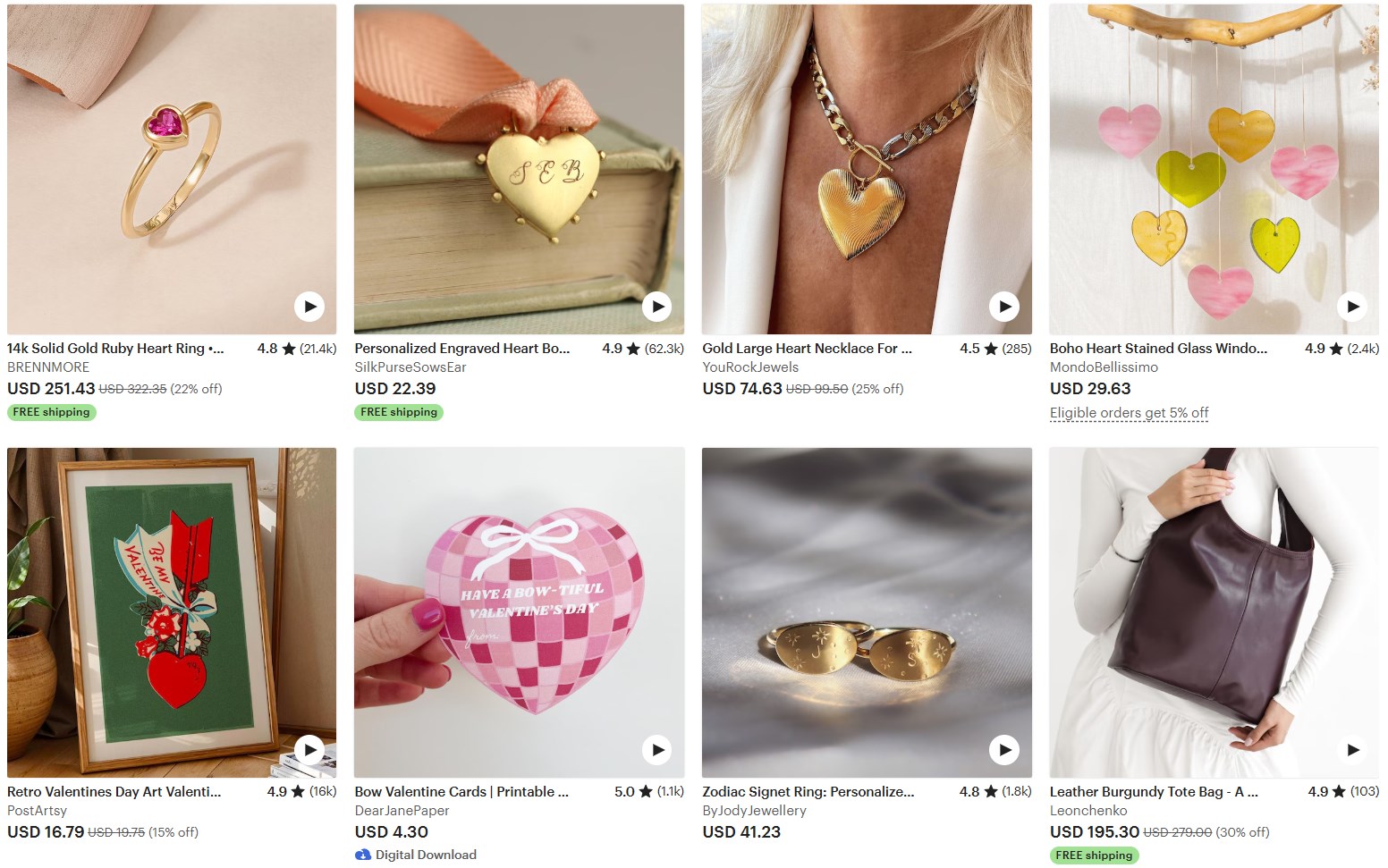
- Optimize listings with keyword-focused titles, benefit-driven bullet points, and high-quality product images to improve rankings
- Add branded package inserts offering a discount on the next order when customers sign up directly on your website to convert marketplace buyers into owned contacts
- Research programs like Amazon Brand Registry, Etsy Pattern, or Walmart Marketplace to understand customer communication limits before scaling
- Run co-marketing partnerships with complementary brands for bundles, giveaways, or shared email promotions
A pet supply brand partnered with a pet food subscription box by adding product samples to shipments. This brought in 890 new customers at a CAC of $11.
Marketplaces provide traffic but limit access to customer data. Use them to generate first purchases, then move buyers to your owned email or SMS channels to build long-term relationships.
10. Product-led growth tactics
Your product can become one of the most powerful customer acquisition strategies. When the experience feels remarkable, customers naturally share it. That word-of-mouth marketing fuels organic growth and reduces reliance on paid ads.
Implementation tactics:
- Design a share-worthy unboxing experience with branded packaging, insert cards, and clear social media prompts
- Add branding elements, such as “powered by [your brand]” on packaging or digital products to reinforce recognition, like this unique packaging by Tomatier:

- Include QR codes on packaging that link not only to your homepage, but also to dedicated email or SMS signup pages with exclusive offers — monitor signup rates by product line
- Run hashtag campaigns that incentivize user-generated content and provide entry into email-only offers to grow your owned channels
- Launch limited editions or collectible drops to spark urgency and drive repeat purchases and social media shares
For example, a streetwear brand designed Instagram-worthy packaging that generated 2,300 tagged organic posts and reached 1.2 million users at zero CAC.
Tools like Omnisend let you build landing pages and email capture forms specifically for QR code traffic. This helps you turn interest into lasting customer relationships.
How to calculate customer acquisition cost
Measuring CAC helps determine whether your customer acquisition strategies deliver a positive return on investment.
The basic CAC formula
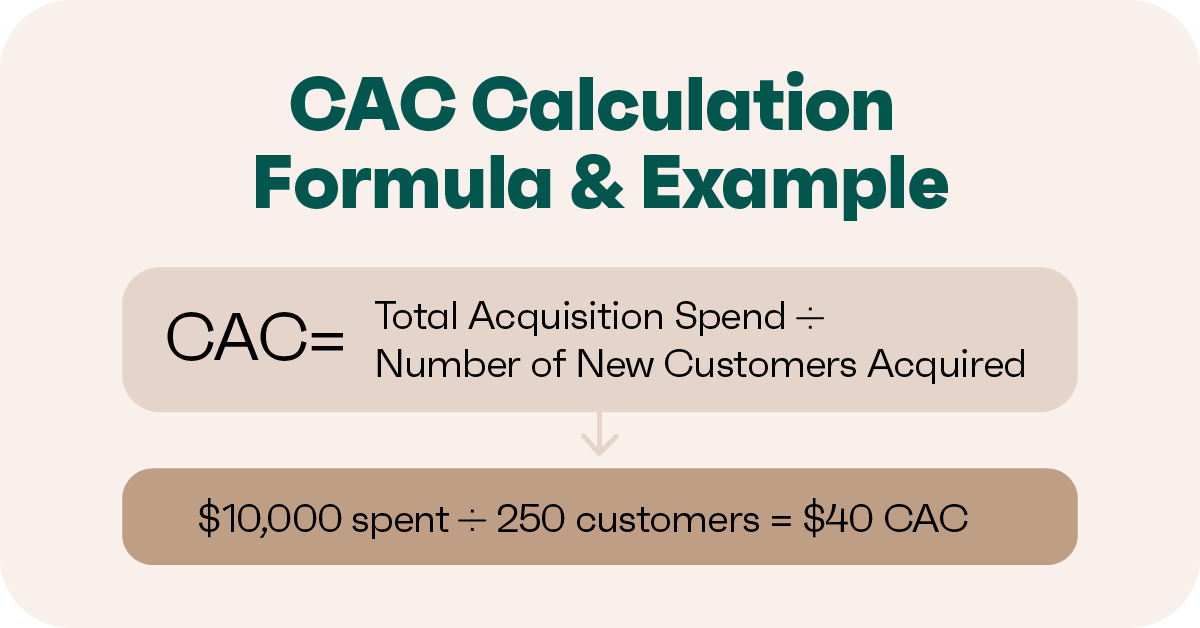
CAC = Total acquisition spend ÷ Number of new customers acquired
For instance, if you spend $10,000 on marketing in a month and gain 250 new customers, your CAC is $40.
What to include in total acquisition spend
- Paid advertising expenses across all platforms
- Content creation costs (copywriting, design, video production)
- Marketing software and tool subscriptions
- Agency and freelancer fees
- The portion of your team’s salaries spent on acquisition
What not to include
- Product expenses and cost of goods sold (COGS)
- Shipping and fulfillment
- Operational overhead, like rent or utilities
Channel-specific CAC
Calculate each channel’s CAC separately to identify your best-performing customer acquisition strategies.
For example:
If you spend $5,000 on Facebook ads and acquire 100 customers, your Facebook CAC is $50. Similarly, if your email marketing spend is $2,000 and it acquires 200 customers, your CAC is $10. This tells you exactly where to focus your budget to maximize results.
Channel-specific CAC vs. blended CAC
Blended CAC (total spend ÷ total customers) gives you an overall view of performance across channels. However, it hides the performance differences that channel-specific CAC provides.
Track both to gain clearer visibility into your customer acquisition strategies and make data-driven decisions.
Common CAC calculation mistakes
- Forgetting tool costs (if your email platform costs $500/month and generates 50 customers, your CAC is $10 before content or ads)
- Overlooking salary allocation
- Tracking revenue instead of new customers
Ecommerce CAC benchmarks
A healthy CAC usually falls within 20%–30% of your average order value. However, it varies depending on profit margin and customer lifetime value.
Average ranges by channel:
| Channel | Average CAC range |
|---|---|
| Email marketing | $8–$15 |
| Organic social | $12–$25 |
| SEO/content marketing | $15–$35 |
| Influencer marketing | $35–$85 |
| Paid social (Facebook/Instagram) | $9–$451 |
| Google Ads | $30–$120 |
Average ranges by industry:
| Industry | Average CAC range |
|---|---|
| Fashion | $15–$45 |
| Beauty | $20–$50 |
| Home goods | $25–$65 |
| Electronics | $30–$80 |
Calculate your CAC monthly. Then, review your three-month rolling average to catch rising costs before they affect profits. Also, compare CAC to customer lifetime value to ensure profitability.
The most sustainable customer acquisition strategies lean on owned channels. Email and SMS consistently deliver a lower CAC than paid ads, often between eight and $15.
To see how costs and features compare across Omnisend and other email marketing platforms, use the pricing calculator below. Enter your contact count, select providers, and see how costs stack up:
Quick email provider pricing comparison
Quickly and easily compare the top email marketing providers so you can find the best platform for your ecommerce store needs.
Total number of contacts:
Oops! Please enter something valid.
Compare
prices for:
prices for:
You can compare Omnisend and 2 more providers at once.
- Omnisend
- Klaviyo
- Mailchimp
- Drip
- Moosend
- Active Campaign
- Get Response GetResponse
- MailerLite
You can compare Omnisend and 2 more providers at once.
Select at least one provider.
Free
Tier 1
Tier 2
Tier 3
Still not sure?
Try out the full version of this calculator
Start optimizing your acquisition spend today with Omnisend’s high-converting ecommerce campaigns
Quick sign up | No credit card required
Key customer acquisition metrics to track
CAC alone won’t tell you if your customer acquisition strategies are profitable. Track these core metrics to understand long-term sustainability.
1. Customer acquisition cost (CAC)
CAC is how much you spend to win each new customer.
- Formula: Total marketing spend ÷ new customers acquired
- Benchmark: 20%–30% of average order value
- Why it matters: Shows whether you’re acquiring customers at a sustainable cost
2. Customer lifetime value (CLV)
CLV predicts the total revenue a customer generates throughout their entire relationship with your business.
- Formula: Average order value × purchase frequency × customer lifespan
- Target CLV:CAC ratio: At least 3:1
- Why it matters: The CLV ratio reveals whether your customer acquisition strategies are profitable long-term
3. CAC payback period
This metric measures how long it takes to recover acquisition costs through revenue.
- Formula: CAC ÷ average monthly revenue per customer
- Target: Three to six months
- Why it matters: Long payback periods tie up capital that you could reinvest into business growth
4. Conversion rate by channel
Conversion rate is the percentage of visitors who convert into customers across each acquisition channel.
- Formula: (Customers ÷ visitors) × 100
- Benchmark: Two to three percent for cold traffic and five to eight percent for warm/owned audiences
- Why it matters: This metric reveals which channels attract ready-to-buy traffic versus casual browsers, allowing you to make wiser investment decisions
5. Marketing efficiency ratio (MER)
MER tracks your entire marketing engine’s profitability. Unlike return on ad spend (ROAS), which tracks the performance of specific campaigns, MER measures the impact of your overall marketing investment on total revenue.
A 4x MER means you generate $4 in revenue for every $1 spent on marketing. Use ROAS to optimize campaigns and MER to allocate budgets strategically. A campaign might yield an 8x ROAS, but if your blended MER is only 2x, your overall strategy needs improvement.
- Formula: Total revenue ÷ total marketing spend
- Benchmark: 2x for early-stage scaling brands and 4x–5x for established companies wanting sustainable growth
- Why it matters: MER helps you improve your customer acquisition strategies to ensure long-term profitability
6. Email/SMS list growth rate
This tracks the number of new subscribers to your list each month.
- Formula: (New subscribers this month ÷ total subscribers last month) x 100
- Target: 5%–10% monthly
- Why it matters: Shows how effectively you’re growing owned channels to reduce long-term CAC
7. First-purchase profitability rate
This metric tracks the percentage of first orders that remain profitable after CAC.
- Formula: (Gross profit from first purchase – CAC) ÷ First purchase revenue
- Target: five to 15%
- Why it matters: If most first purchases lose money, your model depends heavily on repeat buying
| Metric | Formula | Benchmark | Best used for |
|---|---|---|---|
| CAC | Marketing spend ÷ new customers | 20%–30% of AOV | Cost control |
| CLV | AOV × frequency × customer lifespan | 3:1 CLV:CAC | Profit forecasting |
| CAC payback period | CAC ÷ monthly revenue | Three to six months | Cash flow planning |
| Conversion rate | (Customers ÷ visitors) x 100 | Two to 8% | Channel optimization |
| MER | Total revenue ÷ total spend | 2x–5x | Budget allocation |
| Email/SMS list growth rate | (New subscribers ÷ last month subscribers) x 100 | 5%–10% monthly | Owned channel growth |
| First-Purchase Profitability | (Gross first purchase profit − CAC) ÷ first-purchase revenue | 5–15% | Unit economics |
Tracking recommendation
Create a monthly dashboard that tracks all seven metrics and segments data by acquisition channel. Here’s an example of what your dashboard should look like:
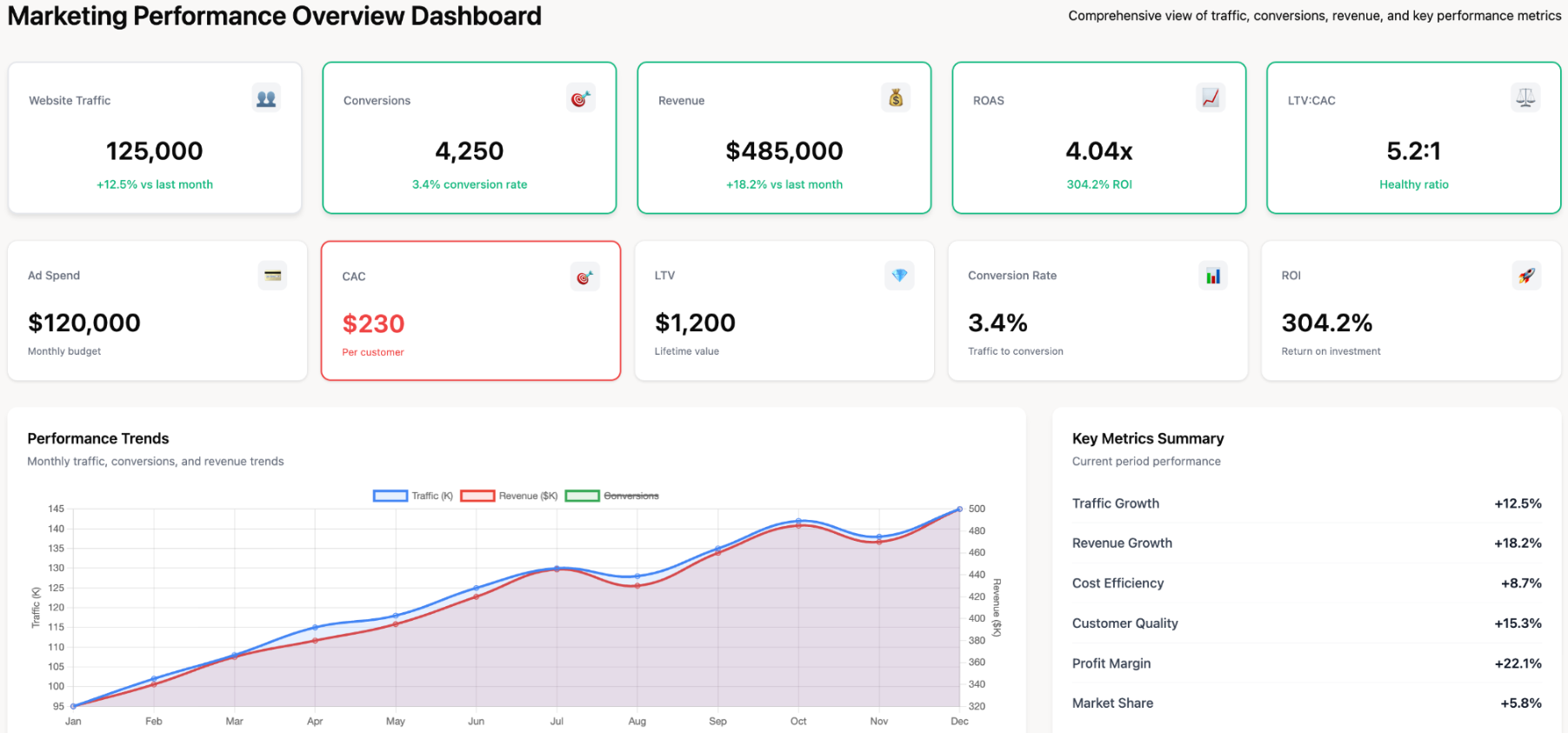
Tools like Omnisend offer performance analytics and reporting that automatically track acquisition metrics. You don’t need to monitor performance manually on spreadsheets.
Its email marketing report and analytics also provide insights into which acquisition campaigns and automations deliver the best returns.
Customer acquisition strategy examples
Real brand examples show you how customer acquisition strategies work in practice. By combining email, SMS, automation, and segmentation, these brands scale revenue while reducing CAC.
Example 1: Rachel Riley

Challenge: As this brand grew, its marketing tools couldn’t keep up. Costs increased, automation became limited, and scaling became harder.
Strategy: Email automation, SMS marketing, and coordinated omnichannel campaigns
Tactics:
- Full welcome series and lifecycle automations
- Cart abandonment workflows and order confirmations
- SMS campaigns focused on USA shoppers
- A month-long BFCM campaign instead of a single weekend push
Results: Rachel Riley achieved a 77.33% year-over-year revenue increase, with automations representing 46% of Omnisend-driven revenue. By shifting 48.1% of total store revenue to owned channels, the brand reduced its overall CAC with minimal additional cost.
This dashboard illustrates the brand’s performance:
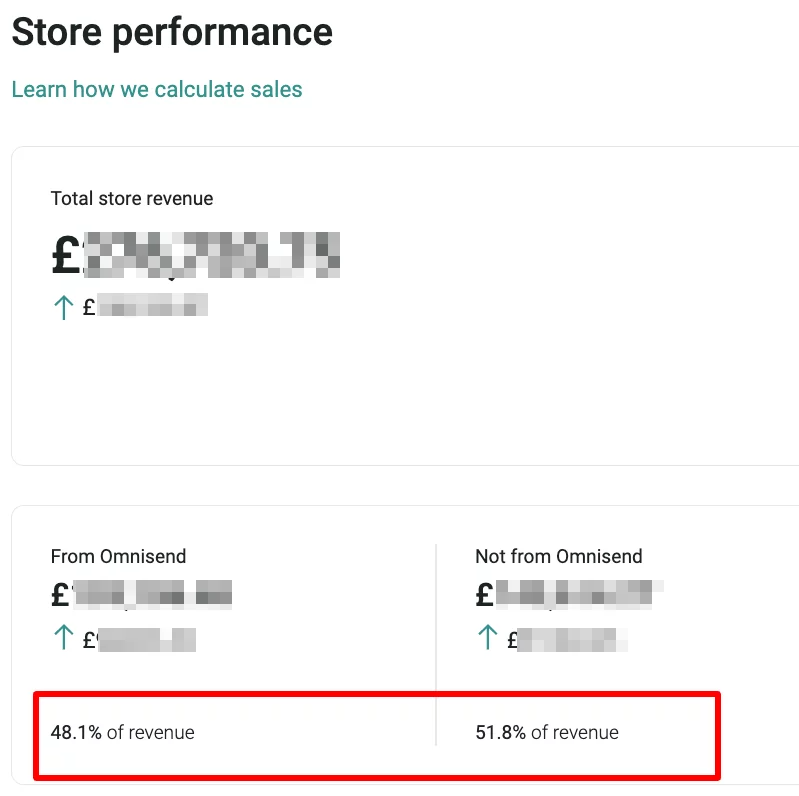
Key takeaway: Owned channels such as email and SMS reduce dependence on paid ads. Start with welcome and cart recovery automations. These two flows alone often generate 30%–40% of email revenue.
Example 2: SM Global Shop

Challenge: The company gained 400,000 email subscribers in a year but needed scalable ways to nurture and engage them.
Strategy: Automated workflows, SMS marketing, and data-driven email marketing covering the complete buyer journey
Tactics:
- Welcome sequence automations
- Cart recovery sent within one hour
- Post-purchase and winback campaigns
- SMS layered into cart abandonment
- Ongoing A/B testing of subject lines, timing, and offers
Results: Within six months, automations generated nearly 50% of email revenue from just 5% of sends. The abandoned cart series achieved a 42.84% conversion rate on its first email, while winback campaigns yielded a 51.78% conversion rate without increasing CAC.
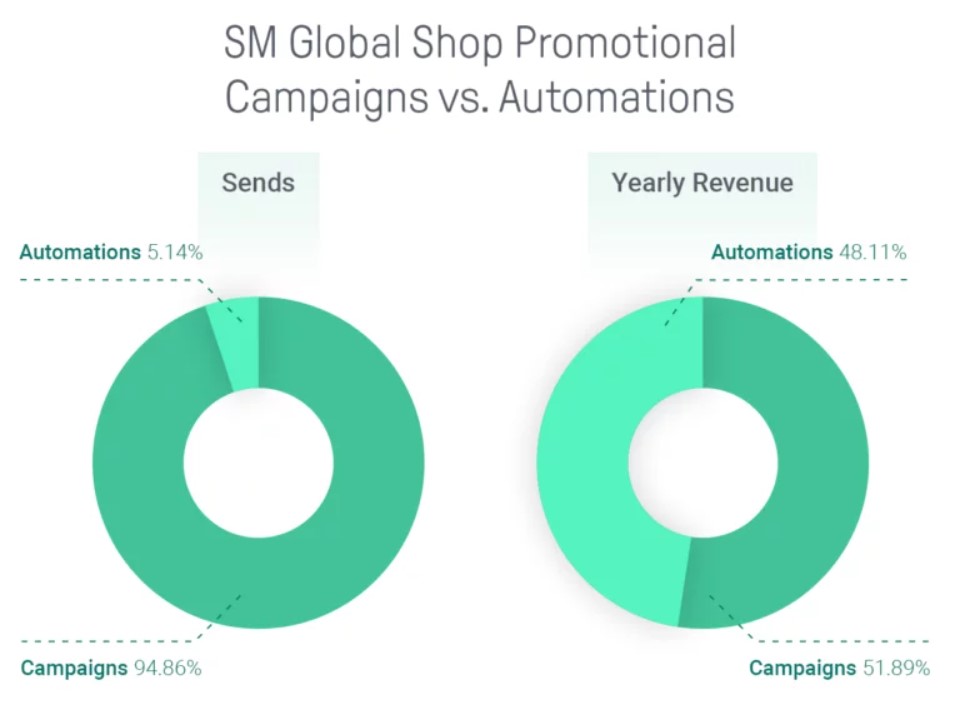
Takeaway: Multichannel customer acquisition strategies with systematic automation enable campaign personalization at scale. To maximize conversions, use SMS to retarget customers when email engagement dips.
Example 3: Dukier
Challenge: Dukier wanted to expand into five European markets while personalizing communication across languages
Strategy: Audience segmentation, localized automations, and ecommerce email marketing adjusted for every market
Tactics:
- Welcome flows in five languages with adjusted catalogs and timing for local cultural habits
- Market-specific cart recovery
- Lead capture funnels
- Segmented campaigns for seasonal promotions like Black Friday
Results: In three years alone, revenue generated by Omnisend grew by 525%, hitting €518,000 in 2025. Automations accounted for 55% of revenue and a 2.8% conversion rate. Remarkably, the brand maintained a tiny 0.36% unsubscribe rate despite massive scaling.
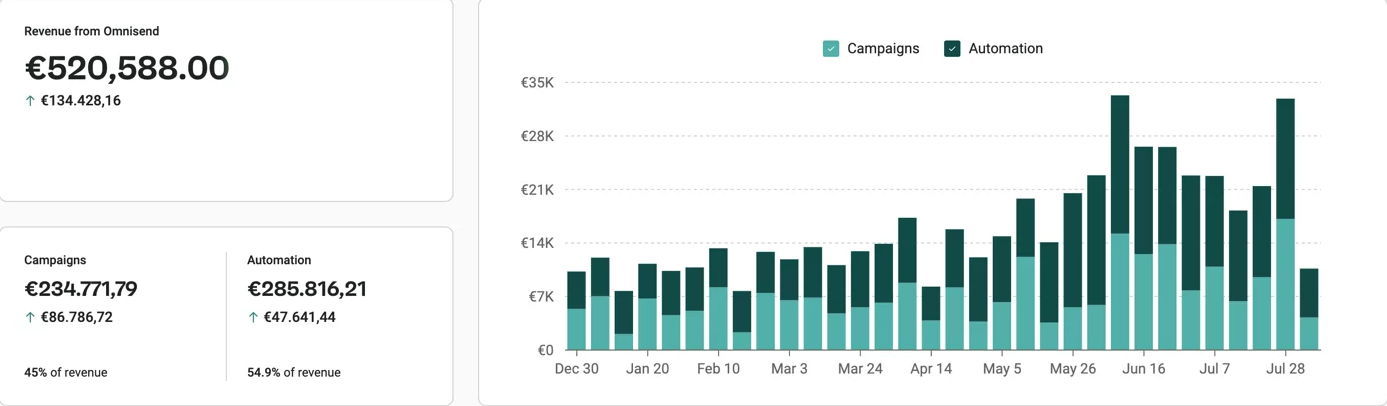
Key takeaway: Localization automation helps you scale internationally without driving up customer acquisition costs at the same pace. Start with granular audience segmentation based on customer data to deliver personalized automated emails.
Example 4: Organic Aromas

Challenge: Organic Aromas had limited signup tools and low conversion from built-in forms
Strategy: Email capture with targeted on-site popups
Tactics:
- Exit-intent popups
- Immediate popups
- Click-based popups
- Signup box
Results: Within an hour, the store captured 661 new leads and got 40 extra orders. The immediate popup alone captured 135 subscribers in a week and achieved a 6.8% conversion rate.
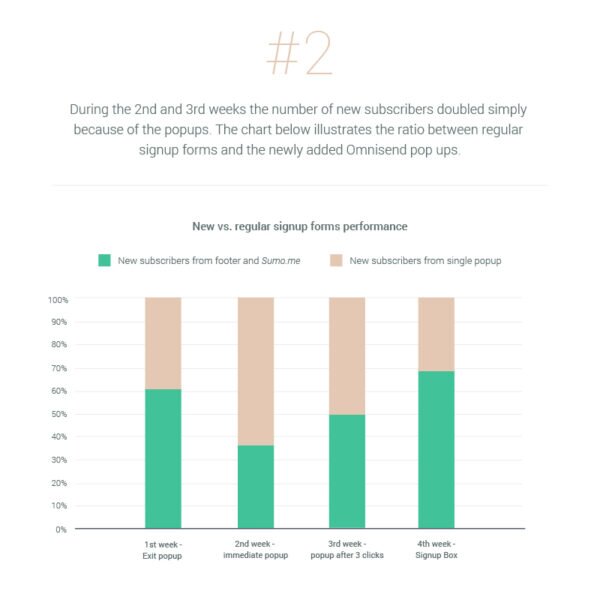
Key takeaway: Experimenting with different ways to capture email addresses can significantly improve owned-channel growth and customer acquisition. Offer clear benefits in your popups, such as discounts or early access, to maximize sign-ups.
Launch your first omnichannel acquisition campaign with Omnisend today and watch your revenue grow
Quick sign up | No credit card required
How to build a customer acquisition strategy
Reliable customer acquisition strategies follow a clear plan that aligns with your business type, margins, target audience, and growth goals.
Follow these steps to build an acquisition strategy that scales with your business:
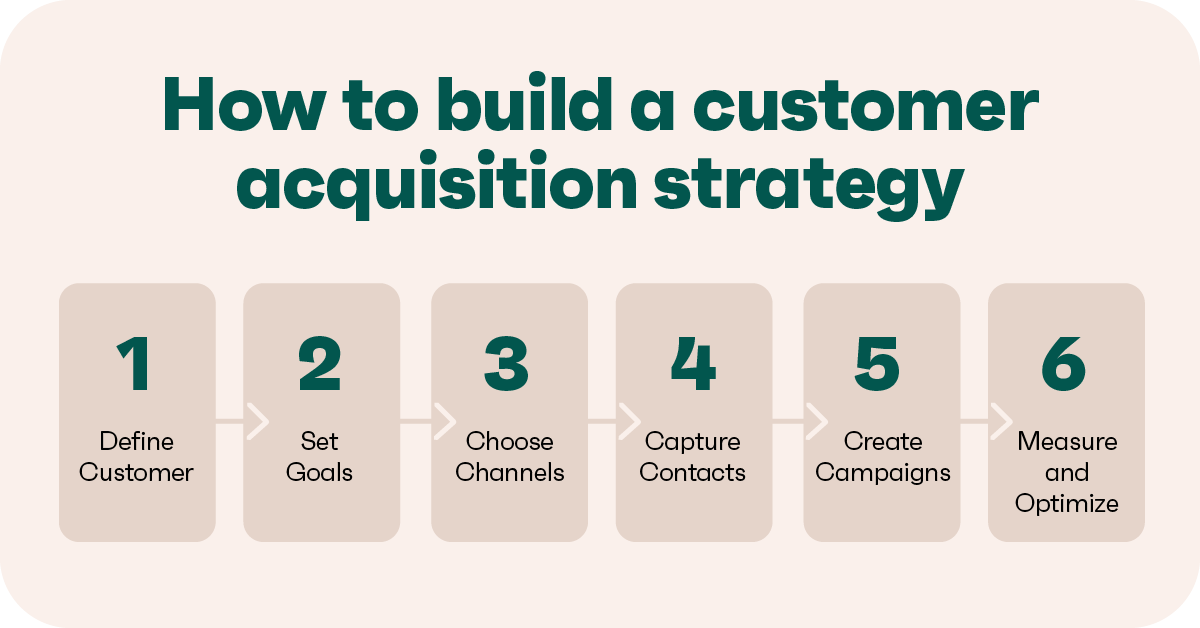
Step 1: Define your ideal customer profile
Identify what type of customer you want to attract. List demographics like age, income, and location. Then, define psychographics, such as motivations, interests, frustrations, and lifestyle.
Validate your ideal customer profile by interviewing recent customers. Ask questions like:
- How did you first hear about our company?
- What almost stopped you from buying from us?
- What made you choose our brand over other options?
- What would make you buy again?
Compare the answers to your purchase data to spot recurring patterns. Also, read competitor reviews to see what customers praise and complain about.
Step 2: Set acquisition goals and budget
Tie your revenue target to specific customer numbers. If your revenue goal is $500,000 and your average order value is $100, you need 5,000 customers. If 30% of buyers return, you’ll need roughly 3,850 new customers annually.
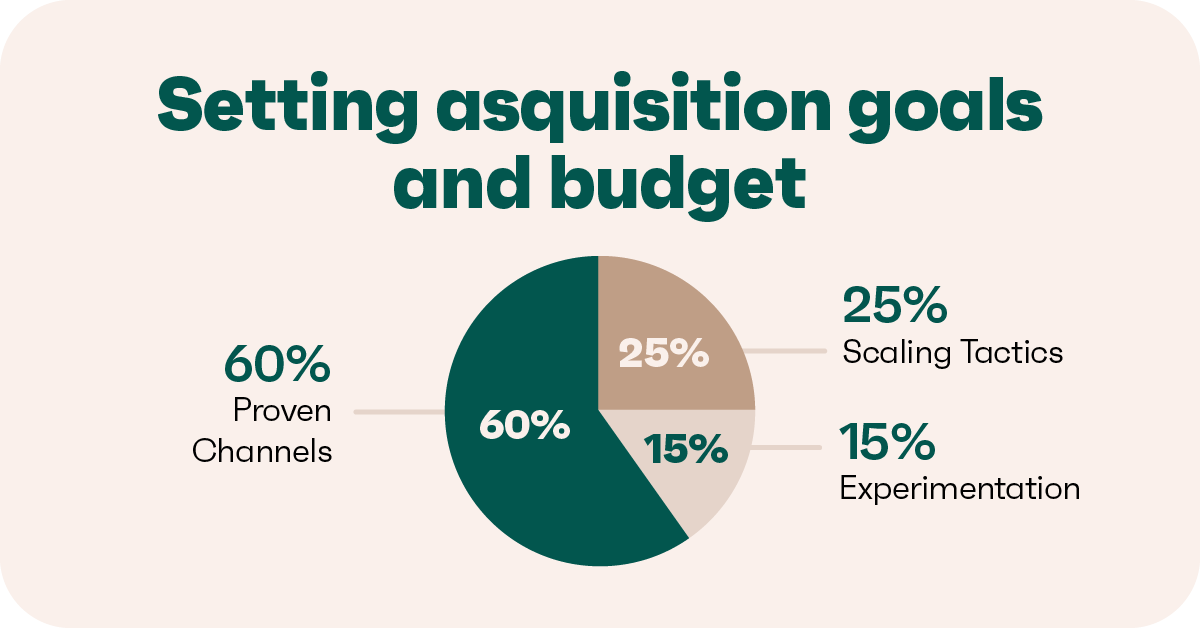
Now, calculate your maximum allowable CAC based on margins and lifetime value. Then, split your budget using the 60-25-15 rule:
- 60% to proven channels
- 25% to scaling opportunities
- 15% to testing new ideas
Step 3: Choose your primary channels
Pick two or three main channels where your audience already spends time. Ensure they match your acquisition budget.
Blend paid and owned channels to balance visibility with long-term relationships. Prioritize platforms with the least competition and strong audience relevance.
For example, if you target Gen Z’ers, your customer acquisition strategies should focus on TikTok, Instagram, and SMS.
Step 4: Capture owned channel contact information
Every acquisition strategy should help you grow your owned email and SMS channels. Use exit-intent popups, post-purchase signup prompts, and gated content to build your email list.
A customer who interacts with your brand through Instagram isn’t fully acquired until they join your email list. This way, you won’t have to pay for the platform again to reach them. Capturing contact details transforms rented traffic into owned relationships.
Step 5: Create integrated campaigns
Your acquisition channels shouldn’t work alone. An integrated campaign keeps your brand visible across the entire customer journey.
You can use automated email and SMS sequences to convert social media audiences while using paid ads to retarget website visitors.
Here’s a workflow example with specific timelines:
- Week 1: Publish a blog post
- Week 2: Promote it across social media platforms
- Week 3: Send it to your email subscribers
- Week 4: Retarget readers with product ads
Step 6: Measure, test, and optimize
Review key acquisition metrics weekly and customer acquisition strategies monthly. Use the findings to tweak your ads, emails, and website for better results.
When A/B testing, prioritize simple but impactful variables. For instance, test:
- Subject lines before redesigning emails
- Landing page headlines before rebuilding the page
- Offers before changing entire funnels
Focus on what drives results and reassign your budget to the most profitable channels.
Tools like Omnisend connect email, SMS, landing pages, and automation in one system. Instead of juggling separate platforms, you capture, nurture, and convert customers while centralizing your customer acquisition strategies.
Start lowering your customer acquisition cost today
The most profitable customer acquisition strategies apply one principle: they turn expensive, paid attention into owned relationships via email and SMS.
Shifting from paid advertising dependency to owned channels lowers your acquisition costs while increasing customer lifetime value and retention.
Start by implementing these three simple steps this week:
1. Calculate your CAC by channel to identify high-performing acquisition sources
2. Add email capture forms to pages with the most traffic
3. Launch at least one automation, such as a welcome series or abandoned cart flow
Omnisend helps ecommerce businesses win customers profitably with email and SMS automation flows that generate $79 for every $1 spent.
Start free today and see results within the first 30 days.
Turn hesitant visitors into long-term customers with Omnisend’s pre-built ecommerce workflows
Quick sign up | No credit card required
FAQs: Customer acquisition strategies
What are customer acquisition strategies?
Customer acquisition strategies are used to attract and convert new customers. They include email marketing, paid ads, SEO, social media marketing, referral programs, and strategic partnerships.
What is a good customer acquisition cost for ecommerce?
A healthy ecommerce CAC generally falls between 20% and 30% of your average order value. However, your acquisition cost also depends on your profit margins and customer lifetime value. If your average order value is $100, aim to spend $20–$30 in gaining new customers.
What are the strategies for customer acquisition?
Primary customer acquisition strategies include:
— Email marketing and list building
— Paid advertising
— Content marketing and SEO
— Social media engagement
— Influencer and affiliate partnerships
— Referral programs
What is the best customer acquisition channel for ecommerce?
There’s no universal best channel. Effective customer acquisition strategies combine paid traffic and owned channels for maximum impact. Email marketing delivers the lowest long-term cost after you build your list. Paid ads deliver results quickly but require ongoing spend.
How long does it take to see results from customer acquisition strategies?
Result timelines depend on the channel. Paid ads produce results in days while email marketing delivers within weeks. SEO and content marketing take around six to nine months.
Should I focus on customer acquisition or retention?
You must balance both to scale sustainably. Acquisition fuels growth while retention maximizes every customer’s value. Successful customer acquisition strategies attract new buyers and immediately move them into retention flows to increase repeat purchases.
How do I reduce customer acquisition cost?
To lower your CAC, prioritize owned marketing channels over paid platforms. While Google Ads range between $30 and $120 per customer, email marketing only costs $8 to $15.
Start by converting paid traffic into email or SMS subscribers. Then, nurture them through personalized automated sequences to lower repeat acquisition costs.
What is the difference between CAC and CPA?
CAC (customer acquisition cost) measures the total cost of acquiring a paying customer. CPA (cost per action) tracks the cost of a specific conversion, such as a newsletter signup.
A $5 CPA for an email signup doesn’t equal your CAC. You must track how many of those $5 sign-ups become paying customers to determine your true acquisition cost.
How do I calculate customer lifetime value?
To calculate CLV, use the formula below:
CLV = Average order value × purchase frequency × customer lifespan
For example:
$100 AOV × three purchases per year × three years = $900 CLV
Aim for a CLV-to-CAC ratio of at least 3:1 to keep your acquisition model sustainable.

TABLE OF CONTENTS
TABLE OF CONTENTS


Subscribe and don’t miss any updates!
No fluff, no spam, no corporate filler. Just a friendly letter, twice a month.