
 Omnisend AI


 OFFER
OFFER








Ecommerce customer journey: A simple (but complete) guide
With over 130+ pre-built integrations and flexible APIs, you can easily centralize data from across your tech stack
Make the most out of your data and unlock powerful growth marketing possibilities with these other top marketing tools.
Build any custom integration with our open, flexible APIs that are simple to use and implement.
Check out apps that have been stealing all the spotlight.
Email and SMS marketing insights, ecommerce resources, and the latest Omnisend news
Expert-led sessions covering email, SMS, and ecommerce marketing strategies.
Educational video and live training to help you make the most out of Omnisend.
Drive sales on autopilot with ecommerce-focused features
See Features
A successful email marketing strategy relies on a well-defined plan that focuses on engaging subscribers and building relationships, rather than just sending bulk emails.
Growing a high-quality email list through value exchanges and maintaining list hygiene is crucial for maximizing ROI and ensuring long-term deliverability.
Implementing must-have automations, such as welcome series and cart abandonment emails, can significantly boost open and conversion rates, driving more revenue from your campaigns.
Regularly segmenting your audience based on dynamic behaviors and preferences allows for personalized communication, enhancing engagement and increasing the effectiveness of your email marketing efforts.
Let’s be real, simply having an email list and shooting bulk marketing emails isn’t going to bring you sales when you don’t have a well-defined email marketing strategy.
To turn subscribers into repeat buyers, you need a focused plan that engages customers, builds relationships, and drives revenue. Our internal analysis shows email delivers an average 76x return, proving that email marketing works but only when done intentionally.
Whether you’re running an ecommerce store, leading a B2B marketing team, or promoting a SaaS product, you need a focused and measurable email marketing strategy.
In this guide, you’ll find the most effective strategies that, according to Omnisend’s latest data, will remain crucial in 2026:
Looking to get more from your email marketing efforts? Download our Email marketing strategy plan to discover a data-driven approach for building smarter campaigns, improving engagement, and boosting ROI. It’s packed with practical insights to help you turn strategy into results.
It’s important to build a healthy email list for your email marketing strategy and not buy it off the shelf.
An engaged, permission-based list delivers the highest ROI, protects your sender reputation, and ensures long-term deliverability. A smaller list of opted-in subscribers will always outperform a large, unverified one.
Think of list building as a value exchange. Visitors “pay” for a subscription with their email address. As inbox clutter increases, so should the value you offer. Beyond discounts, you can offer content upgrades, early product drops, or entry into a community to gain trust and increase subscriptions.
Here are ways to build a healthy email list:
Use Omnisend’s free signup form templates to create simple forms and build an engaged list. You can use gamified forms like spin-to-win wheels that perform well because they trigger a sense of “winning.”
This creates an endowment effect where subscribers value the reward more because they feel like they earned it. Based on our analysis, gamified signup forms can reach conversion rates of up to 11%, compared to 6.5% for standard landing pages.
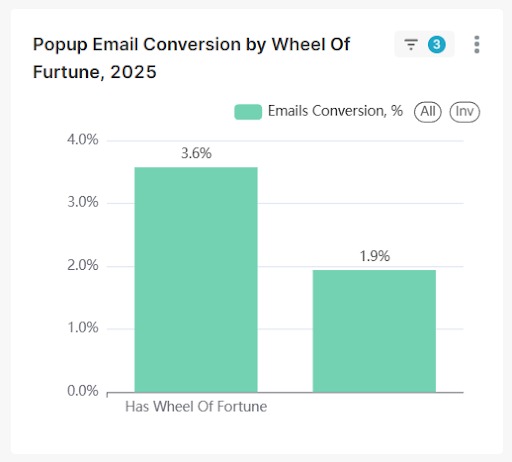
Gamified popups like Wheel of Fortune also work, boasting a conversion rate of 3.6%:
Use double opt-in and follow GDPR or CAN-SPAM rules to ensure only genuinely interested subscribers join your list.
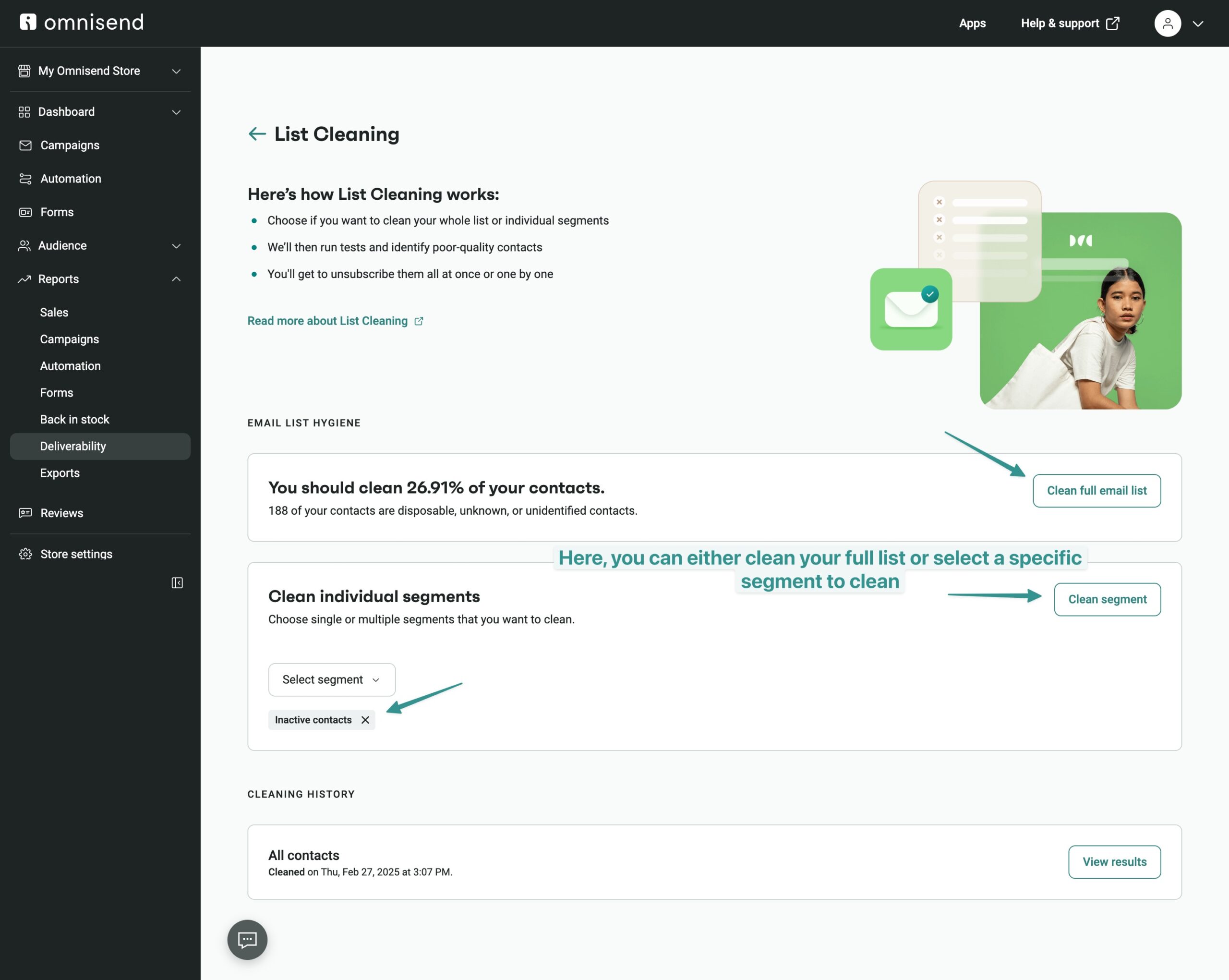
Also, keep your list clean by removing inactive contacts or re-engaging them with targeted campaigns. With Omnisend’s email list hygiene feature, you can clean your list in full or by segments:
Watch this video to learn practical tips on creating high-converting signup forms:
With a proven email marketing automation strategy, you can send messages triggered by customer actions and initiate relationship-building conversions.
According to Omnisend’s 2026 Ecommerce Marketing Report, automated emails deliver 24% higher open rates and 19% higher conversion rates. The top two automations, abandoned cart and welcome series, generate 76% of all automated orders:
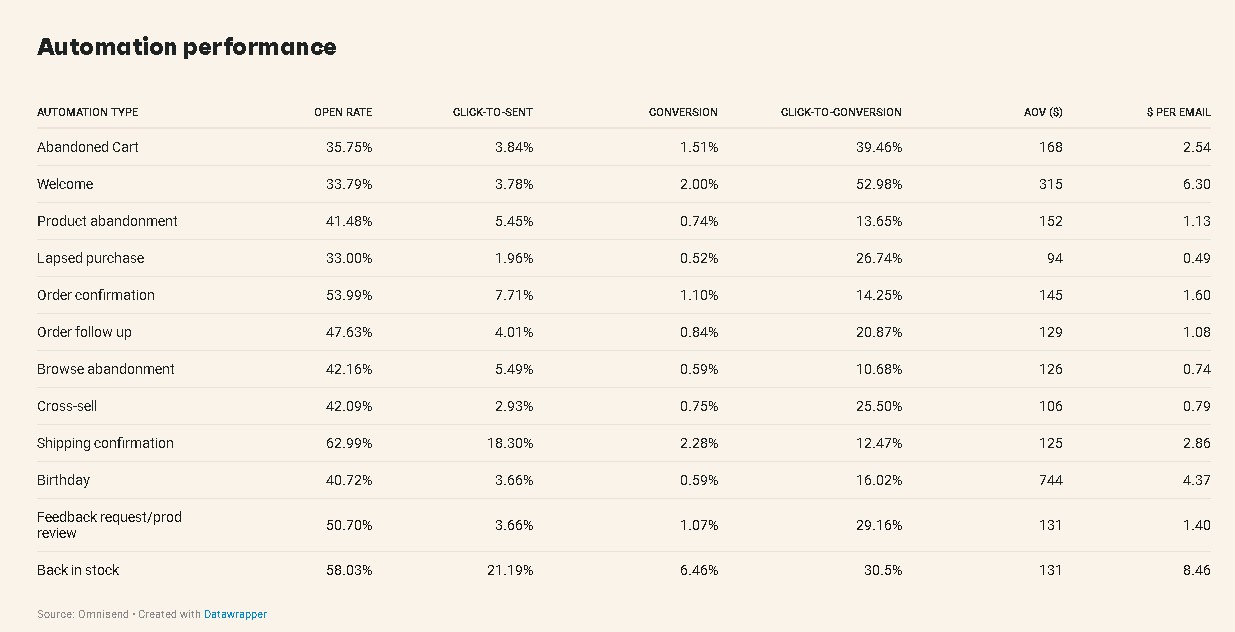
Some of the top automated campaigns you can include in your email marketing strategy are:
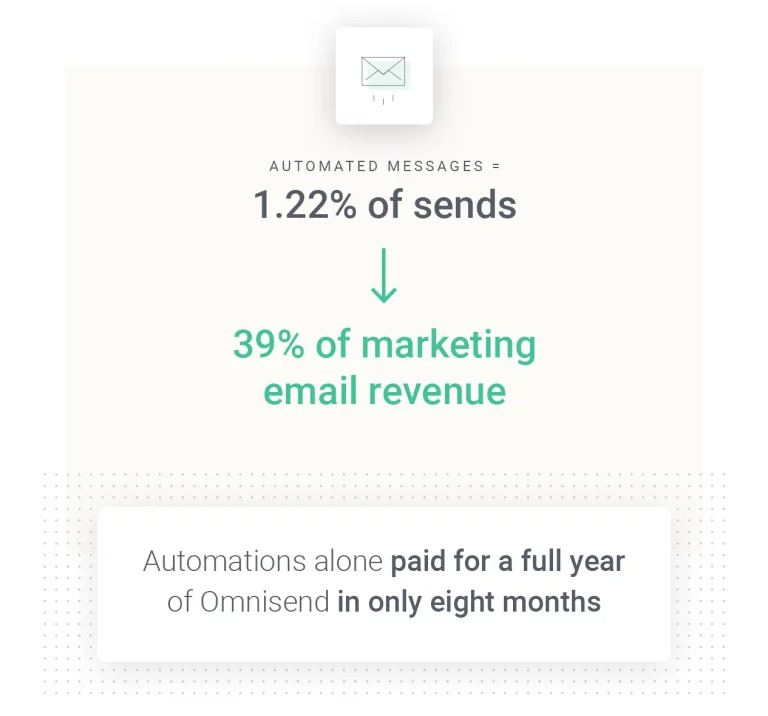
| Automated messages made up only 1.22% of Island Olive Oil’s emails, but those messages drove 39% of total email revenue. Here’s the full success story. |
 |
A mistake brands make with email segmentation is keeping segments static while customer behavior constantly changes. Customer behavior is far more predictive than their attributes.
Omnisend’s dynamic behavioral segmentation uses customer actions like browsing, clicking, and purchasing as they signal intent more clearly.
Here’s how Omnisend segmentation works:
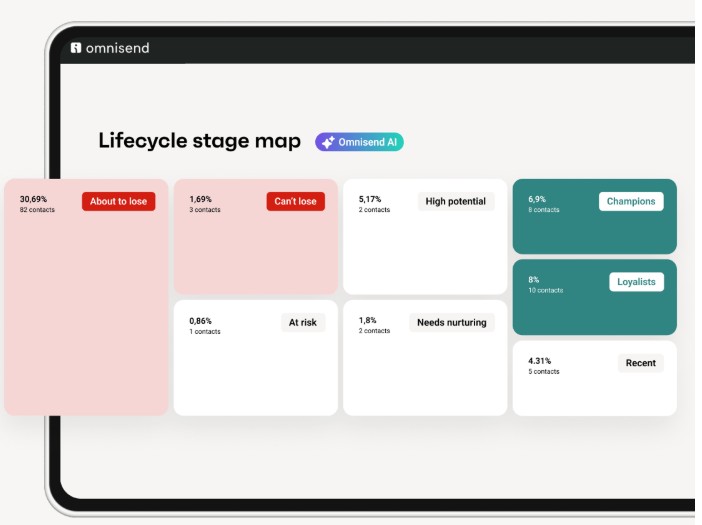
For actionable segmentation, focus on a few high-impact groups like VIPs, at-risk customers, and window shoppers.
Here are some insights we pulled from a video by Magnet Monster CEO, Wiehan Britz, and Omnisend to help improve your email marketing segmentation strategy:
Start with a few behavior-based segments. Then, use engagement and purchase data to refine your messaging over time.
Quick sign up | No credit card required
Your email marketing strategy should focus on giving subscribers a reason to open and engage.
A practical way to do this is the 80/20 content rule. Aim for around 80% value-led content and only 20% direct selling.
You can add more value to your emails using:
When subscribers find non-promotional emails valuable, they’re more likely to regularly open and interact with them. This build sender reputation, helping your emails land in inboxes instead of spam folders.
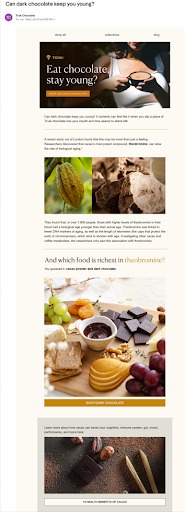
Omnisend’s automated welcome emails helped To’ak Chocolate achieve a 47% open rate and an 18% conversion rate. Here’s an example of a value-driven email by To’ak Chocolate, educating subscribers on the benefits of dark chocolate:
An email subject line is the first thing your subscribers see in their inbox. It plays a crucial role in determining whether they’ll open it. In fact, Omnisend data shows that 35% of customers decide to open an email based solely on the subject line.
Some practical tips for writing effective subject lines include:
Different subject lines work because they tap into different motivations. Here are some common triggers and their corresponding subject line examples:
Test various styles to learn what your audience prefers. Use Omnisend’s subject line tester to test performance, predict open rates, and suggest improvements.
The timing of your emails significantly impact performance. You may be sure that your email marketing is working now but remember, you must continually monitor and analyze metrics and adjust strategies based on data. What worked a month ago may not be beneficial three months from now.
Omnisend’s research findings show patterns that align with general trends, though each audience behaves differently.
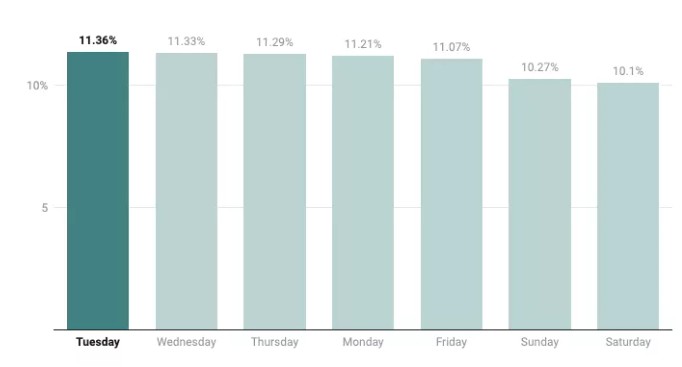
If you have a global audience, segment by time zone or use send-time optimization features to make sure emails arrive at the intended local time for each recipient.
To maintain consistency and protect deliverability, set the correct time zone for your campaigns. You can use A/B tests to send emails at different days or times to subsets of your list, then analyze which options drive the best results.
Remember that sending emails too often can overwhelm subscribers. Meanwhile, you can lose engagement with too few emails. Find a cadence that keeps your audience interested without causing fatigue.
For example, you can send emails for major events like the Super Bowl just before kick-off (6–6:30 PM ET) or around half-time (8–8:30 PM ET). Post-game emails (10 PM ET) are also effective for timely messages or promotions.
When developing an email marketing strategy, you can incorporate other channels like SMS, social campaigns, and push notification for improved results. This approach can strengthen your campaigns and ensure messages reach customers where they’re likely to engage.
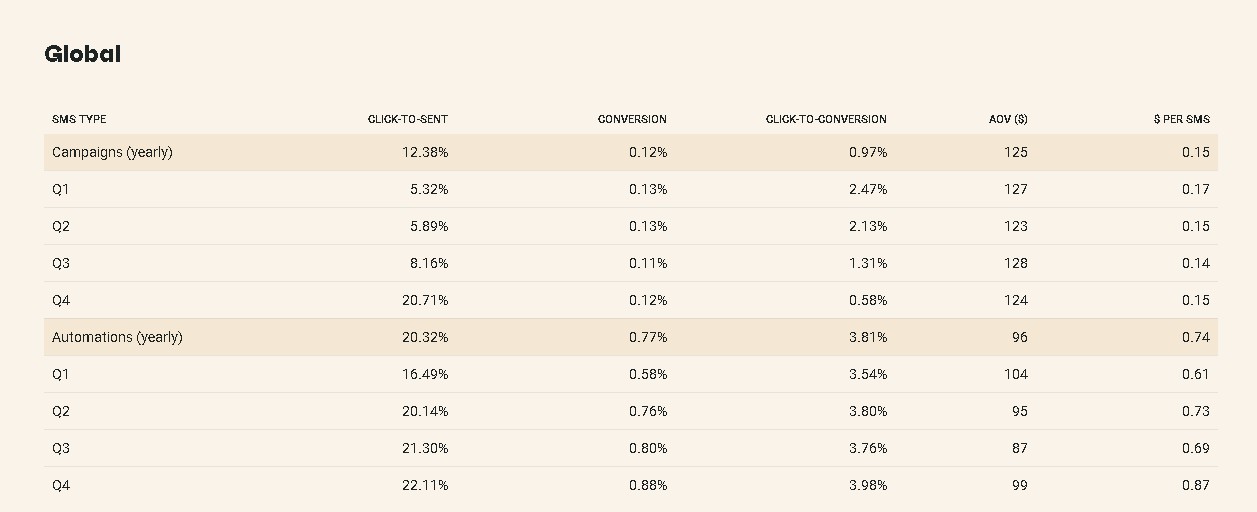
SMS delivers consistent results. After 31% growth in 2024, SMS volume rose another 40% in 2025. Automated SMS performed best, generating $0.74 per send versus $0.15 for campaigns. Meanwhile, behavior-based triggers captured high-intent moments.
An Omnisend report shows that push notifications have also gained traction, with an 11% volume increase in 2025 and an open rate of over 41%. SMS volume also rose by 40% in 2025, achieving click-to-conversion rates of 0.97%:
Different customers prefer different channels. Some respond better to email, while others prefer SMS or push notifications. Respecting these preferences can increase engagement and loyalty. You can also coordinate messages across all channels so they complement each other rather than compete.
For instance, if a user opens your email, don’t send them an SMS. However, if they don’t respond, then you can nudge them with a message 24 hours later.
Vagari Bags used Omnisend to combine email and SMS campaigns and achieved 50% email open rates and £121 for every £1 spent on SMS.
Read the full success story here.
An email marketing campaign is a one-off or scheduled message sent to engage your audience. While email automation flows are triggered by behavior, regular campaigns let you engage customers on your terms and can create spikes in revenue.
Effective campaigns include:
Data from Omnisend’s report show that campaign open rates reached 30.7%, while click to conversion rose from 5.9% to nine percent:
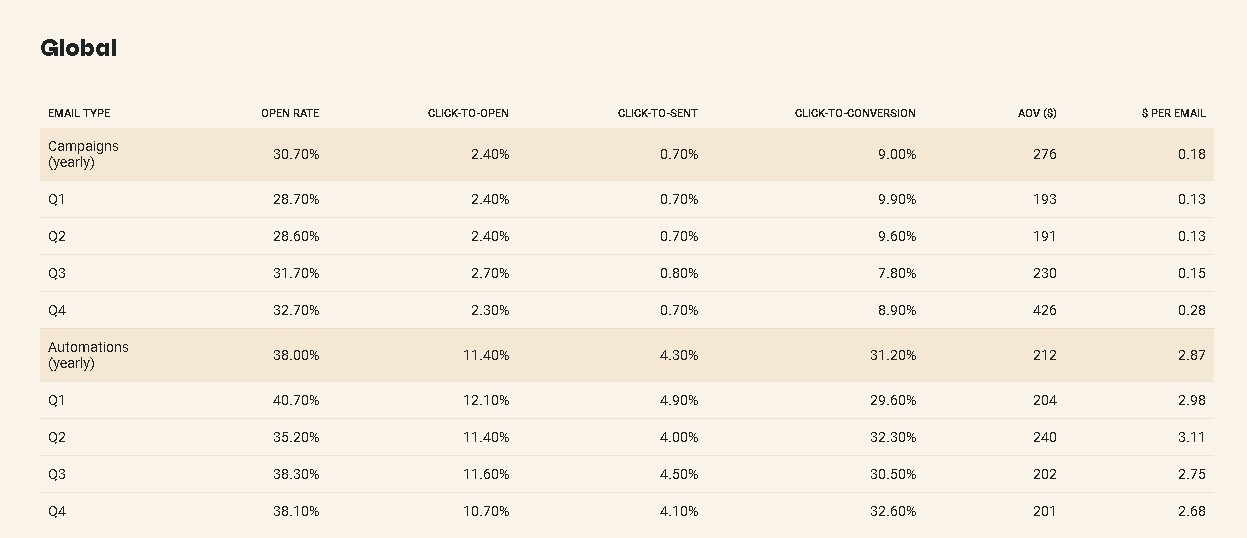
Though automations show higher performance, regular campaigns contribute to your ecommerce email marketing strategy by driving visibility, supporting promotions, and setting the stage for conversions.
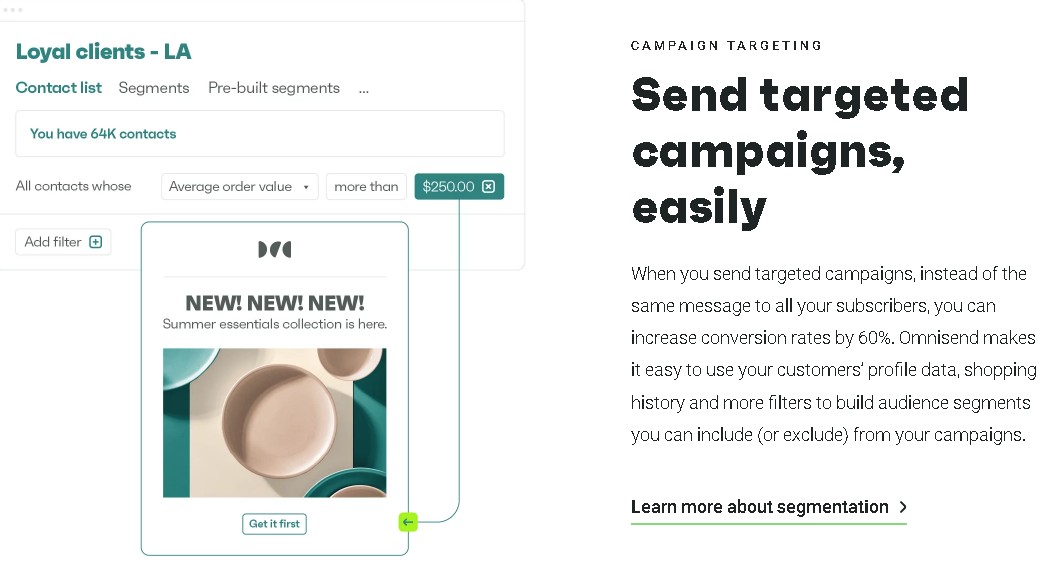
Maintain a regular email schedule, whether weekly, monthly, or daily, to build trust. Also, segment and send tailored campaigns based on customer behavior, which can increase conversions by 60%:
Pro tip
Make use of our 2026 marketing events calendar and plan your campaigns upfront.
Maintaining strong deliverability and compliance with email laws is important to achieve better results for your email marketing strategy. Some key practices you can use to protect deliverability include:
Common mistakes to avoid:
Stay compliant with CAN-SPAM, GDPR, and CASL by using honest sender information, including your physical address. You should also be transparent about why subscribers receive your emails.
Tools like Omnisend offer built-in deliverability safeguards to help maintain inbox placement during high-volume sending periods.
“Omnisend’s team guided us through a much smarter process. Instead of jumping to a new domain, we focused on creating highly segmented audiences to improve engagement. We also moved to a dedicated IP to ensure we were sending from a high-reputation source.“
— Ethan Rodriguez, Marketing Lead at AcreValue.
Read the full success story here.
With more people accessing emails on their mobile devices, it’s crucial to ensure that every email is optimized for these devices. Failing to do so could exclude a significant portion of your audience.
Here are practical ways to optimize emails for mobile:
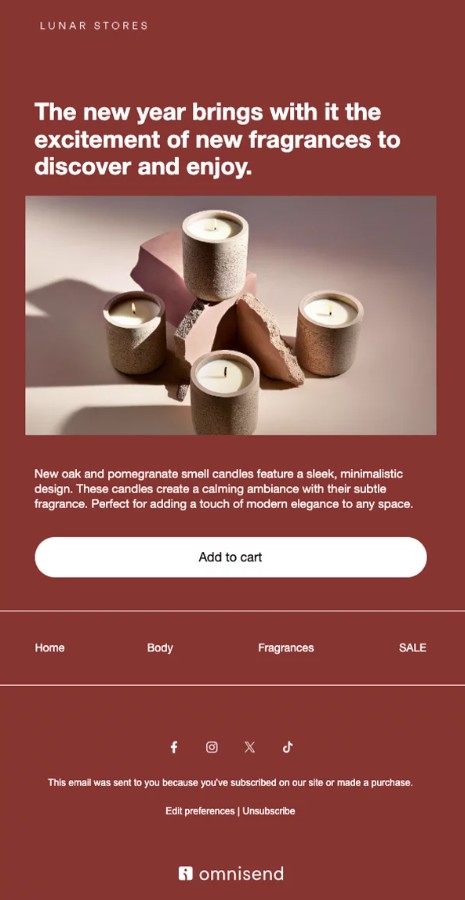
Platforms offer templates to help you create responsive designs without coding. With Omnisend’s mobile-friendly email marketing strategy templates, you can customize brand emails that look great on any device:
Tracking email performance is vital for optimizing your email marketing strategy. Here are key metrics to monitor and their importance:
Tracking results isn’t a one-time task. It’s an ongoing aspect of a strong email marketing strategy. Regular analysis shows what’s working, what’s underperforming, and where to make changes.
Keep in mind that Apple Mail Privacy Protection can preload images, which inflates open rates even when subscribers don’t read the email.
That’s why click through and conversion rate are more reliable performance signals because they show interest and action. Revenue per recipient allows fair comparison across sends, while unsubscribe or spam complaints often signal issues with content, frequency, or targeting.
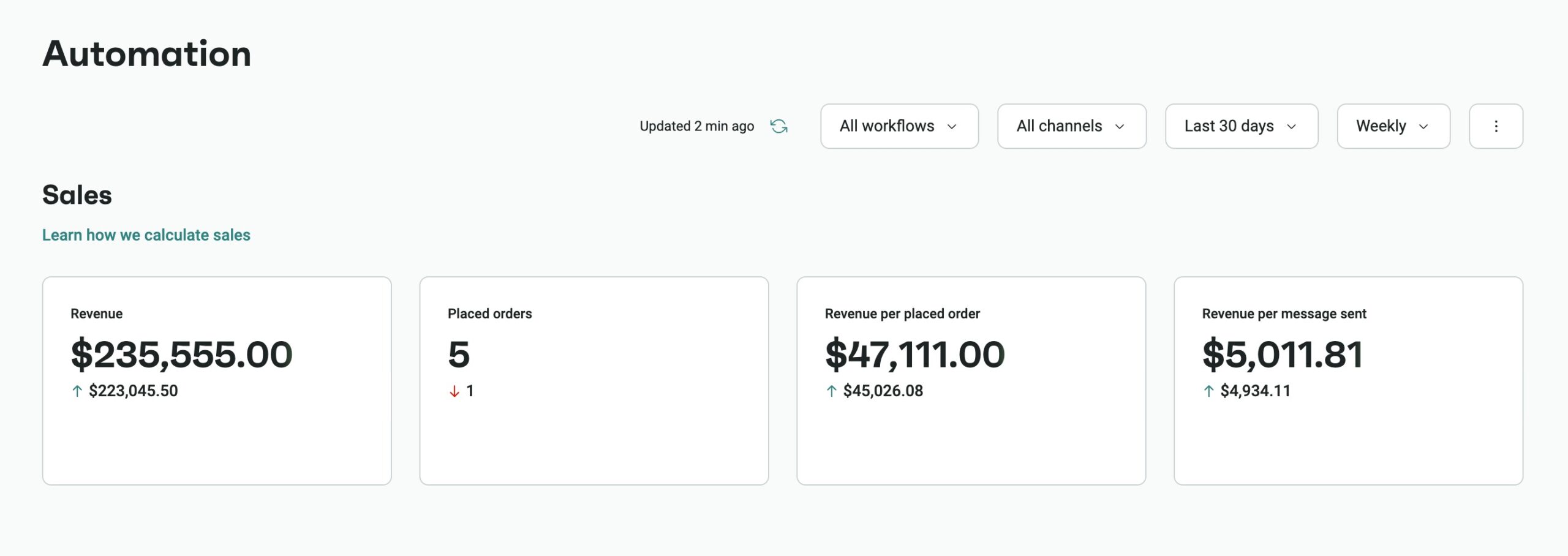
Omnisend’s analytics let you track campaign and automation performance and monitor sales metrics for cost and revenue insights:
A/B testing can help you improve your email marketing strategy over time. It involves sending two versions of the same email to small groups, then sending the better version to the rest of your list. You can test subject lines, email copy, CTAs, layouts, offers, or send times to see what performs best.
To get clear results, use a champion-challenger approach by testing one element at a time. Be realistic about sample size. Small lists may not give reliable results, while larger lists may need more consistent testing to achieve meaningful results.
Pro tip
Use Omnisend’s A/B testing calculator to check the statistical significance of your results to make informed decisions later on.
Take SM Global Shop as an example. They extensively tested their abandoned cart series over a period of six to seven months. Through careful experimentation, they achieved impressive results: a five percent improvement in open rate and an average monthly increase in sales of about $5,000.
“It may not make a huge difference when you’re starting out building your list. But once you have hundreds of thousands of customers in your database, even a .2 or .3 percent increase in any of your metrics can drastically have an improvement on your revenue overall. So I do believe A/B testing is very crucial.”
— David Sung, Digital Marketing Director of SM Global Shop.
Read the full success story here.
Your email marketing strategy differs based on your business model. While the channels may be the same, the goals, timing, and content will vary.
Below is a breakdown of email marketing strategies for each type of business model.
It focuses on long sales cycles and relationship building, prioritizing educational content over immediate conversion. Common tactics include lead nurture drip campaigns, account-based personalization, and webinar invites. Personalization happens at the account or role level, with smaller but highly targeted lists.
An email marketing strategy for ecommerce focuses on driving purchases and repeat orders with frequent, conversion-driven emails. Key campaigns include flash sales, product launches, abandoned cart reminders, and loyalty rewards.
Mobile-friendly layouts are essential since many customers shop on their phones. Automation ensures timely messages, while segmentation delivers relevant offers based on purchase history.
This blends marketing with product communication to increase activation and retention. Emails often include onboarding sequences, feature update newsletters, and churn-prevention emails that reach out to inactive users. These emails guide users to get the most value from the product and encourage continued engagement.
Building a strong email marketing strategy requires careful planning, consistent execution, and ongoing monitoring and improvement. Focus on understanding your audience, setting clear goals, and using automated and personalized messages to drive engagement.
Email marketing keeps evolving, but its core principle remains — delivering content your subscribers find valuable. This approach builds stronger relationships and drives impactful results.
Invest in building a strong email marketing strategy today because email remains one of the most effective marketing channels.
Quick sign up | No credit card required

TABLE OF CONTENTS
TABLE OF CONTENTS

What’s next



No fluff, no spam, no corporate filler. Just a friendly letter, twice a month.