Omnisend AI

 OFFER



The best clearance emails make the deal and the reason to hurry impossible to miss: put the discount in the subject line, the end date or stock limit near the top, and one clear call to action (CTA) leading to the sale page.
A clearance email is a marketing message to existing or potential customers, letting them know you’re having a clear-out of stock. Nine of the 10 examples below show the discount in the subject line or preheader.
These clearance email examples run from sale launches to last-day reminders, with ideas to copy and subject lines to reuse.
10 clearance email examples
We chose each example because it shows a different clearance tactic, from a seasonal clear-out to an extra markdown or a last-chance reminder.
All 10 went out between May 2025 and October 2026, and when you need other campaign formats, our roundup of the best email marketing campaigns is the place to look.
| Brand | Industry | Differentiator |
|---|---|---|
| 1. Vacation | Suncare and fragrance | Warehouse sale as a letter |
| 2. Hikerkind | Women’s hiking apparel | The summer that’s left |
| 3. Jennifer Furniture | Furniture | A reason for the markdown |
| 4. Feetures | Performance socks | Retiring colors named |
| 5. Eames Institute | Design books | Duplicate stock, final sale |
| 6. Carter’s | Kids’ clothing | A $3.99 price floor |
| 7. Phlur | Fragrance | Discontinued scents, new additions |
| 8. Mikasa | Tableware | Extra code on clearance |
| 9. Mackage | Outerwear | Deeper markdowns, no number |
| 10. Kendra Scott | Jewelry | Ends tonight, top-six picks |
1. Vacation: A warehouse sale letter
Subject line: 🌴 WAREHOUSE SALE! Up to 35% OFF 🌴
Preheader: Help us clear our inventory and save big on sunscreens, fragrances, and luxury candles
Trigger: Warehouse sale launch (campaign)
Sent: October 29, 2026, the first day of a five-day warehouse sale
Why this email works
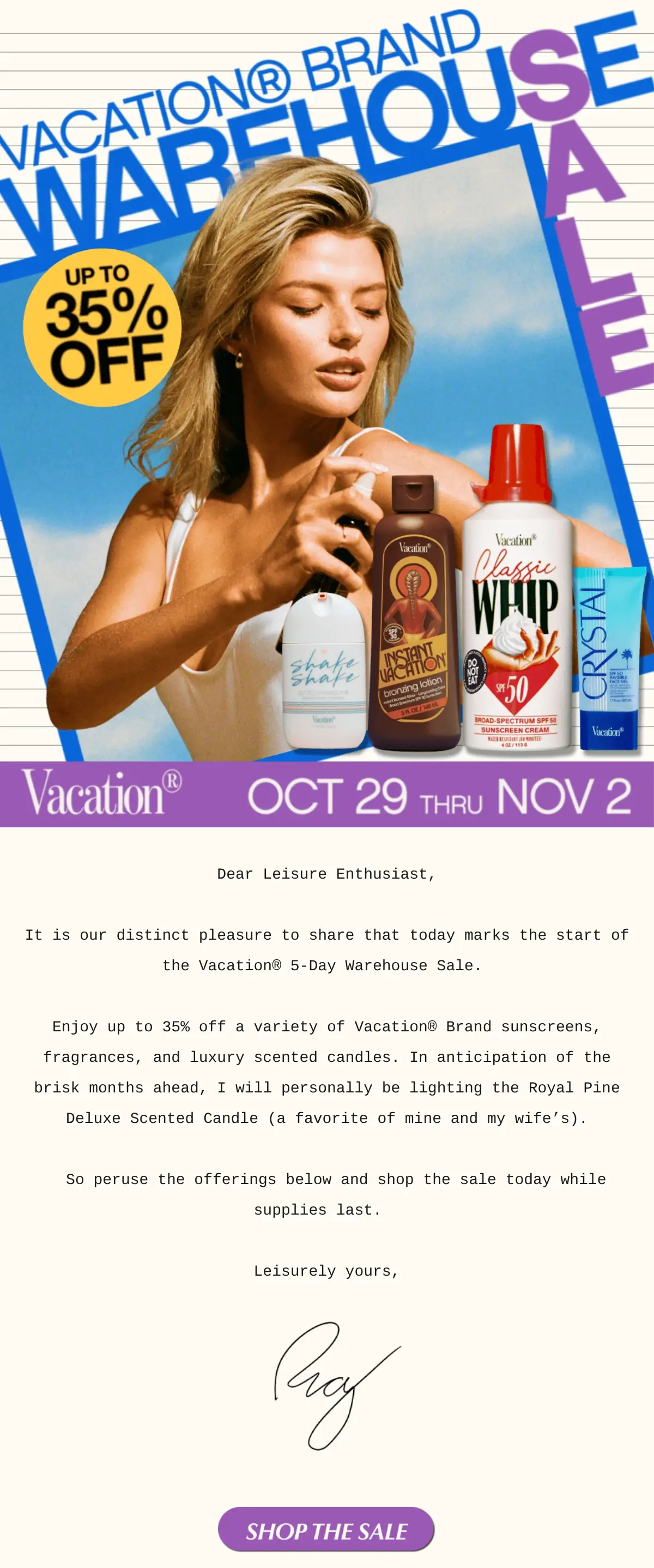
Vacation, a suncare brand, gives the reason for its sale before the email is opened and writes the email as a personal letter, so a clearance sale still sounds like Vacation. The subject line sets “WAREHOUSE SALE!” and “Up to 35% OFF” between palm-tree emojis, and the preheader opens on the reason: “Help us clear our inventory.” Together, these two create a sense of style while keeping the focus on the sale.
Readers get a product pick without being sold one, since the letter’s one named product, the Royal Pine Deluxe Scented Candle, is offered as “a favorite of mine and my wife’s.” The ask comes from a person, too: a handwritten signature sits between “Leisurely yours,” and “SHOP THE SALE.”
What you can learn from it
Give your clearance sale a fixed window and write the email in your own voice, so it reads like news from the brand.
2. Hikerkind: One last adventure
Subject line: This week only: 25-50% off summer styles
Preheader: There’s still time for one last adventure.
Trigger: End-of-season sale launch (campaign)
Sent: August 4, 2026, at the start of a one-week sale
Why this email works
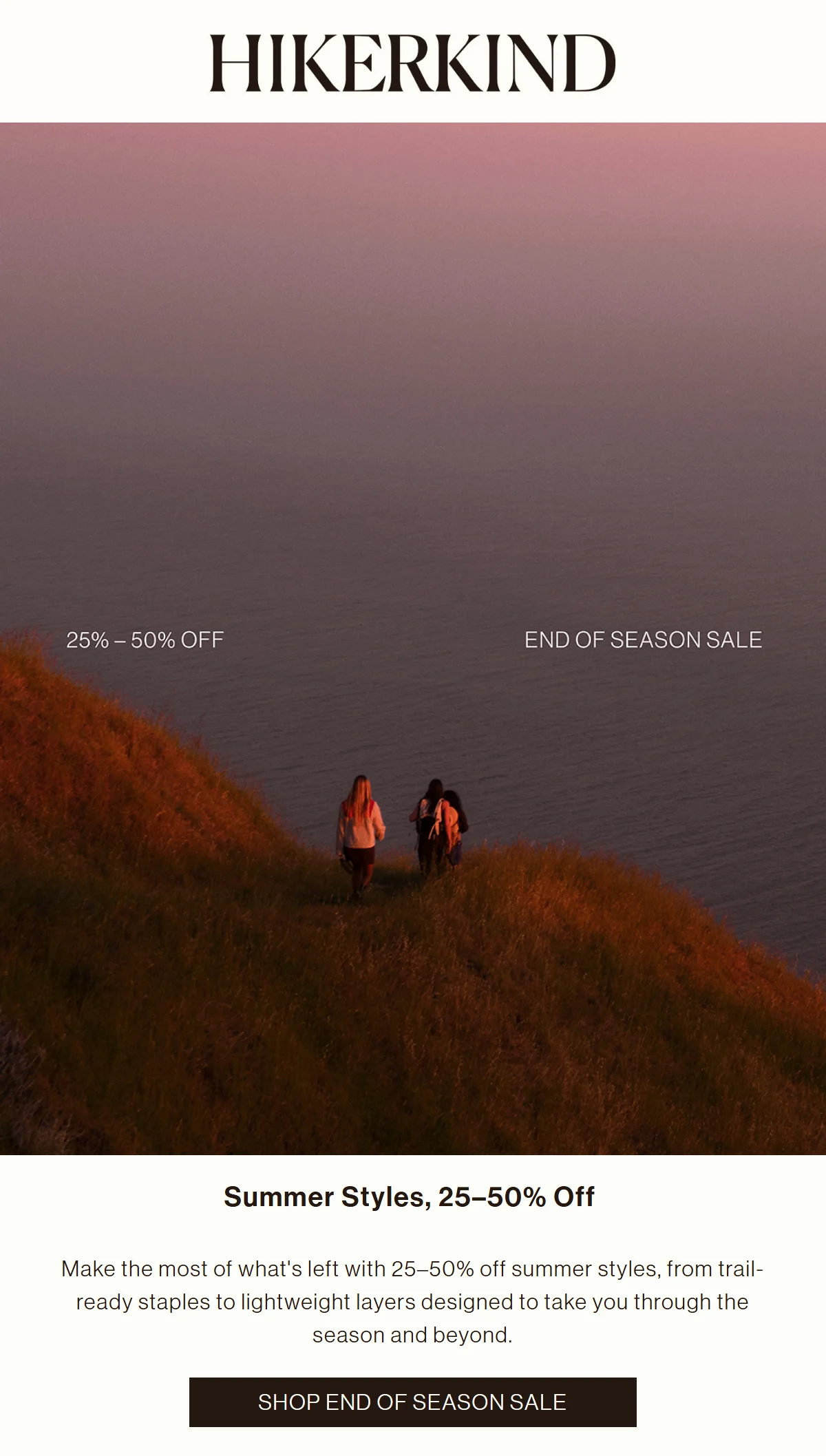
Hikerkind, a women’s hiking apparel brand, uses its end-of-season sale email to sell what’s left of the summer, so the discount reads as a reason to get out once more. The subject line leads with the sale’s length, “This week only,” then the range, “25-50% off summer styles,” and the preheader adds “one last adventure.”
“Make the most of what’s left” reads two ways, as the end of the season and as the end of the stock, so the email moves leftover styles without saying clearance. The subject line’s range also left room to go to 50%, which Hikerkind did two days later with “50% off best-selling summer styles.”
What you can learn from it
Sell the season that’s left and put the sale’s length in the subject line.
3. Jennifer Furniture: Why prices dropped
Subject line: Clearance Day: Everything must go. Seriously.
Preheader: Up to 70% off. Final sale. No returns.
Trigger: Clearance Day sale (campaign)
Sent: May 16, 2026, the launch of its Clearance Day sale
Why this email works
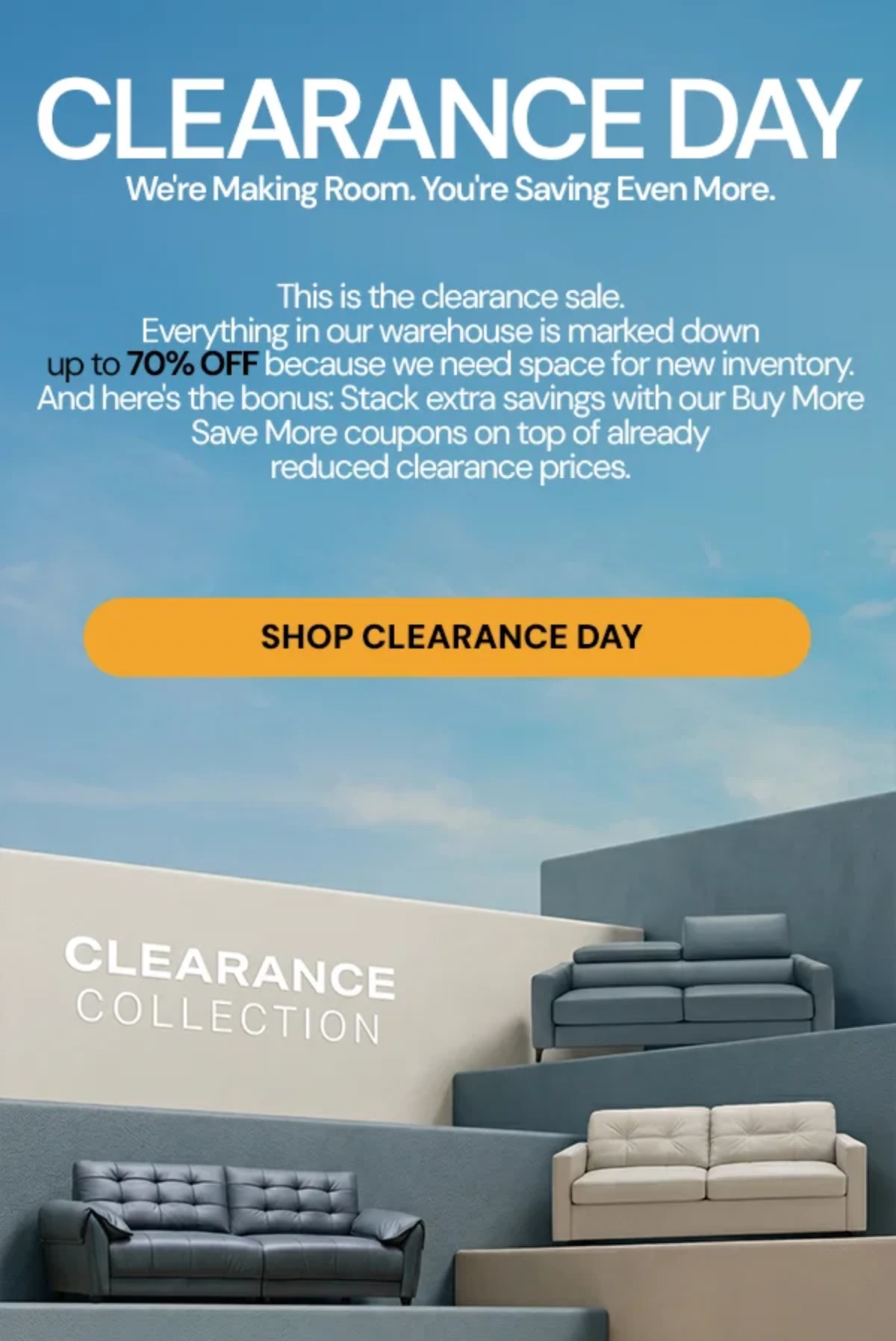
Jennifer Furniture gives its markdown a reason, which makes a deep discount believable. The subject line names the event and promises “Everything must go,” with “Seriously.” as a dry aside, and the preheader adds the terms before anyone opens the email: “Final sale. No returns.”
Up to 70% off a sofa raises the question of what’s wrong with it, and with no returns, per the preheader, the answer has to land before anyone clicks. The email answers in its hero: “because we need space for new inventory.” With no end date, the hurry comes from stock.
What you can learn from it
Explain the markdown in one line, as in “because we need space for new inventory.”
4. Feetures: Retiring colors by name
Subject line: Your seasonal favorites won’t be here forever.
Preheader: Neither will 30% off.
Trigger: End-of-season sale (campaign)
Sent: June 29, 2026, the day after the end-of-season sale opened
Why this email works
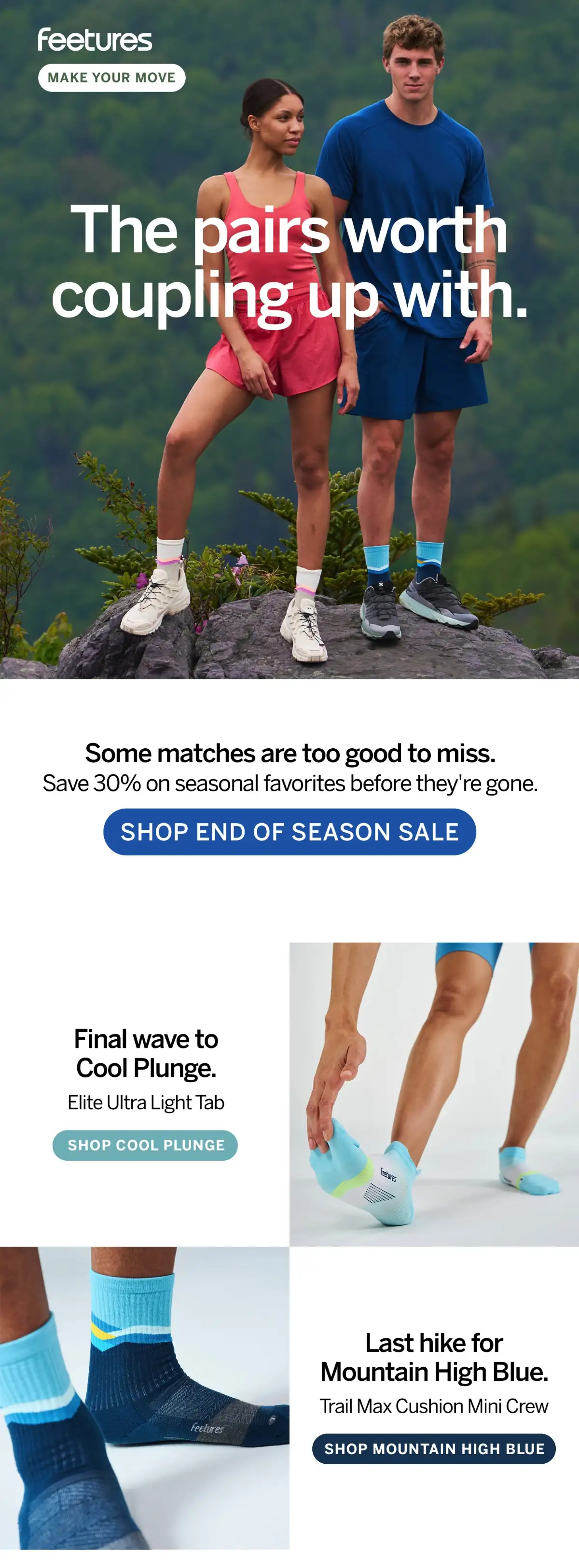
Feetures, a running-sock brand, lets the products that are leaving set the deadline, since the 30% discount is tied to them. Read together, the subject line and preheader make one sentence. The seasonal favorites “won’t be here forever,” it says, and “Neither will 30% off.”
An announcement went out the evening before, so this email skips it and names what is retiring. A Mountain High Blue fan sees that color going, with the Trail Max Cushion Mini Crew under it, and 30% off reads as something they stand to lose. “Final wave” and “Last hike” add a wink to the send-off.
What you can learn from it
Name the variations or products that are leaving, so loyal customers know exactly what to stock up on.
5. Eames Institute: Final-sale terms up front
Subject line: Get 40-70% Off Design Books
Preheader: William Stout Architectural Books is running a rare sale of design monographs online now through the 22nd.
Trigger: Clearance sale announcement (newsletter)
Sent: August 2026, during a sale that ran through August 22

Why this email works
The Eames Institute says where the discounted books come from and that sales are final, so collectors know what they’re buying before they click. The subject line is plain, “Get 40-70% Off Design Books,” and the preheader names the seller, William Stout Architectural Books, and the end date, “now through the 22nd.”
A collector gets spoken to as one here, in “fellow collectors” and “think: Noyes to Neutra,” so the 40% discount reads as a tip between collectors. The extra 30% applies only at five titles or more, so a bigger basket reaches the deepest discount.
What you can learn from it
Put the final-sale terms next to the button, so buyers accept them before they click.
6. Carter’s: Clearance from $3.99
Subject line: CLEARANCE FROM $3.99 🚨❤️
Preheader: (Online only)
Trigger: Clearance update (campaign)
Sent: June 5, 2026, when more markdowns were added
Why this email works
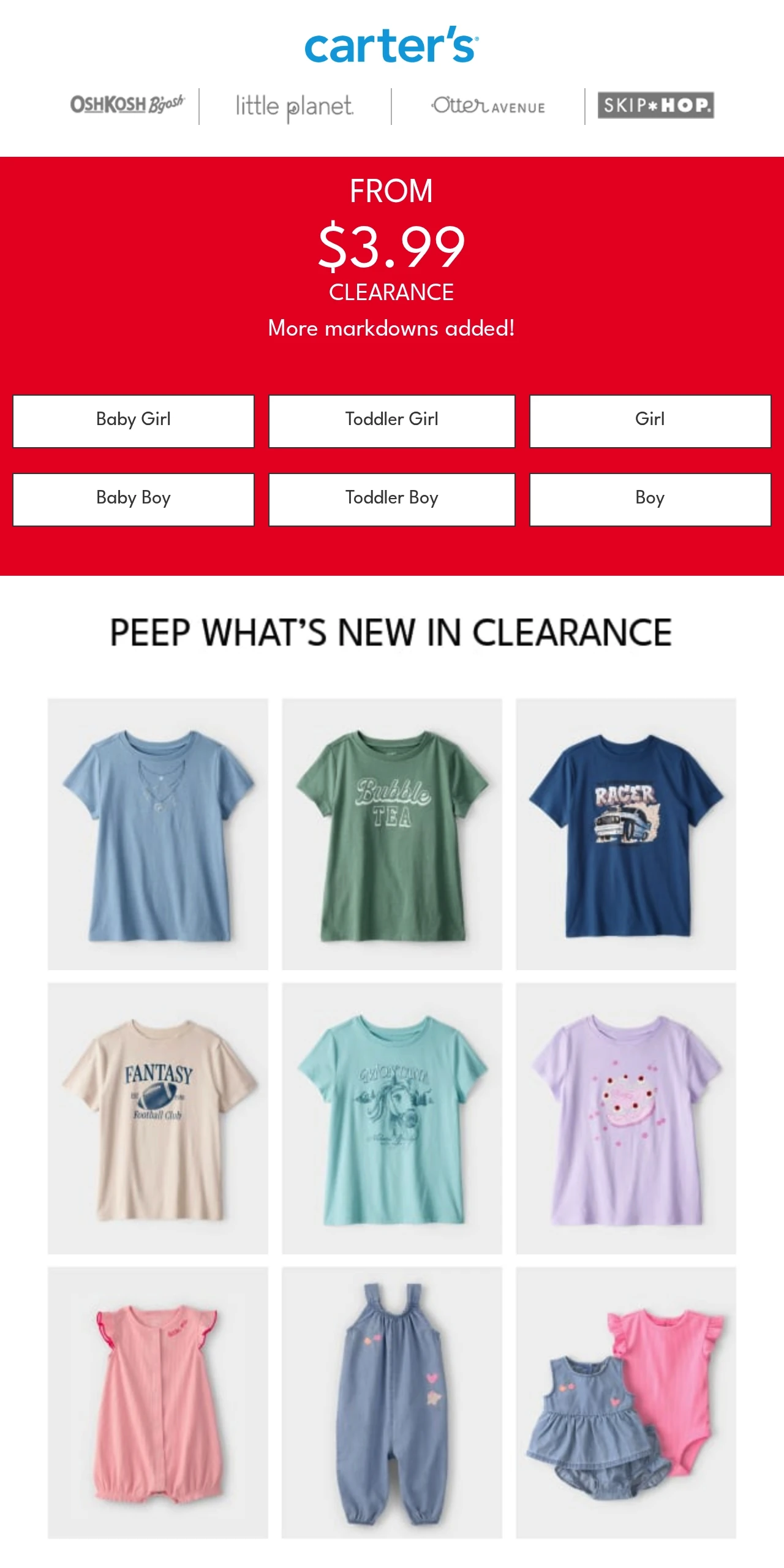
Carter’s leads with its lowest price, which sums up a big kids’ clothing clearance in one number when prices vary from item to item. “CLEARANCE FROM $3.99” is the whole subject line apart from a siren emoji and a heart, and the preheader only says where the deal is: “(Online only).”
“More markdowns added!” under the price gives anyone who opened an earlier clearance email a reason to look again, and the line had work to do, since a $3.99 clearance email went out about weekly in June and July. The nine-item grid below carries no names or prices, so nothing competes with $3.99.
What you can learn from it
Lead a big clearance catalog with its lowest price, and say when new markdowns land.
Try it with Omnisend: Build a clearance email like Carter’s in the email builder, with age-group buttons under the headline and a Product listing block for the clearance items.
7. Phlur: A farewell sale
Subject line: Final Farewell — Up to 50% Off
Preheader: New items added to the sale
Trigger: Farewell sale update (campaign)
Sent: May 2, 2025, when new scents were added to the farewell sale
Why this email works
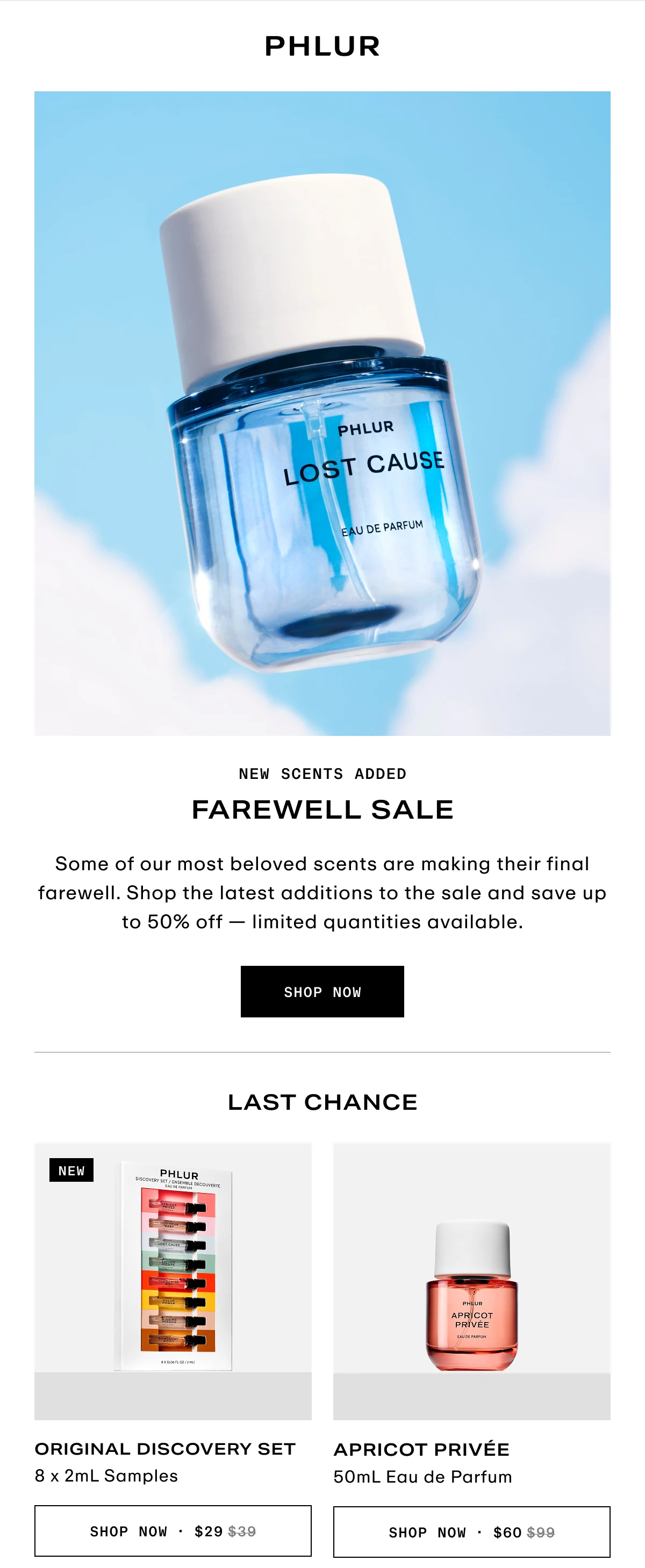
Phlur, a fragrance brand, pairs a goodbye sale with a precise number in the subject line, so subscribers know some scents are leaving and what they’ll save before they open the email.
Note that “Final Farewell” comes first and “Up to 50% Off” second, which makes the discount read as a last chance rather than a routine promotion.
The preheader, “New items added to the sale,” is written for subscribers who already saw the farewell sale and might otherwise skip it. Old prices sit beside the sale prices in the grid so readers can check “up to 50%,” and only the Lost Cause Hand Cream, $10 from $20, hits the full 50%.
What you can learn from it
Pair your farewell message with a clear discount, so customers see the benefit of the final sale at a glance. Use the preheader to entice those who may have known about the sale.
8. Mikasa: A clearance bonus code
Subject line: Summer Sale Bonus: Extra 25% Off Clearance
Preheader: More summer savings are here — extra 25% off clearance with code EXTRA25.
Trigger: Extra markdown on clearance (campaign)
Sent: July 11, 2026, the day after the bonus code launched
Why this email works
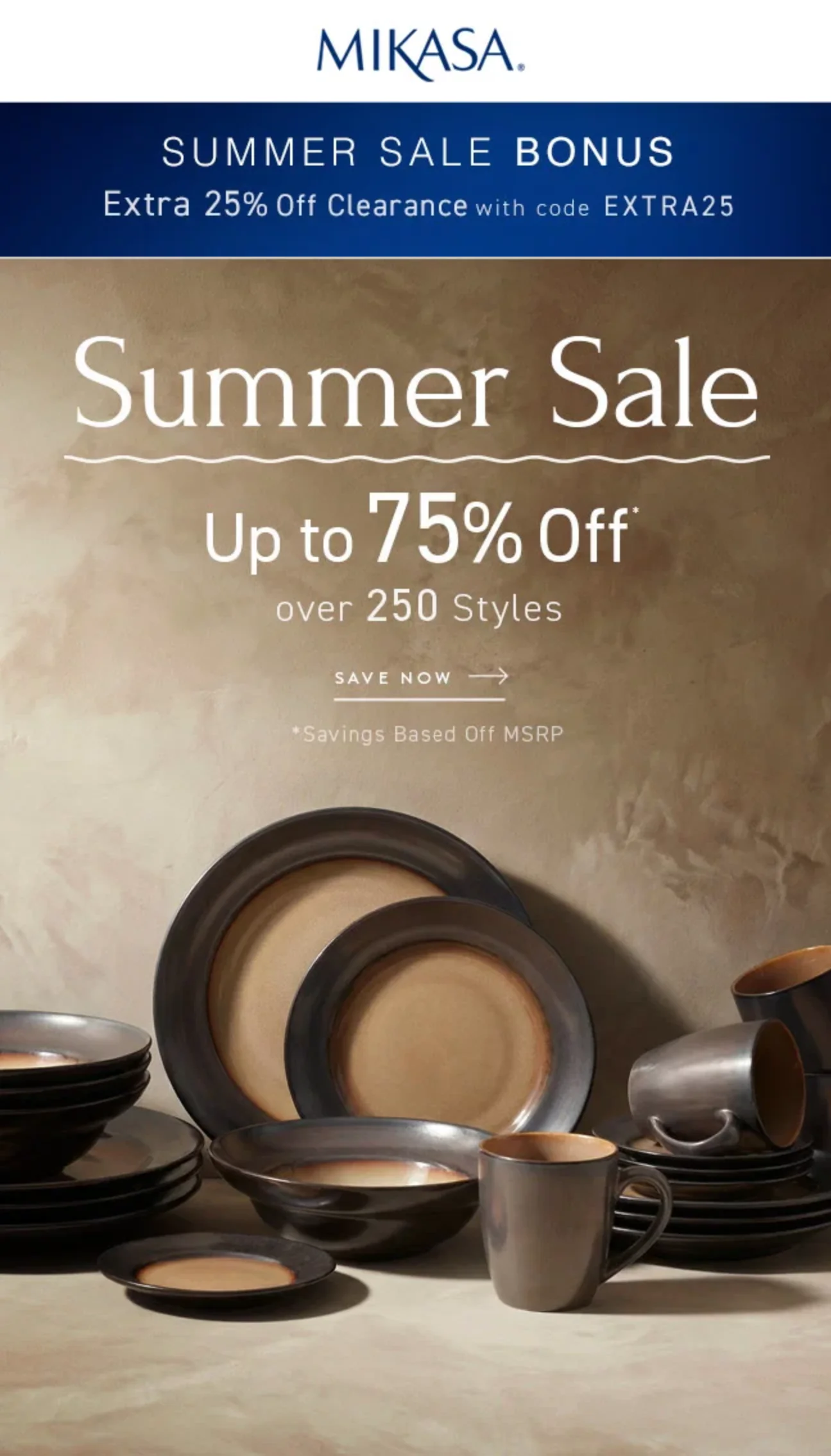
Mikasa, a tableware brand, gives a running sale a fresh reason to open by calling the extra clearance discount a bonus, right in the subject line, “Summer Sale Bonus: Extra 25% Off Clearance.” The preheader names the code, EXTRA25, so subscribers have it before they reach the body.
Two limits on the code are in the email, not at checkout: EXTRA25 ends July 16, and it won’t share an order with another coupon, per the fine print. The blue “SUMMER SALE BONUS” strip ran on all five sends with the code, and anyone who opened one knows the offer from the strip alone.
What you can learn from it
Add an extra code on clearance items partway through a sale, and call it a bonus in the subject line.
9. Mackage: Deeper markdowns
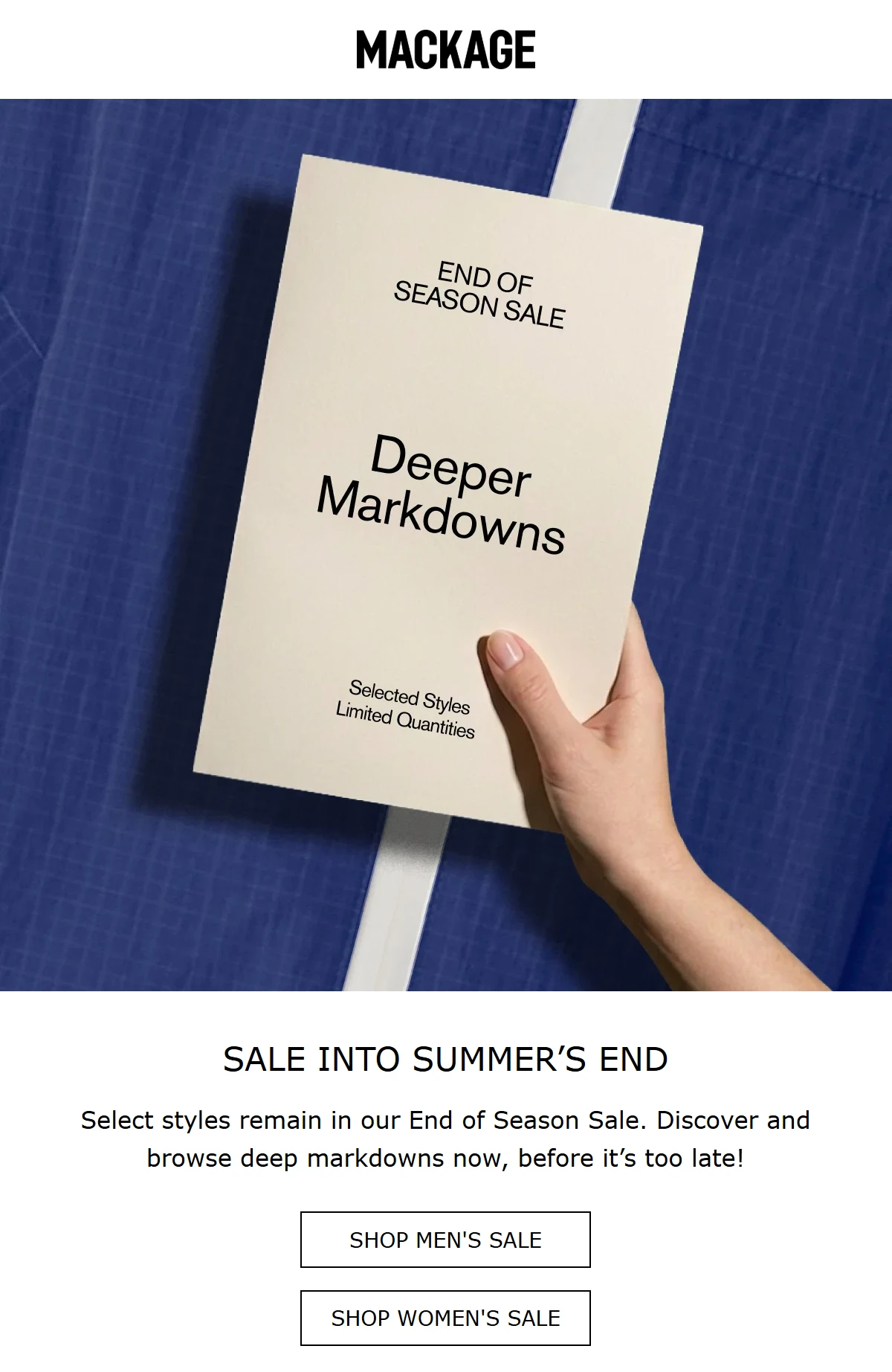
Subject line: Sale Into Summer’s End: Deeper Markdowns, Great Items
Preheader: Rain jackets to technical outerwear: our sale is ongoing.
Trigger: Late end-of-season reminder (campaign)
Sent: August 1, 2026, late in the end-of-season sale
Why this email works
Mackage, a Montreal outerwear brand, keeps a sale that is weeks old worth opening, because the email says prices are lower now.
“Deeper Markdowns” follows “Sale Into Summer’s End” in the subject line. In the preheader, “Rain jackets to technical outerwear” names what’s still on offer, and the line ends by saying the sale is ongoing.
With no percentage or price anywhere in the email, the urgency has to come from the mention of “Summer’s End”. The card warns twice, “Selected Styles” and “Limited Quantities,” and the copy adds “Select styles remain,” so a reader told three times that the range shrank takes “before it’s too late!” at face value.
What you can learn from it
Call the second price cut “deeper,” and say plainly that only selected styles are left.
10. Kendra Scott: A last-day reminder
Subject line: Up to 60% Off Sale Ends Tonight
Preheader: Don’t miss the End of Season Event.
Trigger: Last-day reminder (campaign)
Sent: July 26, 2026, the last day of the End of Season Event

Why this email works
Kendra Scott, a jewelry brand, makes the deadline the news in its last-day email, which is why subscribers opening it see the end of the sale before anything else. “Up to 60% Off” comes first in the subject line and “Sale Ends Tonight” right after it. The preheader names the End of Season Event.
The bar above the hero runs “ENDS TONIGHT” on a loop, so the deadline is in motion while a subscriber is still deciding whether to scroll. The tiers below it keep selling on the final day, since the 60% headline applies only to four or more markdown items, so a late basket still has a reason to grow.
What you can learn from it
Put “ends tonight” at the top of the last-day email, and keep the basket-size tiers so the final day still builds bigger orders.
Try it with Omnisend: Start your last-day email from one of Omnisend’s email templates, then put your deadline above the hero.
What makes a great clearance email?
A great clearance email makes the savings obvious, gives each send one job, and points shoppers to the products on sale. These patterns repeat across the 10 examples above, and our email marketing examples show how they work beyond clearance.
Make the savings obvious
Put the discount where shoppers see it first: name a percentage or a price in the subject line or the hero. Nine of the 10 examples above do that in the subject line or on the first screen, and seven put the number in the subject line itself. Mackage is the one exception, with “Deeper Markdowns” and no number anywhere.
When savings vary across products, say “up to,” as Vacation and Phlur do, and so does Kendra Scott. A big catalog is better led with a starting price, as Carter’s does with “FROM $3.99.” Conditions on the top discount belong in the email too, and Kendra Scott spells out that its 60% applies only to four or more markdown items.
Give every email one main job
Give each send one piece of news, from the launch announcement to the last-chance clearance sale email: what’s included, what’s new, or how much time remains.
Mikasa’s mid-sale email adds an extra 25% off clearance with a code and calls it a bonus, while Kendra Scott’s last-day email leads with “ENDS TONIGHT.” Each email has one piece of news, the code or the deadline. For more ways to frame the offer itself, see our discount email examples.
Keep shopping paths specific
Help shoppers get where they need to go with size, gender, or category buttons and a short product selection. Carter’s six age and gender buttons, Mackage’s men’s and women’s sale buttons, Mikasa’s category tiles, and Kendra Scott’s top six sale picks all shorten the path to the right product.
Focus the email on products included in the clearance promotion. If you feature other deals or full-price items, make their conditions and shopping links distinct. If different customer groups need different products, use email segmentation to send each group its own version.
When should you send clearance emails?
Send clearance emails when a season ends or a big sale wraps up, and you need room for new stock, then follow up as prices drop and the deadline nears. A typical clearance sequence includes three messages: the launch announcement, an update about new markdowns or products, and a last-chance reminder.
Seven of the 10 examples went out between June and August, and the other three in May (Jennifer Furniture in 2026, Phlur in 2025) or late October (Vacation).
Mikasa and Kendra Scott show what a full sequence looks like. Mikasa sent five emails between July 10 and 15 for one code, from “Starts Now” to “Ends Tonight,” and Kendra Scott emailed once a day from July 23 to 25 of a five-day event, then twice on the last day.
Time each send to a stock or price change rather than a fixed interval. A short campaign with distinct messages is usually more useful than repeated sends containing identical offers.
Clearance email subject lines
Good clearance email subject lines name the discount, the deadline, or what’s new in the sale, so adapt the 16 lines below to your offer.
| Approach | Subject line examples |
|---|---|
| Curiosity-led | New markdowns just landed Guess what just moved to clearance A few last-season finds worth a look Your next favorite might be on clearance |
| Urgency-led | Last chance: clearance ends tonight Final hours to shop the clearance sale Ends tomorrow: selected clearance styles Last call for end-of-season savings |
| Benefit-led | Save up to 50% on last-season favorites Extra 20% off clearance starts now Clearance picks from $9.99 Up to 60% off selected end-of-season products |
| Personal and product-led | Your favorite category, now on clearance Find your size before the sale ends We picked a few clearance favorites for you Your wishlist items are now on clearance |
Make sure the subject line accurately reflects the offer inside the clearance sale email. Any discount, price, or deadline you mention should also appear correctly on the landing page.
Use the Omnisend subject line generator to explore additional variations before choosing your final version.
Clearance email templates you can use
Use these three clearance email templates for the three stages of a sale: the launch, an extra markdown, and the last chance. Replace the placeholders with your discount, eligible products, and deadline.
Template 1: Sale launch
When to use it: At the start of the promotion, once the reduced prices and sale page are live.
Template 2: Additional markdown
When to use it: Only when the inventory or prices have changed. Explain how the additional discount applies to items already on clearance.
Template 3: Last chance
When to use it: On the final day of a time-limited promotion, with an accurate deadline and no misleading scarcity claims.
How to create clearance emails with Omnisend
For a scheduled inventory clear-out, go to Campaigns > Create campaign > Create email. In the Campaign audience step, choose All subscribers, or create a segment and select it under Let me choose segments if certain customers are more relevant to the products being cleared.
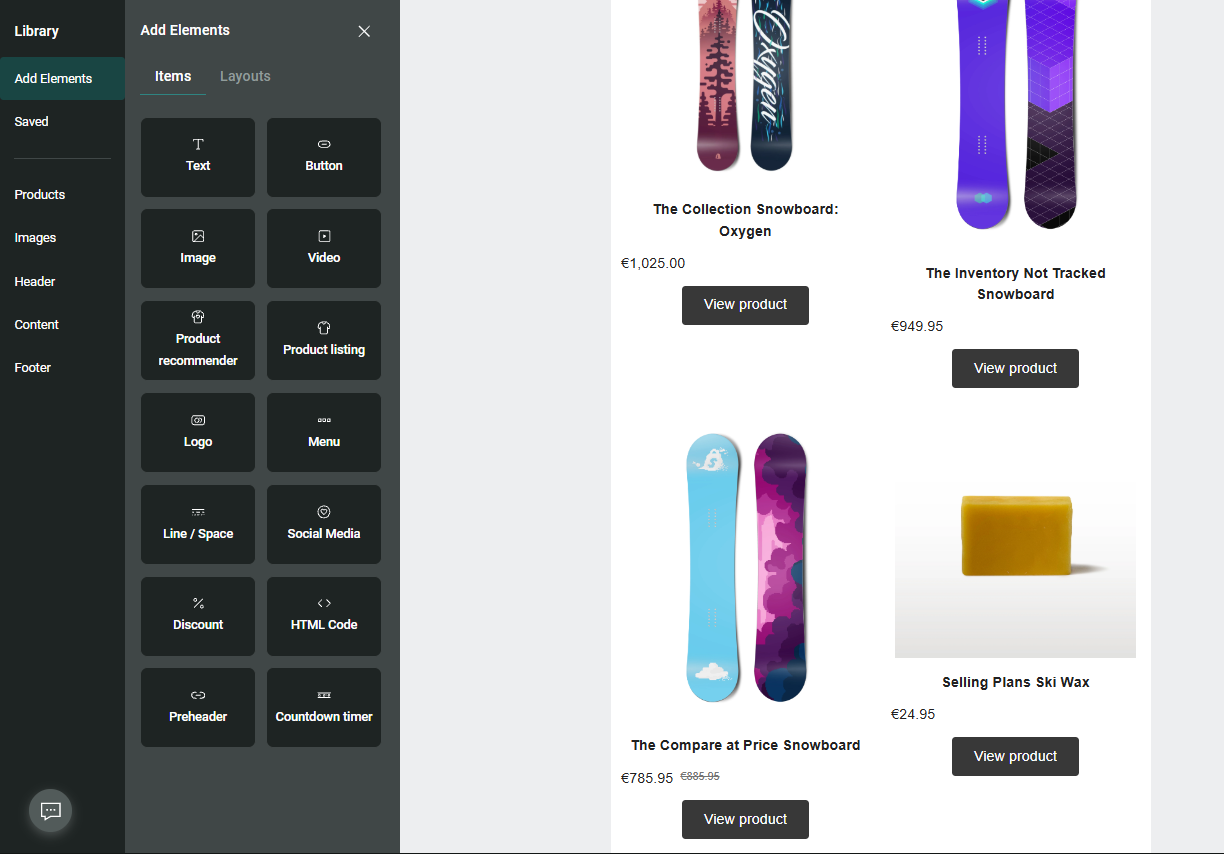
Next, use the email builder in the Edit content step to create the message. Add the discount near the top, include a focused selection of clearance products, and give shoppers one primary CTA. A Product listing block pulls product images, names, prices, and links from your connected store, and its Show old price option displays the markdown.
Plan follow-ups around changes customers need to know about, such as lower prices or the last day to shop. Test the clearance sale email on both desktop and mobile, double-check the terms, and ensure the sale page matches the campaign.
Wrap-up
The most useful clearance emails share a clear offer, relevant products, and a short path to checkout. Choose the tactic that fits your stock from the examples above. Then adapt a clearance email template to your own sale and deadline.